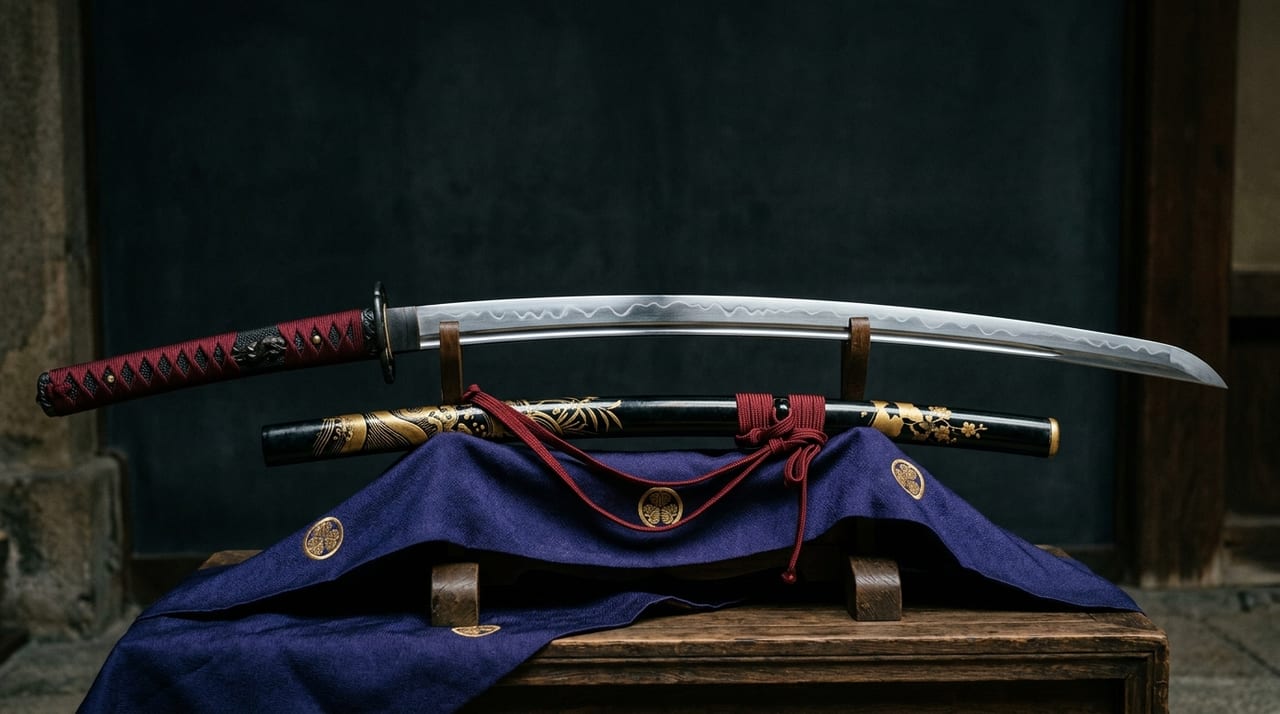
 * Image is for illustrative purposes only.
Monohoshizao
物干し竿
Also known as: Blade of Sasaki Kojiro, Sword of Ganryujima
Description
Overview of the Blade
Monohoshizao (Clothes-drying Pole) is an exceptionally long sword that swordmaster Sasaki Kojiro is said to have used throughout his life, and it is one of the most famous blades in Japanese sword history. Its total length is reported as either "over san-shaku" (approximately 90–100 cm or more) or "san-shaku san-sun" (approximately 1 meter), far exceeding the standard katana blade length of ni-shaku san-sun (approximately 70 cm). According to tradition, the alternative name "Monohoshizao" was derived from its extraordinary length.
Regarding the blade's form, there is a tradition attributing it to "Bizen Osafune Nagamitsu," but historical documentation is scarce, and it is likely a legend formed after the Edo period. Because the blade length was extremely long, drawing it in the normal manner of carrying a sword would have been extremely difficult; Sasaki Kojiro is said to have developed his own unique drawing technique. His distinctive stance—carrying the sword in front of him—and the sword technique known as "Tsubame Gaeshi" (Swallow Counter) are inseparably linked with this long blade in historical accounts.
Sasaki Kojiro and the Chūjō-ryū
There are various theories regarding Sasaki Kojiro's origins, with legends of his birthplace preserved in various regions including Fukui, Iwakuni, Buzen, and Iyo, though reliable historical sources are sparse. As for his martial tradition, the leading theory is that he studied under Toda Seigen and learned the Chūjō-ryū, a sword school established during the Muromachi period that specialized in long swords and employed a paradoxical technical system in which short swords could defeat long ones. Kojiro is said to have uniquely developed this tradition, creating a sword art called "Ganryū," which utilized long blades.
Monohoshizao was not merely a long sword but rather a weapon selected to maximize the techniques of Ganryū—particularly the secret technique called "Tsubame Gaeshi"—to their fullest potential. Tsubame Gaeshi is said to have been a series of continuous slashes modeled after the flight of swallows, a technique that exploited the sword's length to the maximum to confound one's opponent.
The Battle of Ganryu Island (1612)
On April 13, 1612 (Keichō 17), a historic duel between Sasaki Kojiro and Miyamoto Musashi took place on Ganryu Island, a small island in Buzen Province (present-day Shimonoseki, Yamaguchi Prefecture). In this confrontation, Kojiro brought Monohoshizao. Musashi arrived carrying only a wooden sword (said by some to be fashioned from a boat's oar) and reportedly came much later than the agreed-upon time.
There are many competing accounts of the duel's details. According to the prevailing narrative, when Kojiro cast his scabbard into the sea, Musashi is said to have remarked, "Victory is mine." Before Kojiro could execute Tsubame Gaeshi, Musashi's wooden sword struck first, striking down Kojiro, who fell at the spot. After the duel, Monohoshizao was left on Ganryu Island, and its subsequent whereabouts are unknown.
The Martial Significance of Long-Sword Technique
The philosophy of "sword technique using long blades" exemplified by Monohoshizao forms an important lineage in Japanese sword history. A long blade possesses the advantage of controlling the distance (ma'ai) between combatants; however, it is unwieldy in enclosed or confined spaces and requires time to draw. Kojiro refined techniques that transformed this length from a weakness into his greatest weapon.
In later sword traditions, Monohoshizao became remembered as "a symbol of long-sword technique," serving as an important reference point in the study of long-sword lineages and practical sword combat. In particular, the technique of "Tsubame Gaeshi" appears in numerous sword manuals and narratives, and research regarding the actual nature of this technique continues among scholars to this day.
Cultural Influence and Modern Evaluation
The legend of Monohoshizao and Sasaki Kojiro has been depicted in numerous novels, films, manga, and video games, beginning with Yoshikawa Eiji's novel "Miyamoto Musashi" (1935–1939). As a result, the name "Monohoshizao" is today known not only among Japanese sword enthusiasts but widely among the general public. Though Monohoshizao does not appear in the video game Touken Ranbu, the story of Sasaki Kojiro and the legend of Monohoshizao rank among the most widely known sword-master legends.
From the perspective of Japanese sword authentication, since no original Monohoshizao exists, definitive statements about its smith or form are impossible. However, multiple records from the Edo period mention a "san-shaku san-sun long blade," indicating that even at that time it was recognized as a legendary length. In modern Japanese sword research, some scholars point out that the legend of this sword has been significantly embellished under the influence of samurai novels; however, this itself is valued as demonstrating one aspect of the rich narrative quality of Japanese sword culture.
Legends & Stories
The Legend of Tsubame Gaeshi and Monohoshizao
The most important legend surrounding Monohoshizao is the secret technique of "Tsubame Gaeshi" (Swallow Counter). Various interpretations exist regarding the true nature of Tsubame Gaeshi: one theory holds that it was a series of continuous strikes so fast and sharp they could cut down a flying swallow; another claims it was an unconventional strike that changes trajectory after the sword is swung downward. In Eiji Yoshikawa's "Musashi," the Tsubame Gaeshi is depicted as a technique in which "the sword swung downward is reversed mid-swing and then struck down from above," and this image has become the standard modern interpretation.
There is also a theory that the length of Monohoshizao made Tsubame Gaeshi possible. A curved strike arc too difficult to execute with an ordinary sword could, it is argued, be achieved for the first time through the length of Monohoshizao. According to this interpretation, Monohoshizao was not merely a "long sword," but rather a specialized weapon optimized specifically for the technique of Tsubame Gaeshi.
The Shadow of Ganryu Island
Various legends remain in different regions claiming that Monohoshizao was left at the place where Kojiro fell after the duel at Ganryu Island. There is also a theory that after Musashi defeated Kojiro with a wooden sword, his accompanying disciples administered a coup de grâce to Kojiro, though the truth remains unclear. In any case, Monohoshizao vanished from this world after the duel, and no records of it remain afterward.
Ganryu Island (currently a small uninhabited island off Hikoshima in Shimonoseki, Yamaguchi Prefecture) is known today as "Ganryu Island," but its original name was "Funaashima." The island came to be called "Ganryu Island" in reference to Sasaki Kojiro's sword school, "Ganryu" (Iwaryuu). Thus a historical paradox emerged: the island's name came to bear the name of Sasaki Kojiro, and despite being the defeated party, Kojiro's presence is inscribed in the place itself.