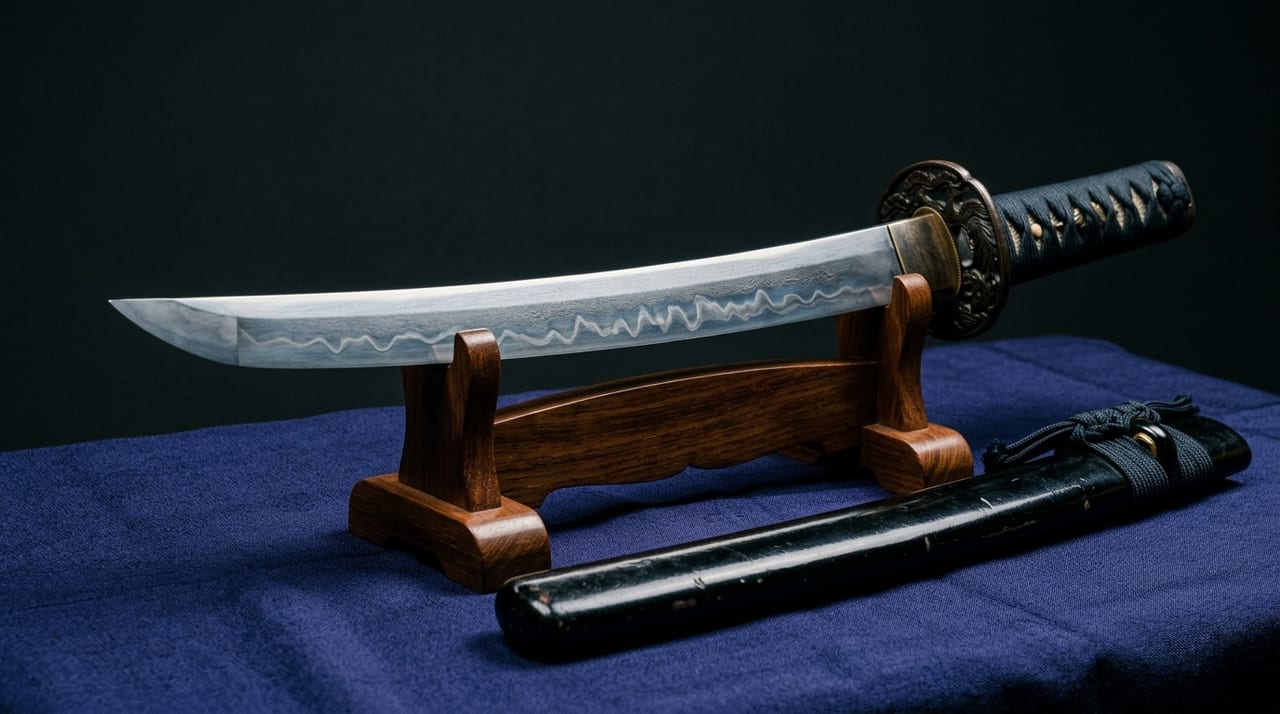
 * Image is for illustrative purposes only.
Midare Tōshirō
乱藤四郎
Also known as: Wild Tōshirō
Description
Overview of the Sword
Midare Tōshirō is a tantō forged by Awataguchi Yoshimitsu, a master craftsman of the mid-Kamakura period. As its name "Midare" (undulating) suggests, it stands out as an exceptional work among Yoshimitsu's tantō for bearing a midare-hamon (undulating temper pattern) — an unusual choice for this smith. While Yoshimitsu's tantō generally feature calm, straight temper lines (suguha) or suguha-like patterns, Midare Tōshirō is covered throughout with an undulating temper pattern, demonstrating the diversity and technical breadth of Yoshimitsu's mastery. Measuring 9 shaku 2 sun (approximately 27.9 cm), this tantō-sized blade represents a unique creation in which the bold dynamism of the midare-hamon coexists with Yoshimitsu's characteristic fine and precise steel. It is currently in private hands and has been designated an Important Blade (Jūyō Tōken) by the Japanese Sword and Curio Preservation Society.
Midare-Hamon in Yoshimitsu — An Exceptional Masterpiece
The appearance of a midare-hamon in Yoshimitsu's tantō is extremely rare, and among his surviving tantō, Midare Tōshirō is particularly noted as an anomalous work. Where Yoshimitsu's typical suguha displays a "beauty of stillness," the midare-hamon of Midare Tōshirō embodies a "beauty of motion." The midare-hamon is characterized by a temper pattern that deviates sharply from regular straight lines, displaying an irregular, wave-like undulating form. Its creation requires special skill in temperature control and clay application during the hardening process. While it remains unclear why Yoshimitsu chose midare-hamon for this blade, the fact that the same craftsman could produce works of the highest quality in both suguha and midare-hamon serves as testament to Yoshimitsu's technical versatility.
Characteristics of the Steel
The steel of Midare Tōshirō exhibits the typical small itame-hada (wood-grain pattern) characteristic of Yoshimitsu, with fine ji-nie (steel particles) throughout, resulting in a lustrous iron color. Despite the vigorous movement of the midare-hamon, the serene beauty of Yoshimitsu's characteristic clear and pure steel is not lost; rather, the pristine steel background accentuates the midare-hamon, creating an overall harmonious composition. The point (kissaki) is undulating with a deep return, demonstrating bold execution with the temper pattern extending fully to the tip. The tang is unpolished (aibuki), bearing the signature "Yoshimitsu," confirming its authenticity.
Provenance — From Hosokawa Katsumoto to the Kutsugi and Abe Families
The provenance of Midare Tōshirō is said to have begun with its ownership by Hosokawa Katsumoto, administrator (kanrei) of the Ashikaga shogunate. Subsequently, it passed through the Ashikaga shoguns, and it is recorded that Kutsugi Mototsuna was granted it in 1569 (Eiroku 12) in recognition of his service during the Honkō-ji Incident. It later passed through the hands of Toyotomi Hideyoshi before being transmitted to the Abe family, daimyo of Fukuyama Domain in Bingo Province. In modern times, it left the family collection and is now in private hands. This lineage, passing from warrior to warrior through the ages, speaks to how Yoshimitsu's tantō were treasured by those who held power across the centuries.
The Technology of Midare-Hamon — Yoshimitsu's "Other Face"
Yoshimitsu's tantō are generally dominated by suguha (straight temper lines), which have been considered his principal characteristic. The fact that Midare Tōshirō displays a pronounced midare-hamon represents precious evidence of Yoshimitsu's technical breadth. Forging a midare-hamon requires considerably greater technical skill than creating a suguha. In Yoshimitsu's Midare Tōshirō, the midare-hamon displays gumomé patterns arranged in succession, yet the height of each valley and peak varies subtly, avoiding monotony and exhibiting what might be called a "calculated undulation" — a highly refined compositional beauty. The edge is rich in nie (fine sparkle), with kinsuji (golden lines) and sunagarashi (sand-flow patterns) appearing throughout. The steel exhibits Yoshimitsu's characteristic fine small itame-hada, displaying a quiet dignity in contrast to the bold midare-hamon. Within the modest span of 9 shaku 2 sun, it is evaluated as a masterwork crystallizing Yoshimitsu's technical achievement.
The Kyōhō Meibuts-chō and Midare Tōshirō
Its inclusion in the Kyōhō Meibuts-chō (Register of Famous Blades), compiled between 1716 and 1736, formally established Midare Tōshirō's status as a named treasure (meibuts). The register grants Midare Tōshirō high evaluation as a Yoshimitsu tantō under that name, positioning it as a blade of distinctive character among Yoshimitsu's works — one bearing a midare-hamon. As a reflection of Yoshimitsu's "other face" — distinct from his reputation for suguha — Midare Tōshirō continues to command special interest in the history of the sword.
Legends & Stories
Yoshimitsu's "Wildness"—The Story Told by the Midare Blade
Yoshimitsu's tantō are known for the serene beauty of their straight blades, but the Midare Tōshirō's midare blade reveals another facet of Yoshimitsu—wild power and intensity. In Japanese sword blade patterns, "midare" is not merely decorative variation but is sometimes understood as an expression of something from within the swordsmith's inner world manifesting outwardly. If Yoshimitsu chose a midare blade for the Midare Tōshirō, there may have been some special intention or desire behind it. Or perhaps the patron who commissioned this blade specifically requested a midare blade. In any case, the very fact of "a midare blade by Yoshimitsu" stands as the defining characteristic that distinguishes this sword from all other Tōshirō tantō.
The Significance of the Sanjōnishi Family Provenance
The fact that this blade came to the Sanjōnishi family, a prominent aristocratic house, poses intriguing questions in Japanese cultural history. What does it mean for a sword—a weapon—to be transmitted through an aristocratic household? In the era of Sanjō Nishisanetaka (late Muromachi period), swords were not only warriors' weapons but had penetrated deeply into aristocratic society as artworks, gifts, and treasures. His diary, the Sanetaka Kōki, contains numerous references to swords, suggesting he possessed deep understanding of their artistic value. The Midare Tōshirō was owned by Hosokawa Katsumoto, the Shogunal Deputy of the Muromachi Bakufu, and was called "Hosokawa's Midare Tōshirō." It later passed through the hands of the Ashikaga Shogunal house, was given to Kusoki Mototsuna in the 12th year of Eiroku (1569), and is recorded to have subsequently been transmitted to the Abe clan (the domain of Oshi, later Fukuyama).
The Aesthetics of Midare—Dialogue with Straight Blades
In Japanese sword blade patterns, straight blades and midare blades are not in opposition but rather complementary aesthetic concepts. While straight blades express "refinement, correctness, and reason," midare blades represent "vitality, passion, and natural force." The existence of the Midare Tōshirō, a midare blade, among Yoshimitsu's group of tantō gives depth to this great swordsmith's artistic world. When one views the Midare Tōshirō and then sees the straight blades of the other Tōshirō tantō, the quietness of those straight blades is felt all the more deeply—conversely, after coming to know the world of straight blades, when one confronts the Midare Tōshirō's midare blade, its intensity stands out. By illuminating each other, each beauty is enhanced—this is why Yoshimitsu's group of tantō is said to form a unified world.
As a National Treasure Today
The Midare Tōshirō is designated as an Important Sword by the Society for the Preservation of Japanese Art Swords and has been transmitted as a private collection since the Showa period. It is a celebrated blade known for its rare and distinctive midare-blade style by Yoshimitsu. In Touken Ranbu, it appears as "Midare Tōshirō," and its passionate character design has won many fans.
The Aesthetics Named Midare—Philosophy of Japanese Sword Art
In Japanese sword blade patterns, "midare" possesses deep aesthetic and spiritual significance that transcends mere formal variation. In Japanese traditional aesthetics, "midare" does not signify incompleteness or disorder. Rather, it has been highly valued as an organic transformation within harmony—a dynamic beauty imbued with natural force. The midare in a sword's blade pattern is also the "beauty of crystallized natural force" born at the point where chance and necessity intersect as the swordsmith contends with the material. There must have been some necessity behind Yoshimitsu, a master of straight blades, deliberately choosing to create a notably midare blade. Some suggest it was made for a specific purpose (escort duty, ceremony, etc.) requiring a magnificent appearance, or alternatively that Yoshimitsu deliberately undertook the challenge of a midare blade to demonstrate his technical versatility. In any case, the Midare Tōshirō's midare blade demonstrates the breadth of Yoshimitsu's artistic range and is positioned as a masterpiece that embodies "the beauty of midare" in Japanese swords at the highest level.
Touken Ranbu and Midare Tōshirō in Modern Times
In the sword-cultivation game "Touken Ranbu," the "Midare Tōshirō" is depicted as an exceptionally distinctive character and holds a unique presence among the group of Yoshimitsu-made tantō (the Tōshirō brothers). Based on its characteristic midare blade, it is given a character defined as "strongly individual and following its own path," and it enjoys high popularity among fans. The game's success has greatly increased the Midare Tōshirō's fame, and through Touken Ranbu as an entry point, the number of young fans becoming interested in the Tōshirō tantō, beginning with the Midare Tōshirō, has grown. This has been noted as a typical example of a chemical reaction between traditional cultural heritage and contemporary entertainment. The phenomenon of historic famous swords gaining new "life" through modern pop culture proves the universal appeal of Japanese sword culture and the spiritual power of swords that transcends time in drawing people to it. The Midare Tōshirō—Yoshimitsu's midare blade—continues to possess the charm to "disturb" people's hearts across seven centuries of time.
The Kyoto National Museum and the Preservation of Famous Swords
Since its opening in the 30th year of Meiji (1897), the Kyoto National Museum has functioned as a central institution for the protection of Japanese cultural properties. The museum houses many National Treasure and Important Cultural Property Japanese swords, and their preservation and study are conducted continuously by specialized researchers. These famous swords are subjected to scientific analysis, and details such as iron composition, the condition of the blade pattern, and the progression of rust are sometimes recorded with precision. Through advances in modern conservation science, the details of Yoshimitsu's blade-forging technique from seven hundred years ago are becoming increasingly clear. From the analysis of the composition of the base steel, it is now possible to infer even the sources of iron sand used by the swordsmith and their refinement methods. The fusion of such scientific approaches and traditional connoisseurship is the face of contemporary Japanese sword research.