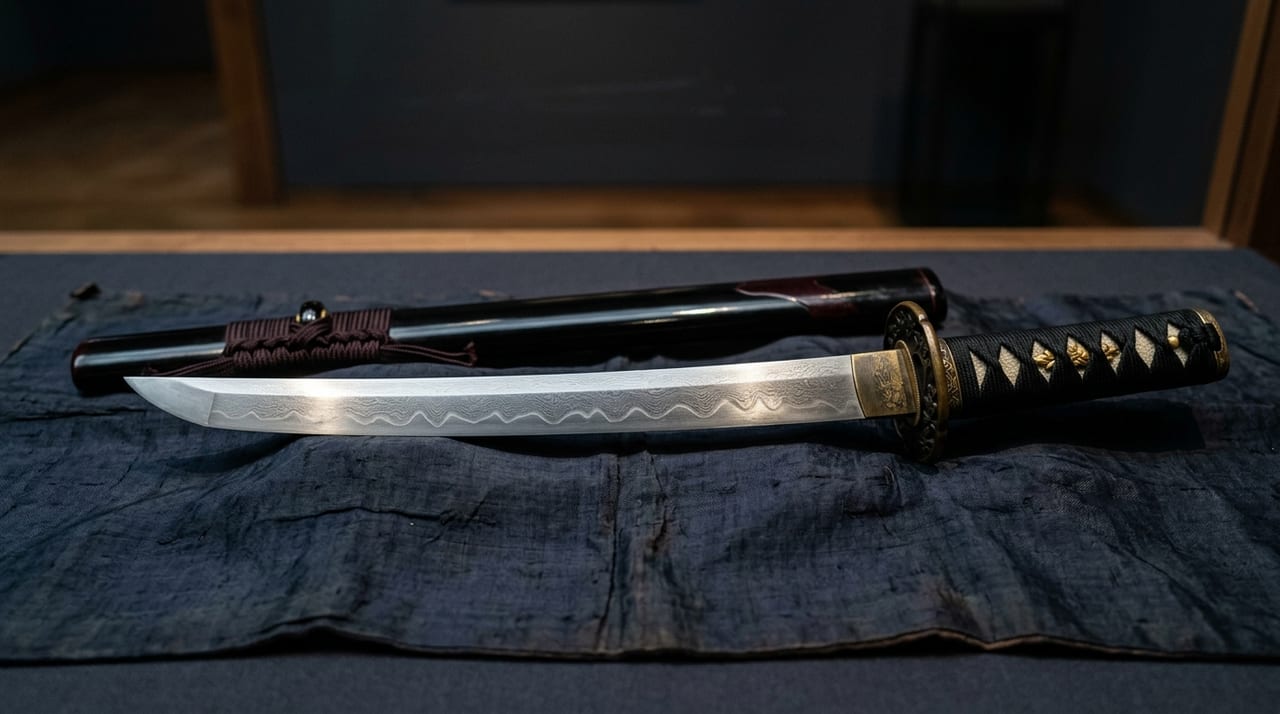
 * Image is for illustrative purposes only.
Maeda Tōshirō
前田藤四郎
Also known as: Maeda Blade; Sword of the Kaga Million-Koku Domain
Description
Overview of the Blade
Maeda Tōshirō is a tantō attributed as a masterwork of Awataguchi Yoshimitsu, named after being possessed by Maeda Toshimasa, second son of Maeda Toshiie—the great daimyō ranked second only to the Tokugawa shogunate—and later became a celebrated blade passed down through the Kaga Maeda clan. With a blade length of slightly over nine sun (approximately 27.3 cm), it features hirazukuri construction. The hamon exhibits Yoshimitsu's characteristic quiet, delicate wavering that approaches a straight edge, and the jigane displays densely packed ko-itame hada with uniformly gleaming ji-nie, presenting a highly finished appearance. As daimyō under the Tokugawa shogunate, the Maeda clan boasted the largest outer-domain territory of one million koku, and from their abundant cultural resources, they deeply cultivated tea ceremony, Noh theater, poetry, and other arts and culture. Maeda Tōshirō was treasured as a family heirloom of this culture-patronizing daimyō, passed down through generations as a work embodying the highest standard of sword craftsmanship. The fact that Yoshimitsu's tantō are widely distributed as treasured heirlooms among powerful daimyō throughout the country demonstrates that Yoshimitsu was not merely a regional master smith, but a craftsman who enjoyed the highest national reputation throughout the medieval and early modern periods. As a treasured heirloom of the largest outer-domain daimyō, Maeda Tōshirō holds a particularly special political and cultural significance among the Tōshirō series of blades.
The Kaga Maeda Clan and Cultural Flourishing
The Maeda clan's founder, Maeda Toshiie (1538–1599), rose to prominence as a retainer of Oda Nobunaga in Owari Province. After Nobunaga's death, he served Toyotomi Hideyoshi and ruled the three provinces of Kaga (present-day Ishikawa Prefecture), Noto, and Etchū as one million koku territory. Through Toshiie's successors Toshinaga and Toshitsune, the Maeda clan continued as outer-domain daimyō under Tokugawa authority throughout the Edo period while maintaining their domain's prestige through extensive cultural patronage. So zealous was the Maeda clan in sword collecting that "Kaga is a treasure house of blades," and the domain established the okoshimono-kata (swords-management office), enabling systematic maintenance, recording, and preservation of celebrated blades. Maeda Tōshirō stands at the core of the Maeda clan's sword collection, serving as the exemplary Yoshimitsu tantō and a symbolic representative of Kaga culture. Kaga domain also developed distinctive craft traditions including Kutani ware, Kaga yuzen dyeing, and Kanazawa gold leaf. The fact that they treasured the greatest tantō by the greatest blade smith is among the clearest evidence of this craft powerhouse's refined aesthetic judgment.
The Collecting of Yoshimitsu's Tantō—The Intersection of Tea Culture and Blade Beauty
As part of Kaga domain's cultural promotion, the Maeda clan deeply encouraged the tea ceremony, and the daimyō themselves collected celebrated tea implements. That Yoshimitsu tantō, prized as celebrated tea ceremony implements, entered the Maeda collection exemplifies the affinity between blades and tea at its most typical. Maeda Toshitsune (third daimyō) was such an accomplished tea master that he studied tea under Sen no Sōtan, grandson-disciple of Sen no Rikyū, and his cultural refinement stood out among the domains. The Maeda collection is believed to have expanded significantly during Toshitsune's tenure, making it likely that Maeda Tōshirō was designated as a celebrated treasure of the clan during this period. Toshitsune was a wise ruler who, as "Kaga's retired daimyō," performed deference to the shogunate while focusing on domestic administration, and the collecting of celebrated objects formed an important pillar of his cultural policy. That the supreme "beauty of quietude" embodied by Yoshimitsu's tantō came into the hands of Toshitsune, the "quiet statesman," was a fortunate convergence of the era's demands and one man's aesthetic sensibility.
The Blade of One Million Koku—The Celebrated Sword as a Symbol of Authority
The fact that the Maeda clan, as outer-domain daimyō constantly watched by the Tokugawa shogunate, collected and preserved celebrated blades as a strategy to enhance cultural authority rather than military power illuminates an important aspect of Japanese sword-collecting history. For the samurai, the possession of celebrated blades was both proof of military power and proof of cultural status. Making Yoshimitsu's supreme masterpiece Maeda Tōshirō a family treasure was a means for the Maeda clan to assert legitimacy not only as a "house of martial prowess" but as a "house of culture." As a symbol of cultural authority backed by the economic power of one million koku, Maeda Tōshirō is still carefully preserved today by a foundation affiliated with the Maeda clan. Within the Edo-period cultural environment that advanced society's understanding beyond "blades are weapons" to "blades are symbols of authority" and "blades are works of art," Maeda Tōshirō stands as a rare embodiment of the political wisdom and cultural refinement of the greatest outer-domain daimyō, all concentrated in a single blade.
The System of the Maeda Clan's Sword Collection
The Maeda clan, ahead of other daimyō families, established a specialized position called okoshimono-kata (swords-management officer) within the domain, creating a systematic structure for cataloging, storing, maintaining, and record-keeping of celebrated blades. This systematic approach to sword management indicates that the Maeda clan's sword collection transcended personal collecting and was treated as a cultural asset of the domain itself. Maeda Tōshirō was similarly managed systematically under this structure and passed down through successive daimyō. Even after the Meiji Restoration, the Maeda clan established a foundation to maintain the collection, and as the Maeda Ikutokukai, it continues today to preserve, research, and publicly exhibit cultural properties. The transmission of the Maeda clan's cultural-property protection tradition through the modern transformation from domain to foundation demonstrates that the "blade of one million koku" functions in the present not as a mere relic of the past, but as a living cultural property.
Transmission to the Present—Preservation by Maeda Ikutokukai
Maeda Tōshirō is currently held by the Maeda Ikutokukai foundation (Tokyo), which manages the Maeda clan's cultural properties, and is designated an Important Cultural Property. The Maeda Ikutokukai is a specialist institution for cultural-property preservation and research, holding numerous National Treasures and Important Cultural Properties descended from the Maeda clan, with Maeda Tōshirō at the core of its sword collection. Through periodic public exhibitions and scholarly research opportunities, this blade continues to transmit the essence of Yoshimitsu's tantō to the present, perpetuating its inheritance to future generations as one of the most brilliant crystallizations of the cultural legacy of Kaga's one million koku.
Legends & Stories
The Maeda clan's survival as the most powerful outer domain in Tokugawa Japan required a kind of strategic genius that is easy to overlook. They had a million koku. They had a large army. They had a name associated with Toyotomi Hideyoshi. Any one of these things, badly handled, could have brought the Tokugawa down on them. Instead, the Maeda chose a different path: they became the most conspicuously cultural daimyō in Japan. They patronized Noh, tea, ceramics, calligraphy, poetry. They made Kanazawa a city of arts. And they collected swords — not as weapons but as objects, as beauty, as the highest expression of Japanese craft. Maeda Tōshirō, the Yoshimitsu tantō that stands at the center of their collection, is a perfect emblem of this strategy: it is a sword that carries no blood, remembers no battle, threatens no one. It simply is. And in being what it is — the quietest, most refined, most inwardly deep of all the sword types made by the greatest of the Kyoto masters — it says everything about what the Maeda chose to become.