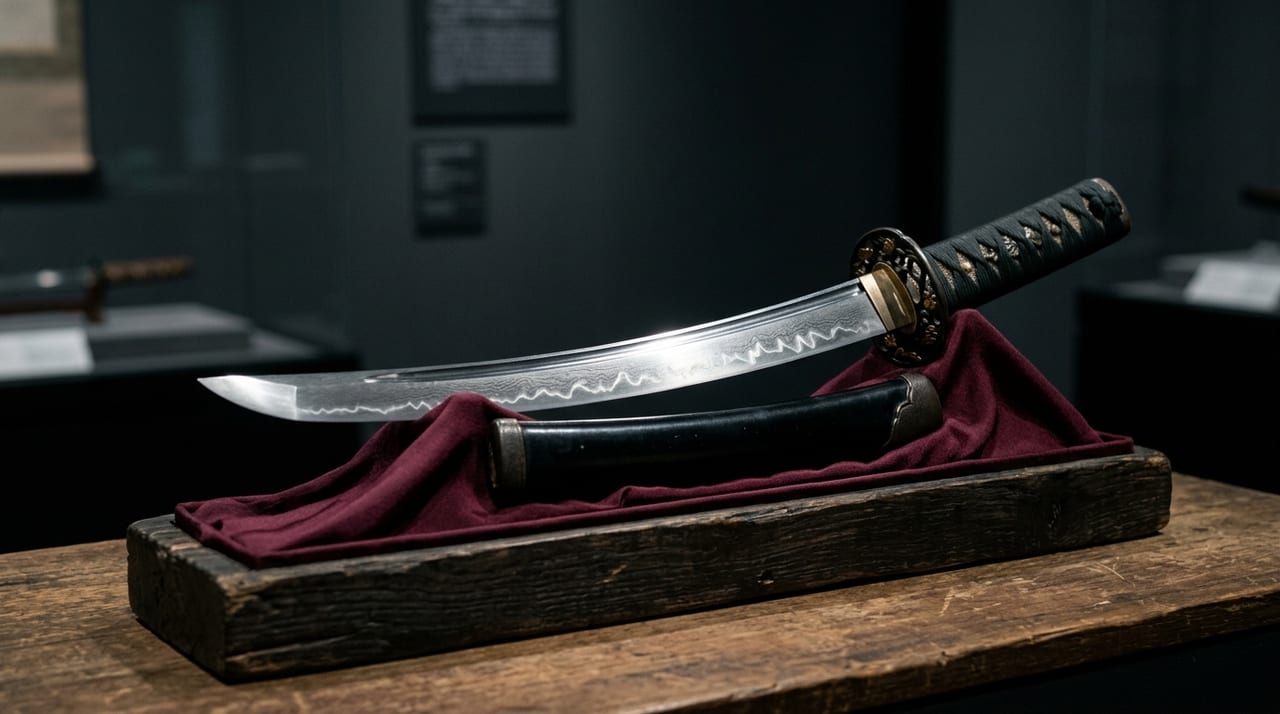
 * Image is for illustrative purposes only.
Jō Izumi no Kami Masamune
城和泉守正宗
Also known as: A Masterpiece Among Jō Izumi no Kami Masamune, Jō Masamune, and Sōshū Masamune Works
Description
Jō Izumi no Kami Masamune is a blade renowned for its transmission to the Jō clan among swords forged by Masamune, a master smith of Sōshū Kamakura, and celebrated as a masterwork embodying the essence of the Sōshū tradition, it has earned its place in sword history. Masamune was a swordsmith active in Kamakura, Sagami Province during the late Kamakura period, whose works are distinguished by robust jigane and deep hamon that possess outstanding beauty unmatched by his contemporaries. The Jō clan was a prominent samurai family of the medieval period, known as a warrior house bearing the court rank of Izumi no Kami, and this blade is said to have been a treasured family heirloom preserved by the clan's lord. The designation "Jō Izumi no Kami Masamune" became established as a celebrated sword name, derived from this provenance and combining the Jō clan name with Masamune's signature. The blade displays a dignified sugata with graceful sori and bears no signature due to extensive polishing. The jigane exhibits Masamune's characteristic large itamehada pattern with heavy nie accumulation, while the hamon reveals a fierce yet solemn composition of gunome-midare interspersed with undulating temper lines. Kinsuji and sunagashi streak through the blade, manifesting the refined essence of the Sōshū tradition that established Masamune's renown throughout the realm. The nakago exhibits characteristics common to Masamune's signed works and has been recognized as authentic by connoisseurs. Currently housed in the Tokyo National Museum, it is regarded as one of the standard exemplars of Masamune's work with high scholarly valuation. Designated a National Treasure, this blade possesses indispensable scholarly value for Sōshū-tradition sword research.
Legends & Stories
According to legend surrounding Jō Izumi no Kami Masamune, when the lord of the Jō clan wielded this tachi into battle, it clashed fiercely with the blade of an enemy commander yet suffered not a single nick, and is said to have shattered the opponent's sword. This anecdote has been transmitted as emblematic of Masamune's distinctive edge-iron toughness and razor-sharp cutting ability. Following the extinction of the Jō clan line, this blade continued to be passed as a prized treasure among samurai houses, eventually transferred to a daimyo family in the early modern period, and subsequently placed in a museum under state protection after the Meiji Restoration. Extant tachi by Masamune are extremely rare, and this blade—as an authenticated example bearing a signature or equivalent proof—holds exceptional importance in sword scholarship. By bearing the Jō clan name, this blade transcends mere artwork and serves as a historical testament to the spirit and ethos of medieval samurai society.