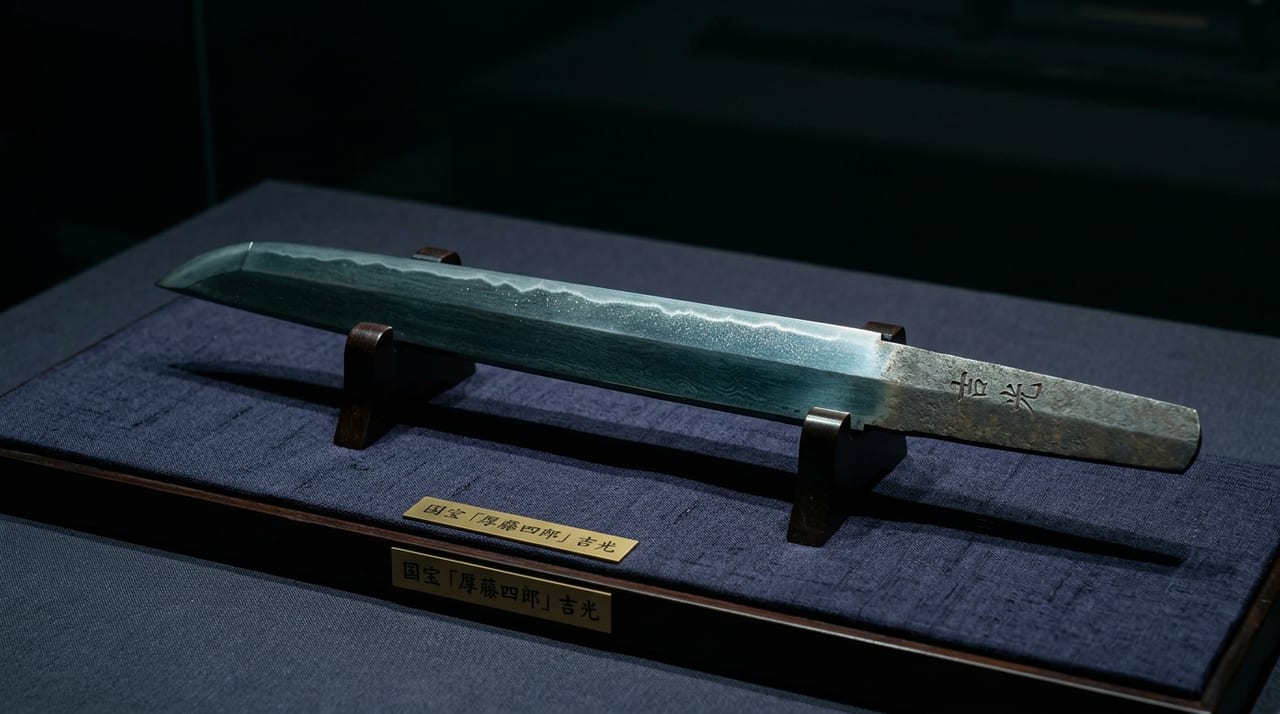
 * Image is for illustrative purposes only.
Tachi signed Mitsutada (Jikkyū Mitsutada)
太刀 銘 光忠(実休光忠)
Also known as: Jikkyū Mitsutada, the sword Oda Nobunaga wore at his death
Description
Overview
The Jikkyū Mitsutada is a tachi traditionally attributed to Mitsutada, founder of the Bizen Osafune school. Its name derives from Miyoshi Jikkyū, a Sengoku warlord who was one of its owners. At the Honnōji Incident on the 2nd day of the 6th month of Tenshō 10 (1582), Oda Nobunaga, who was still wearing the sword, was engulfed by fire. The blade is said to have been found among the ashes and, by order of Toyotomi Hideyoshi, to have been re-tempered and passed down to later generations. It was also recorded as a famous sword in the Kyōhō Meibutsuchō together with its provenance, but its whereabouts are now unknown.
Style
Osafune Mitsutada was a master smith regarded as the de facto founder of the Osafune school, and he was known for bold and splendid hamon in the ō-chōji midare style. Several of his works survive as famous swords under names such as "Shokudaigiri Mitsutada," and this work is counted among them. According to the Kyōhō Meibutsuchō, the blade of this work bears 18 sword wounds, apparently from use in battle. This suggests that it was not merely a famous sword displayed in a tokonoma, but a blade heavily used in actual combat.
Provenance
This work was originally held by Mikumo Sadamochi, a retainer of the Rokkaku clan of Ōmi Province. It later passed to Miyoshi Jikkyū, a Sengoku daimyō who was a member of the Miyoshi clan and based in Awa Province. In Eiroku 5 (1562), Jikkyū was killed in action at the Battle of Kumeda against Hatakeyama Takamasa and the Negoro-shū. Hatakeyama Takamasa is said to have then acquired the sword and presented it to Oda Nobunaga. Nobunaga was greatly pleased with it and thereafter wore it as a favored sword.
Designation and Fire Loss
On the 2nd day of the 6th month of Tenshō 10 (1582), at the Honnōji Incident, Nobunaga is said to have been attacked at Honnōji by the rebel forces of Akechi Mitsuhide. After fighting valiantly while carrying this sword, he took his own life. Honnōji was engulfed in flames, and the blade is said to have been found in the ashes after surviving the fire. Having been fire-damaged, this work is said to have been re-tempered by order of Toyotomi Hideyoshi. It was recorded with its provenance in the Kyōhō Meibutsuchō and passed down to later generations. However, its whereabouts are now unknown. Although it holds a special position as a sword that witnessed the end of the tenkabito, the ruler of the realm, it is counted among the famous swords whose location is no longer known.
Anecdotes
As the sword Nobunaga kept in his hand until the end at Honnōji, the Jikkyū Mitsutada is a relic symbolizing the Honnōji Incident, a turning point in history. The 18 cuts recorded in the Kyōhō Meibutsuchō and the history of its fire damage tell of the end of the Sengoku age of turmoil and the dramatic end of Nobunaga.
Legends & Stories
Besieged by Akechi Mitsuhide's forces at Honnō-ji, Oda Nobunaga is said to have fought on wearing this sword before taking his own life. The blade was later recovered, burned, from the ashes of the temple, and its story was recorded in the Kyōhō Meibutsuchō as the sword that witnessed the end of the man who nearly unified Japan.