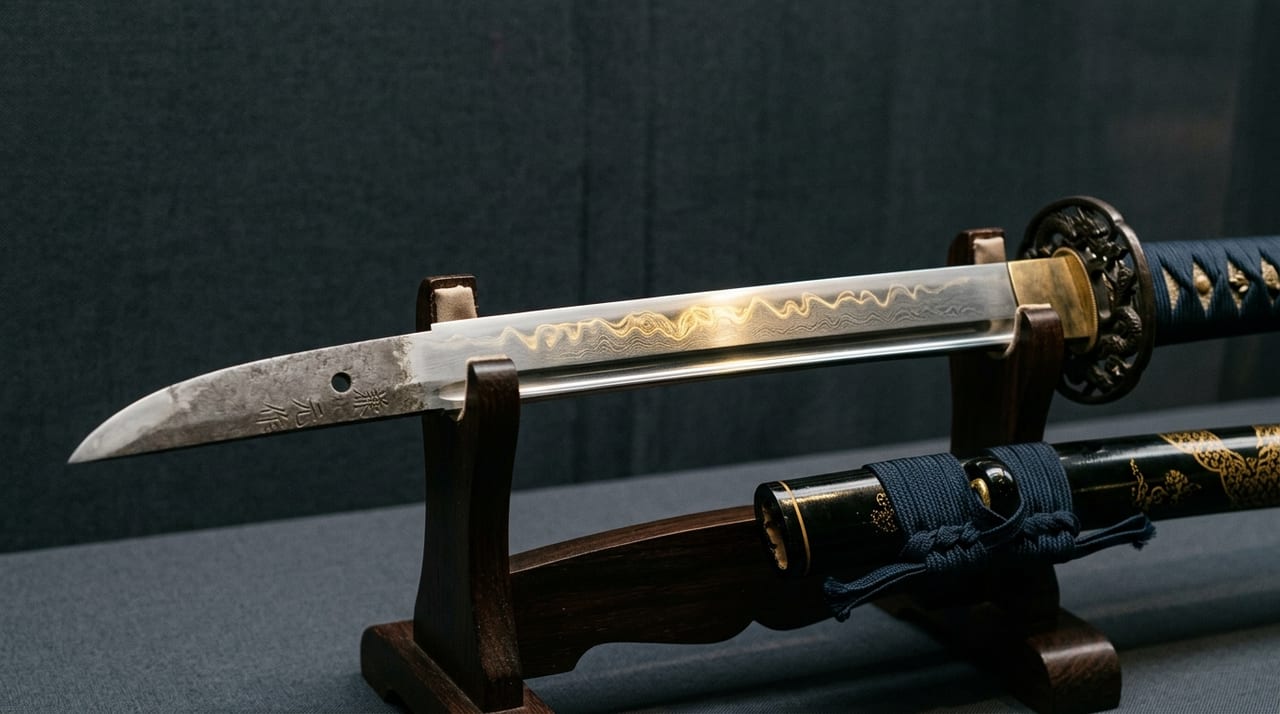
 * Image is for illustrative purposes only.
Inaba Shizu
稲葉志津
Also known as: Inaba Shizu; Tantō by Shizu Saburō Kaneuji
Description
Shizu Saburō Kaneuji, One of the Ten Great Disciples of Masamune
Inaba Shizu is an unsigned tantō attributed to Shizu Saburō Kaneuji, a swordsmith of the Nanbokuchō period. Originally trained in the Tegai school of Yamato Province, Kaneuji studied under Masamune of Sagami and later settled at Shizu in Mino Province (near present-day Kaizu, Gifu Prefecture), from which he took his name; he is counted among the Ten Great Disciples of Masamune. His work is known for fusing the Yamato and Soshu traditions, tempering an itame ground with a nie-laden notare mixed with gunome, showing kinsuji and sunagashi activity throughout.
Honami Kōtoku's Attribution and Red Signature
Although unsigned, the blade was judged to be Kaneuji's work by Honami Kōtoku, the leading appraiser of his day, who added a red-lacquer signature. The blade measures roughly 25 cm in length, retaining a shape fitting for a Nanbokuchō-period tantō. Its fine ground and temper have long made it esteemed as one of Kaneuji's representative works.
From the Inaba Family to the Tokugawa, Asano, and Kuroda Houses
The blade is named Inaba Shizu after Inaba Michitō, a warrior descended from a Mino lineage who once owned it. It later passed into the hands of Tokugawa Ieyasu, who bestowed it upon Asano Yoshinaga. After Yoshinaga's death it returned to the shogunal house, and is said to have subsequently been granted to the Kuroda family, daimyo of the Fukuoka domain in Chikuzen, in whose keeping it remained through the Edo period.
Designation and Present Status
The blade was designated an Important Cultural Property after the war and is today held by a private owner in Aichi Prefecture. With a provenance passing through the Inaba, Tokugawa, Asano, and Kuroda houses — leading warrior families from the Sengoku through early Edo periods — it is valued as a blade conveying the skill of Kaneuji, foremost among the Ten Great Disciples of Masamune.
Shizu as the Wellspring of the Mino Tradition
Kaneuji's fusion of the Yamato and Soshu styles is regarded as having laid the groundwork for the Mino tradition, which later became a major force in Mino Province, and ultimately for the Seki forges that produced smiths such as Magoroku Kanemoto and Izumi no Kami Kanesada. Smiths said to be Kaneuji's sons or students, including Kanetomo and Kaneshige, settled in Mino and developed his style further, so that the Mino tradition grew into a distinctive school combining the nie-laden temper of the Soshu tradition with the sturdy steel of the Yamato tradition. Inaba Shizu is significant also as a rare surviving work directly conveying the skill of Kaneuji himself, the very source of that lineage.
Legends & Stories
Though unsigned, Inaba Shizu was judged to be the work of Shizu Kaneuji by Honami Kōtoku, the foremost appraiser of his age, who marked it with a red-lacquer attribution. It is known for a provenance that passed from Inaba Michitō to Tokugawa Ieyasu, to Asano Yoshinaga, and finally to the Kuroda family, tracing a path through the leading warrior houses of the late Sengoku and early Edo periods.