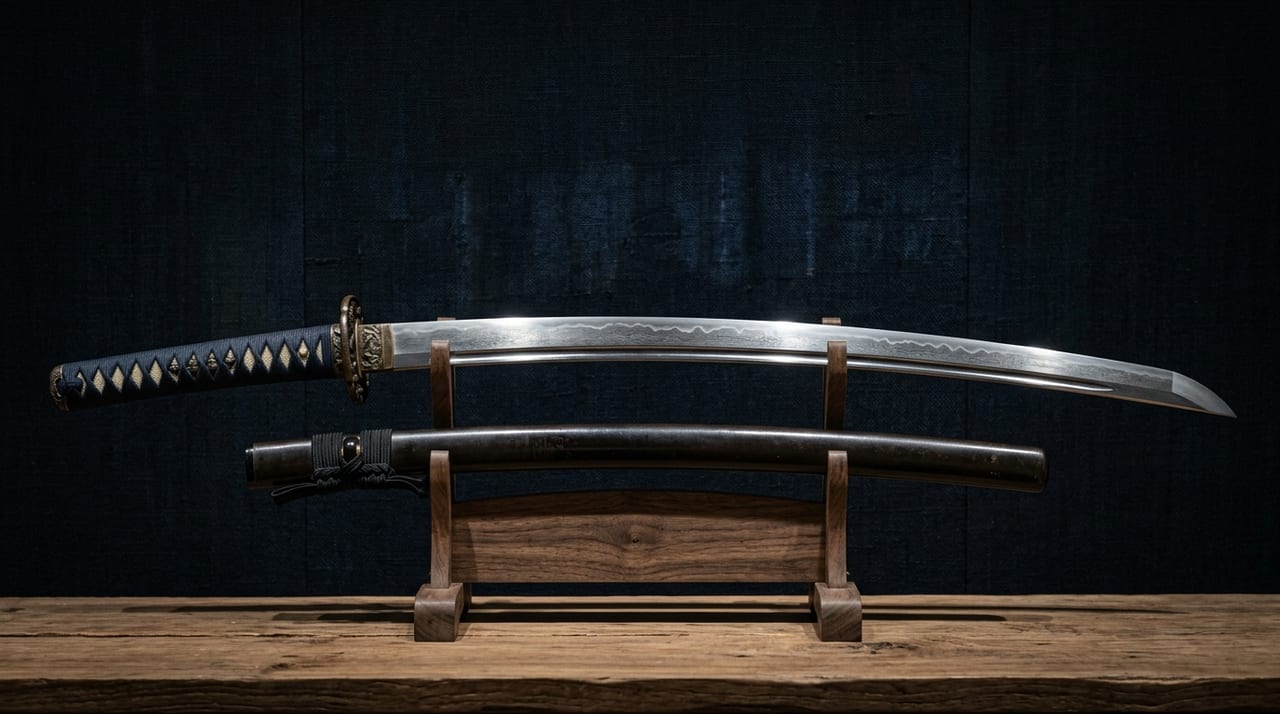
 * Image is for illustrative purposes only.
Hotarumaru
蛍丸
Also known as: Firefly Blade
Description
Overview of the Sword
Hotarumaru is an ōdachi transmitted to Aso Shrine. It is a spirit-imbued sword whose imposing form, with a blade length of about 101 cm, is its defining feature. It is said to have been forged in Einin 5 (1297) by Rai Kunitoshi, a master smith of Yamashiro Province in the late Kamakura period. The tang bore the inscription "Rai Kunitoshi" on the omote side and "Einin gonen sangatsu tsuitachi" on the ura side. The name Hotarumaru derives from the legend described below, in which countless fireflies helped repair the blade. This name and legend took deep root in the warrior society of Kyushu, and the sword long maintained its status as a guardian deity of the Aso clan.
Aso Clan and the History of Hotarumaru
The Aso clan was a great family that ruled Higo Province (present-day Kumamoto Prefecture). For generations it had inherited the post of daiguji (chief priest) of Aso Shrine, and it was a priestly warrior clan. This shrine family revered the natural richness of Aso and its volcano as sacred objects of worship, and it was honored for several centuries as the spiritual authority of Kyushu. Hotarumaru was a treasured heirloom carefully kept by the heads of the Aso clan, and it is said that successive daiguji carried it in important battles and ceremonies. During the Northern and Southern Courts period, the Aso clan also actively took part on the Southern Court side, and records survive stating that Hotarumaru was taken to the battlefield.
Smith Rai Kunitoshi
Rai Kunitoshi, the maker of Hotarumaru, was a master of the Rai school that flourished in Yamashiro Province (present-day Kyoto Prefecture). He is said to have been the son of Rai Kuniyuki. Active in the late Kamakura period, he left many excellent works in both tachi and tanto forms. The ōdachi form was especially favored for long swords during the Northern and Southern Courts period. It was an imposing weapon that mounted warriors swung down from horseback. According to the illustrations in the Edo-period collection "Shūkojisshu," the blade had a hi (groove). On the front, at the base of the habaki, there was a gomabashi carving, and on the back there was a soken carving.
Fate in the Modern Era
Hotarumaru continued to be passed down as a treasured heirloom of the Aso family after the Meiji era. In Shōwa 6 (1931) it was designated a National Treasure under the old system (kyū-kokuhō), but it went missing after the end of the Pacific War. There are theories that it was disposed of during the sword confiscation after the war, but its actual form can no longer be seen today. In 2015, however, a crowdfunding-based restoration project aimed at dedicating a sword to Aso Shrine began. In 2017, a replica made by a swordsmith was completed and dedicated to Aso Shrine. The creation of this replica was supported by many sword enthusiasts and researchers, which shows how deep the reverence for Hotarumaru is. In recent years, Hotarumaru has also become widely known among younger generations after appearing as a striking character in the popular game Tōken Ranbu, and pilgrimages to the site (seichi junrei) to Aso Shrine have increased.
Hotarumaru as Cultural Heritage
Even though the physical sword has been lost, Hotarumaru still holds a firm place in Japanese sword culture through its legend and its name. The story of fireflies repairing the blade is a mythic tale that condenses the Japanese view of nature, the sense of spirits, and reverence for swords. It embodies the essence of the Japanese sword as a spiritual being that goes beyond a mere weapon. Materials related to Hotarumaru and a replica sword are preserved at Aso Shrine, where visitors can encounter the legend. On summer nights in Aso, when fireflies dance through the air, the legend of this spirit-imbued sword still lingers in the atmosphere of the place.
Legends & Stories
The Night the Fireflies Repaired the Blade
The legend that gave Hotarumaru its name has been passed down in the warrior society of Kyushu as one of the most mysterious tales of swords. During the Northern and Southern Courts period, after Aso Korezumi fought against the Ashikaga forces at the Battle of Tatarahama in Engen 1 (Kenmu 3, 1336), the blade of this ōdachi was said to have countless nicks (hakobore) caused by the fierce fighting. Faced with the damaged famous sword, the Aso warrior who owned it grieved deeply. This sword was the very guardian deity of the clan, and the damaged blade was thought to directly reflect the decline of the family's fortunes.
That night, the fragments that had broken off were said to have flown back and settled into their original places, and the blade repaired itself on its own. Because the scene resembled fireflies flying, this ōdachi came to be called "Hotarumaru." There is also a variant tradition that Korezumi dreamed of countless fireflies swarming over the blade to fix the nicks, and that when he woke, the blade had indeed been repaired.
Fireflies and the Spirit World
In the traditional Japanese view of nature, the light of fireflies is sometimes linked with the light of the souls of the dead (reikon) or with messengers of the gods. Fireflies flitting about on summer nights are a symbol of the season when the boundary between this world and the realm of the unseen (yūmei) grows thin. The combination of a sword, which symbolizes the spirit of a warrior, with fireflies strikes a chord deeply with the Japanese religious sensibility. The legend of Hotarumaru eloquently tells of the belief that a sword is a spiritual being beyond a mere weapon, and that the spiritual power of the natural world guards it.
Aso Shrine and Faith in Hotarumaru
Aso Shrine is an ancient shrine that enshrines Takeiwatatsu no Mikoto as its principal deity. Hotarumaru was passed down as a treasured heirloom of the Aso family, who served as daiguji of this shrine. It is said that when Hosokawa Tsunatoshi, lord of the Higo domain, tried to take the sword during the Genroku era, the Aso family strongly refused.
Contemporary Faith in Hotarumaru
Even in the Reiwa era, Hotarumaru has devoted fans. The popularity of the Hotarumaru character in Tōken Ranbu has brought an actual increase in visitors. Every year, a curious scene unfolds in which younger generations visit Aso Shrine and press their palms together before the replica sword, where traditional faith and modern pop culture intersect.