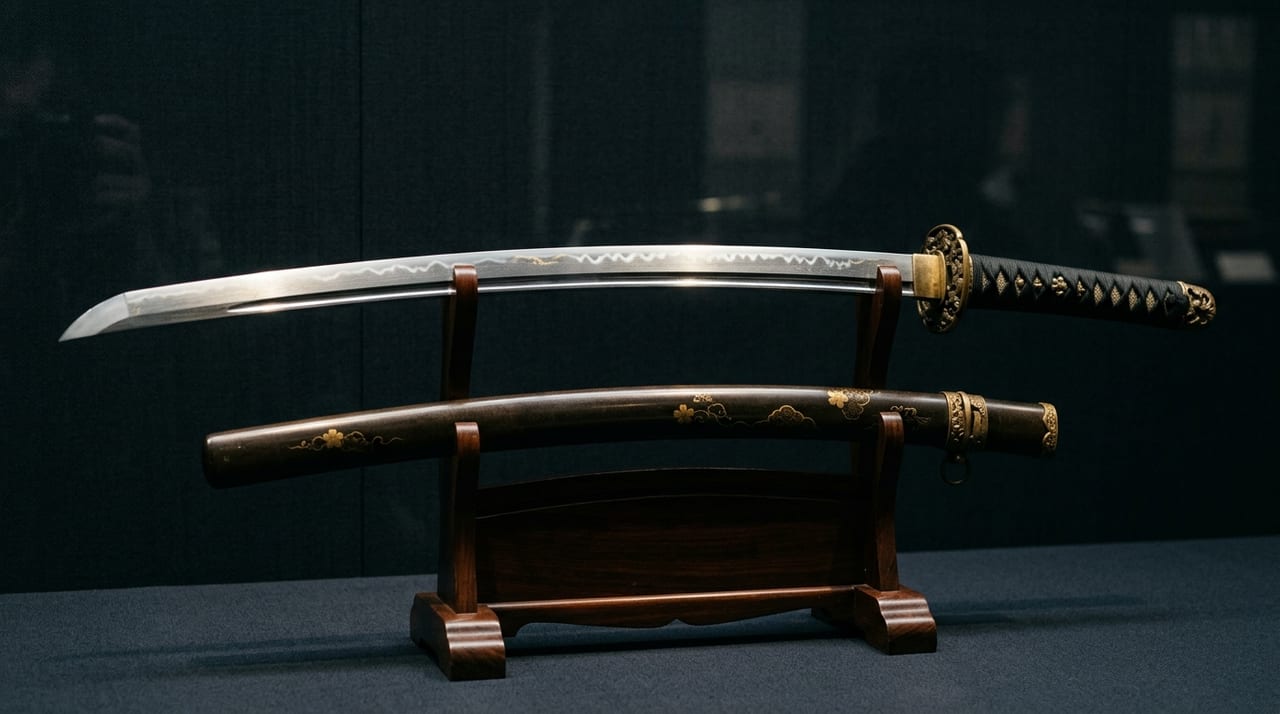
 * Image is for illustrative purposes only.
Hakusan Yoshimitsu
白山吉光
Also known as: Hakusan Yoshimitsu — Tachi by Awataguchi Yoshimitsu; National Treasure, Sacred Treasure of Shirayama-hime Jinja
Description
Hakusan Yoshimitsu is a National Treasure tachi preserved as a sacred divine treasure (shinpō) of Shirayama-hime Jinja, located in Hakusan City, Ishikawa Prefecture. Among the surviving works of Awataguchi Yoshimitsu—a swordsmith celebrated above all for his tantō—Hakusan Yoshimitsu holds a unique and important place in sword scholarship as a rare surviving example bearing a maker's signature.
Awataguchi Yoshimitsu was a swordsmith who flourished in the Awataguchi district of Kyoto during the middle to late Kamakura period. He ranks among the supreme masters in the history of the Japanese sword, having created numerous National Treasure and Important Cultural Property tantō, including his masterwork "Ichigo Hitofuri" (an Imperial Household treasure). Yoshimitsu was held in exceptional regard, particularly as a master of the tantō. Among his surviving works, Hakusan Yoshimitsu is a rare surviving example in tachi form, rendering its evidentiary value for the history of the Japanese sword incalculable.
The blade exhibits the antique character of a Kamakura-period tachi, with high koshi-zori (curvature at the base) and a kissaki approaching chū-kissaki in form. The jigane displays densely packed ko-itame-hada, with fine and uniform ji-nie yielding a clear, pure surface. The hamon reveals the refined and intricate pattern characteristic of Yoshimitsu—a complex of ko-chōji and ko-gunome—with kinsuji (gold thread-like lines) and suna-nagashi (sand-drift patterns) running delicately through the blade, while the nioi-guchi gleams bright and white.
Shirayama-hime Jinja is a distinguished ancient shrine of the Hokuriku region, renowned as the head shrine of approximately three thousand Hakusan shrines throughout Japan—shrines that venerate the sacred peak of Mount Hakusan as their divine body. As Mount Hakusan has long been honored as a sacred site of mountain worship and the harmonious fusion of Buddhism and Shinto, so Hakusan Yoshimitsu, enshrined here, has been cherished and carefully preserved through the generations as a sacred presence unified with the divine spirit of Hakusan.
Legends & Stories
The legends surrounding Hakusan Yoshimitsu are deeply intertwined with the syncretic Buddhist-Shinto culture of the Hokuriku region, in which the divine spirit of the sacred peak Hakusan and the spiritual power of the famous sword are unified as one. According to the oral tradition of Shirayama-hime Jinja, when the monk Taichō Daishi, who opened Mount Hakusan, received a divine revelation on the mountain in 717 (the Nara period), a single shaft of light descended from the sacred summit, and within the light appeared the vision of a divine sword. In later ages this legend became intertwined with Yoshimitsu's sword, giving rise to the belief that it was "a divine sword forged by the hands of Yoshimitsu, the renowned master craftsman of the capital, as proof of the descent of Hakusan's divine spirit."
In the warrior culture of Hokuriku, the belief spread that those who possessed Hakusan Yoshimitsu received the protection of the Hakusan deity; warriors of Kaga and Echizen are said to have pressed their hands together in prayer before this sword whenever they visited Shirayama-hime Jinja before setting out for battle. Maeda Toshiie, the first lord of the Kaga domain (the Maeda clan), deeply revered Shirayama-hime Jinja, and it is said that in Bunroku 5 (1596), he undertook the reconstruction of the shrine's halls and pagodas. It is further transmitted that Hakusan Yoshimitsu came to the Maeda clan of Kaga at a later date, accompanying the marriage of Achi (Seytai'in), the consort of the fourth daimyo Maeda Mitsutaka, who came from the Mito Tokugawa clan. Following her death, it is said that in Manja 1 (1658), the fifth daimyo Maeda Tsunanori donated it to Shirayama-hime Jinja as an offering to honor his mother's spiritual repose.
Moreover, even during the chaos of the Sengoku period, this sword alone was miraculously preserved from fire and plunder. During the upheavals of the Kaga Ikkō-ikki, when Shirayama-hime Jinja faced repeated crises, Hakusan Yoshimitsu was kept hidden deep within the shrine and was transmitted unharmed—giving rise to the saying, still handed down today, that "Hakusan's god personally protected it."