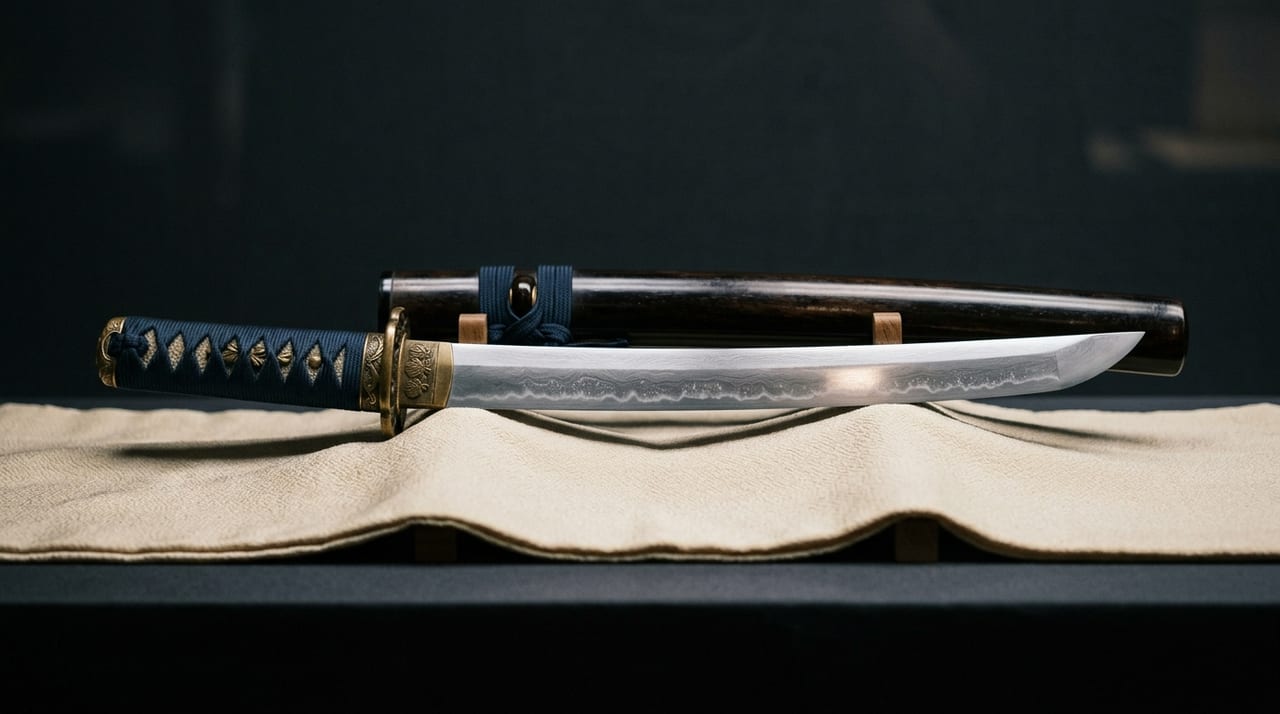
 * Image is for illustrative purposes only.
Hakata Tōshirō
博多藤四郎
Also known as: Hakata Blade; Treasure of the Kuroda Clan
Description
Overview of the Sword
Hakata Tōshirō is a tantō forged by the renowned Kamakura-period smith Awataguchi Yoshimitsu, named for Hakata, the region from which it emerged, and was transmitted through successive custody from the Kuroda clan (daimyō of Fukuoka) to the Ogasawara clan (daimyō of Kokura). It is a blade of hirazukuri form with a blade length of approximately 24.6 cm (8 sun 1 bu and a fraction). The steel exhibits densely packed ko-itame hada with fine, uniformly distributed ji-nie and a lustrous surface. The hamon is a straight-hada-style ko-midare with finely detailed nie evenly distributed along the edge, displaying the characteristic quiet and profound beauty distinctive of Yoshimitsu. The tang is in a state close to the original finish, and a two-character 'Yoshimitsu' signature has been confirmed, establishing it as a work of genuine attribution (shinsaku) of the highest authority. Among Yoshimitsu's tantō, this blade holds a position of paramount importance in Awataguchi studies due to its clear provenance and exceptional state of preservation. The combination of the name Hakata—an international metropolis—with the technical mastery of Kyoto's finest short-sword craftsman exemplifies how Japanese sword culture was deeply rooted in large-scale trade networks and human movement dating back to antiquity. That an authentic Yoshimitsu tantō came to reside and survive in Kyushu is a rare occurrence, endowing this blade with special significance both geographically and culturally.
Hakata as a Place and the Kuroda Clan's History
Hakata is an international city that has prospered since antiquity through trade with the continent, serving as the center of Sino-Japanese and Sino-Ming commerce and contributing greatly to the cultural and economic development of medieval Japan. The Kuroda clan came to rule Chikuzen Province through Kuroda Kanbe (Takatsugu) and his son Nagamasa, who served Toyotomi Hideyoshi. Throughout the Edo period, they governed as great daimyō of Fukuoka with a domain assessed at 520,000 koku, making Hakata their administrative seat. The Kuroda clan was also renowned for possessing an exceptional sword collection, and Hakata Tōshirō, as one of its premier named masterpieces, was carefully transmitted through successive generations. This short sword, bearing the name of Hakata—an international trading metropolis—encodes within its name the historical context rooted in Kyushu's position at the intersection of continental and Japanese cultures. Kuroda Kanbe was widely known as "the strategist of Harima" and ranks among the greatest military commanders of the Sengoku period. His son Nagamasa distinguished himself at the Battle of Sekigahara by fighting with the Eastern Army, earning the favor of Tokugawa Ieyasu and thereby receiving the domain of Chikuzen assessed at 520,000 koku. As a family treasure testifying to the formidable intellect and capacity for action of this father and son, Hakata Tōshirō symbolizes both the martial and aesthetic culture of the Kuroda house.
The Artistry of Yoshimitsu's Tantō—Perfection in Quietude
Awataguchi Yoshimitsu's tantō constructs an aesthetic world entirely distinct from that of the Sōshū tradition of Masamune and Sadamitsu. Whereas the swords of the Sōshū school are characterized by the dramatic beauty of vigorous nie activity, kinsuji, and inazuma patterns, Yoshimitsu's Yamashiro-tradition short swords take as the core of their beauty the quiet and profoundly deep "straight-hada with applied nie" or "ko-midare" hamon and the lustrous sheen of densely packed body steel. This contrast demonstrates the polar opposition of "movement" and "stillness" in Japanese sword aesthetics, and the beauty of Hakata Tōshirō belongs to a category of beauty that "deepens the more one gazes upon it"—a quiet profundity that does not yield to immediate comprehension but gradually unfolds the inner realm of the blade through repeated contemplation. The reason tea masters and cultivated persons treasured Yoshimitsu's short swords as "swords of wabi" lies in this quiet and profound beauty. In Hakata Tōshirō, this aesthetic of quietude stands in striking contrast to Hakata, the vibrant name of an international metropolis, and the poetic tension generated by this gap between name and substance forms part of the blade's essential allure.
The Bond Between Kuroda Kanbe, Nagamasa, and Hakata Tōshirō
Kuroda Kanbe (Jōsui) was one of the greatest military strategists of the Sengoku period and made immense contributions to Toyotomi Hideyoshi's unification of Japan. Known as "the strategist of Harima," Kanbe supported Hideyoshi's territorial expansion from the Kanto to Kyushu and was also noted for conducting independent military operations in Kyushu during the Battle of Sekigahara. Nagamasa, the son of Kanbe, fought at Sekigahara on the Eastern side, earned military distinction, and received the domain of Chikuzen assessed at 520,000 koku. When this father and son became the rulers of Chikuzen Province centered on Hakata, the circumstances under which Yoshimitsu's short sword bearing the name Hakata came to be treasured as "Hakata Tōshirō" and became a precious heirloom of the Kuroda house can be understood as natural and fitting. Throughout the Edo period, the Kuroda clan supported the cultural development of Chikuzen (Fukuoka), and Fukuoka Domain produced many outstanding scholars and cultural figures. Within this tradition, Hakata Tōshirō was cherished as the highest form of art; in the modern period, it left the Ogasawara house and was designated an Important Cultural Property.
The Mongol Invasions and Hakata—The Continental Threat Experienced by Kyushu
The place-name Hakata carries within it the memory of the Mongol invasions (Genkō Invasion of 1274 and Kōan Invasion of 1281), the greatest external crisis in Japanese history. Hakata Bay, where Mongol forces first made landfall, became for Japan "a seacoast violated by foreign enemies," casting a deep shadow over Japan's subsequent national consciousness and defensive awareness. The late 13th century, when the Mongol invasions occurred, overlaps completely with the era in which Awataguchi Yoshimitsu was active. The Japan of the time when Hakata Tōshirō was forged was an age that experienced the defense of the archipelago against an unprecedented external threat. If the name Hakata Tōshirō, in some manner, encodes within the blade the spirit of the age—the tense atmosphere of external threat and internal technical perfection—then it may be understood as a product of Japan's self-consciousness from seven hundred years ago.
Modern Conservation and Display
Hakata Tōshirō is presently an Important Cultural Property owned by the Agency for Cultural Affairs. The museum that houses it is a major facility displaying historical cultural property owned by Fukuoka City and preserves among Japan's most significant cultural treasures, including the Golden Seal (Han Delegation to Japan Seal, National Treasure). That a Yoshimitsu short sword came to reside and survive in Kyushu is rare, and Hakata Tōshirō has become a cherished sword among Fukuoka's historical and cultural heritage, beloved by its citizens. Admirers of Yoshimitsu short swords from throughout the nation visit Fukuoka to encounter this blade, which even after more than seven hundred years continues to convey the breath of the Kamakura master craftsman.
Legends & Stories
Hakata Harbor and the Way of the Sword
Hakata has functioned as the most important gateway connecting the Japanese islands and the continent since ancient times. It was the departure point for envoys sent to Tang and Song, and served as the principal window for Japan-Song trade, Japan-Yuan trade, and Japan-Ming trade—the starting point of the routes through which continental culture, technology, and art flowed into Japan. During the Mongol invasions (the Bunei Campaign and the Kōan Campaign), Hakata Bay became the landing point for Yuan forces and the frontline of the crisis threatening Japan's very existence. The Hakata Tōshirō, bearing the name of such an internationally and historically significant place, engraves upon its blade a symbolic place name in Japan's history of exchange with the continent. Forged by a master of Kamakura, granted the name of Kyushu's greatest international city, and passed from Kuroda Tadayuki, lord of Fukuoka domain, to Ogasawara Tadasane, lord of Buzen-Kokura domain, before descending through the Ogasawara family, this tantō carries a richness of provenance such that the cultures of north and south of the Japanese islands converge in a single blade.
Kanbei's Strategic Vision and Eye for Great Swords
Kuroda Kanbei was known both as a strategic genius and as a culturally refined warlord. The intellectual openness of Kanbei, who was also a Christian daimyo (though he later renounced the faith), manifested in an excellent aesthetic eye in sword appreciation. The Hakata Tōshirō takes its name not from the possession of Kuroda Jōsui (Kanbei), but rather from that of Kuroda Tadayuki, the second daimyo of Fukuoka domain, who is said to have presented this great sword to Ogasawara Tadasane, lord of Buzen-Kokura domain. Both the giver, Kuroda Tadayuki, and the recipient, Ogasawara Tadasane, were warlords who experienced the Siege of Osaka, and it is said that Tadasane wielded this work without hesitation as a field sword. The tales of warlords surrounding great swords continue to captivate the imagination of sword enthusiasts.
The Lineage of Yoshimitsu Tantō—Hakata Among the Tōshirō Series
Multiple examples of the works of Awataguchi Yoshimitsu survive to the present day, including the Gotō Tōshirō, Hakata Tōshirō, Hōchō Tōshirō, Maeda Tōshirō, Akita Tōshirō, Namazuo Tōshirō, and Yagen Tōshirō, each bearing the name "Tōshirō" differentiated by its provenance. Comparing these specimens offers the supreme appreciation experience of discovering subtle distinctions and individuality within the consistent artistic style of the swordsmith Yoshimitsu. The Hakata Tōshirō, as the blade bearing the place name positioned furthest to the west among this Tōshirō series, is a single work bearing the cultural weight of the Kyushu region. The fact that Yoshimitsu's tantō came down scattered across various regions of the Japanese islands demonstrates how widely treasured the works of this swordsmith have been, and the Hakata Tōshirō is transmitted to the present day as Kyushu's representative of that nationwide distribution.