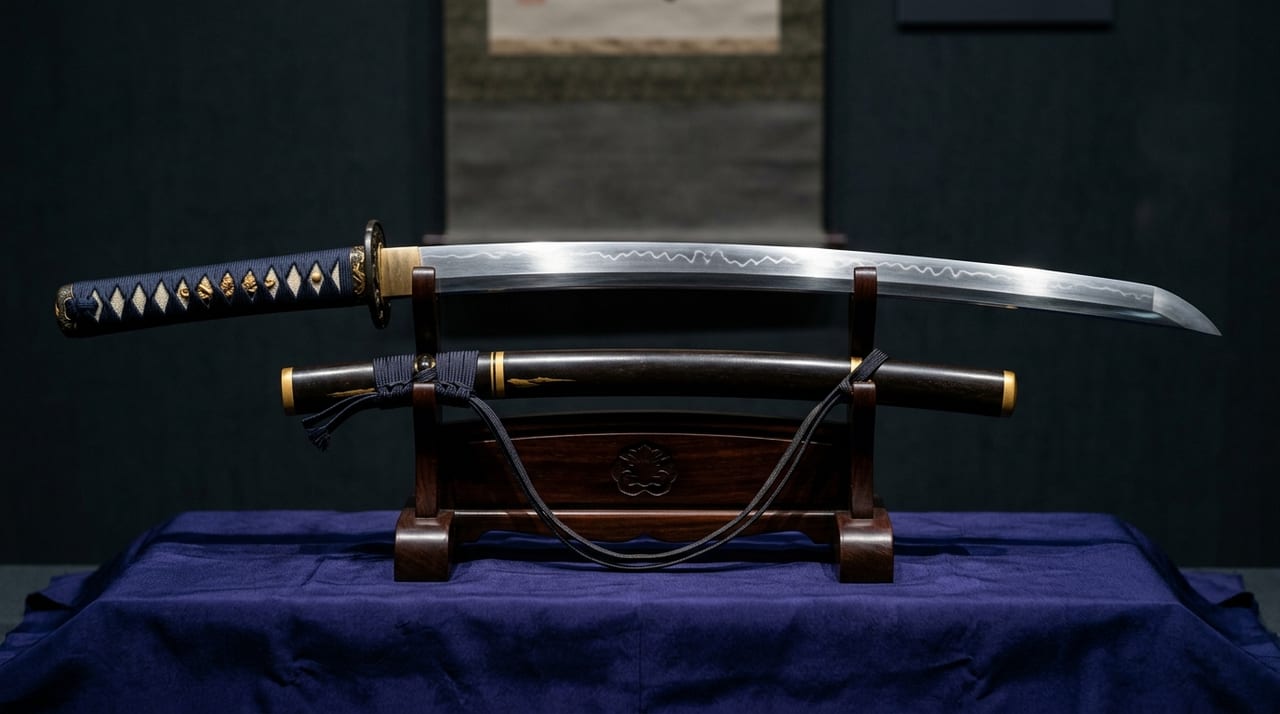
 * Image is for illustrative purposes only.
Hachisuka Kotetsu
蜂須賀虎徹
Also known as: The Kotetsu of Hachisuka
Description
Hachisuka Kotetsu is one sword, renowned in particular for having been transmitted to the Hachisuka family, lords of Tokushima Domain, among the blades forged by Nagasone Kotetsu, who is hailed as the finest smith of the early Edo period. Kotetsu was an armorer in Echizen (present-day Fukui Prefecture), but around age 50, during the Meireki era (around 1656), he shifted from armorer to swordsmith, and his late-blooming talent blossomed, making him a renowned master in Edo who swept the age. He is one of the most highly regarded smiths of the shintō period, and his cutting performance became widely known in warrior society as "the Kotetsu cutting performance"; the Kaihō Kenshaku ranks him among the saijō ō-wazamono (highest grade for cutting ability), and he was rated, together with Horikawa Kunihiro, as the yokozuna of shintō. This sword has a blade length of 2 shaku 2 sun 8 bu (approximately 69.1 centimeters) and a sori of 3 bu, and its mune is iori-mune. The nakago bears an inscription reading "Nagasone Okisato Nyūdō Kotetsu," and it shows workmanship befitting the peak of Kotetsu's career. In the Edo period, it is recorded as having been held by the Hachisuka family of Tokushima Domain in Awa; it is now in private hands. It is a renowned piece (meibutsu) transmitted through the Hachisuka family, lords of Tokushima Domain. It is well known that Shinsengumi commander Kondō Isami favored a Kotetsu as his beloved sword, and this Kotetsu, formerly held by the Hachisuka family, also contributes to that reputation for famous blades.
Legends & Stories
Kotetsu's swords were popular even during his lifetime for their cutting sharpness, to the point that many counterfeits were made. Regarding this Kotetsu formerly held by the Hachisuka family, the nakago bears a cutting-test inscription inlaid in gold (gold inlay) recording that in Kanbun 5 (1665) a cutting test (satsudan) was performed and that futatsu-dō (two bodies) were cut. The cutter is said to have been Yamano Kaemon Nagahisa, a renowned sword-testing specialist of the time. Together with the Kotetsu said to have been used by Kondō Isami in the Ikedaya Incident, this sword is passed down as a piece that secures Kotetsu's reputation as the finest master of the shintō period.