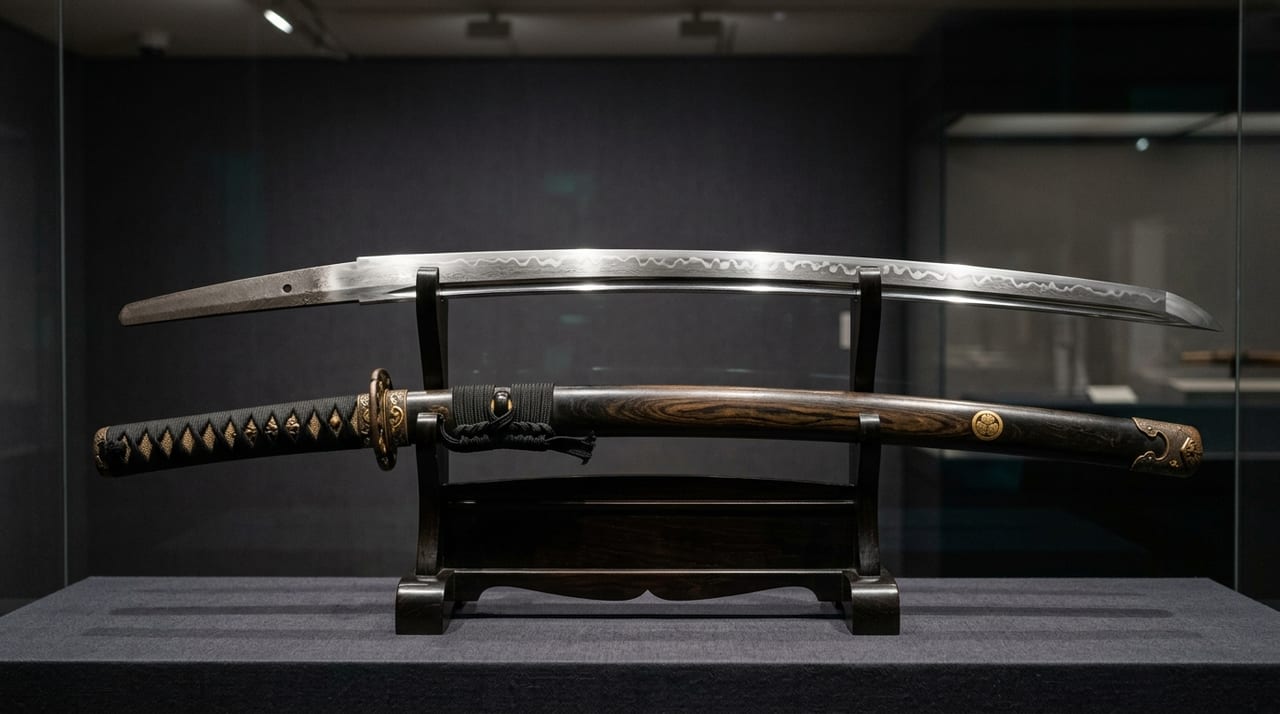
 * Image is for illustrative purposes only.
Two-Signature Norimune
二つ銘則宗
Also known as: Futatsu-mei Norimune; the Twin-Signed Tachi of Fukuoka Ichimonji Norimune
Description
Overview of the Sword
Futatsu-mei Norimune is a tachi forged by Fukuoka Ichimonji Norimune, a celebrated swordsmith representing early Kamakura period Bizen Province (present-day Okayama Prefecture). The name "Futatsu-mei" (two-signature) derives from the rare characteristic that the signature "Norimune" is cut into two locations on the tang of this tachi. It is designated as an Important Cultural Property and is housed at Atago Shrine in Kyoto (entrusted to and managed by the Kyoto National Museum). Norimune was the founder of the Fukuoka Ichimonji school and is said to have been chosen among the goban kaji of Retired Emperor Go-Toba; his tachi are highly regarded as the school's finest.
The Forging Style of Fukuoka Ichimonji Norimune
The tachi of Fukuoka Ichimonji Norimune (dates unknown, active during the early Kamakura period) are characterized by bright body steel with fine, tightly-wrought grain incorporating small wood-grain patterns (mokume), and a rich blade pattern blending gunome (mutual-eye) and choji (clove) forms, exemplifying the flamboyant and dignified beauty distinctive of the Fukuoka Ichimonji school. Regarding the distinctive manner of inscribing the two signatures ('Futatsu-mei'), there are multiple theories: that Norimune himself cut the signature twice, that a later craftsman added a second signature, or that two copies were created at different locations during repair to preserve the inscription. In any case, the fact of bearing two signatures imparts this tachi with distinctive mystique and identifiability, and it is clearly distinguished from other Norimune works by the designation "Futatsu-mei Norimune."
Provenance and Custody
After passing through multiple samurai households, Futatsu-mei Norimune is now housed at Atago Shrine in Kyoto (entrusted to and managed by the Kyoto National Museum) and is preserved as an Important Cultural Property. Signed Norimune tachi are rare among surviving examples, and Futatsu-mei Norimune holds a distinguished position among them due to the singularity of its signatures and artistic value. It ranks among the finest Bizen blades of the early Kamakura period and stands as an important cultural property attesting to the high technical standards of the Fukuoka Ichimonji school.
The Mystery of Signatures: The Depths of Japanese Sword Appraisal Culture
In the appraisal of Japanese swords, the signature (mei) is one of the most important elements, and the signature indicating the swordsmith's name is considered the paramount evidence for establishing a sword's 'true identity'. The mystery of the "two signatures" in Futatsu-mei Norimune embodies one of the most direct instances of the fundamental question that Japanese sword appraisal culture grapples with—'What is a signature, and where does a sword's authenticity reside?'—a topic that has long been debated among sword researchers.
Legends & Stories
The double signature of Futatsu-mei Norimune has generated centuries of inconclusive debate — and that irresolution is itself part of the sword's character. Japanese aesthetics has long recognized that incompleteness and mystery are not failures of meaning but its enhancement: yūgen (the beauty of what is suggested rather than stated), ma (the significance of empty space). A blade that has been studied for a thousand years and still poses unanswerable questions about its own most basic fact — why does it carry its maker's name twice? — is a blade that continues to repay attention in perpetuity. Ko-Bizen Norimune was Kanehira's contemporary, and this tachi, a National Treasure at the Tokyo National Museum, stands alongside Ōkanehira as testimony to what the Ko-Bizen masters achieved at the beginning of the great Bizen tradition. The double name is a riddle with a blade attached.