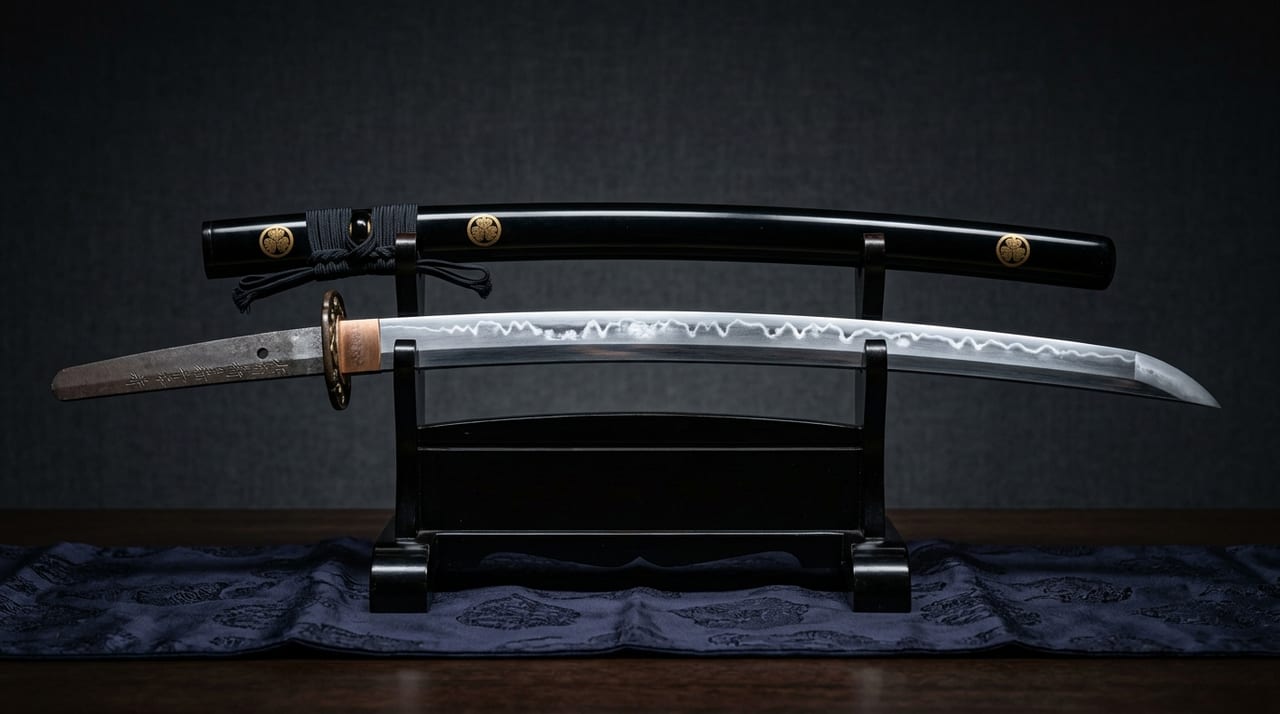
 * Image is for illustrative purposes only.
Fukuro Samonji
袋左文字
Also known as: Fukuro · Samonji School · Transmitted through the Shoni clan · A celebrated Kyushu sword
Description
Fukuro Samonji is a tachi of the Samonji school (Sa-monji school), based in Chikuzen Province (present-day Fukuoka Prefecture), and is transmitted to be one of the celebrated swords representative of the Samonji school in Kyushu. The Samonji school was the most flourishing sword-making group in Kyushu during the Nanbokuchō period, known by the name "Samonji" after the founder's practice of cutting the character "Sa" (左) into his blade inscriptions. Among the masterworks of the Sa school are such celebrated swords as "Taikō Samonji" and "Sōza Samonji," and many famous blades of great renown still survive. Fukuro Samonji, as a tachi forged by smiths of the Samonji school, stands as an important example that transmits the history of sword veneration in the samurai society of Kyushu.
The name "Fukuro" (meaning "bag" or "pouch") is said to derive either from the distinctive bag-shaped koshirae (sword mounting and scabbard) in which the tachi was transmitted, or from small bag-shaped fittings applied to the tsuba (guard) and tsuka (grip). The derivation of the name has several proposed explanations, but in any case this sobriquet became established early in sword history, and it is said that by the time the Shōni clan ruled northern Kyushu, the sword was already known by this name.
The blade presents the robust silhouette typical of Nanbokuchō tachi—broad in width with a firm, thick moto-gasane. The hamon, characterized by the Samonji school's distinctive gunome-midare and ō-gunome patterns, unfolds with sharp clarity, with deep nie producing a vivid blade landscape. The jigane—with itame-hada flowing broadly and abundant ji-nie—shows the influence of the Sōshū tradition and presents a rich, expressive surface. While it is transmitted as an example that conveys Nanbokuchō sword culture in Kyushu, reliable records concerning its current designation and custody are sparse.
Legends & Stories
Fukuro Samonji is associated with legends concerning the warrior spirit of Kyushu and the divine power of the Samonji school. The Shōni clan were a powerful warrior house that dominated northern Kyushu—centered on Chikuzen and Hizen Provinces (present-day Fukuoka and Saga Prefectures)—from the late Kamakura period through the Nanbokuchō era. Based at Dazaifu, they inherited the position of Dazai-Shōni, which originated from the Kamakura Shogunate's Chinzei Bugyo (Commissioner for the Western Provinces), and wielded influence over northern Kyushu.
According to the Shōni clan's tradition, this tachi was commissioned by the founding head of the house from a master smith of the Chikuzen Samonji school, forged as a special blade, and dedicated to the clan deity as a "divine sword to protect the land of Kyushu"—then passed down through generations as the clan's treasured heirloom.
During one battle, it is said that when a Shōni warrior wore this tachi on the battlefield, the blade emitted a mysterious light that made the enemy's front lines falter. The warrior felt convinced that "this must be the divine spirit of Samonji protecting us," and thereafter carried it to battle without fail. Another tradition holds that the storehouse where the tachi was kept glowed with an uncanny light at night, and when investigated, the blade was found covered with dew but entirely free of rust—preserved as "proof of a divine sword."
In later years, even as the Shōni clan fell into decline after their defeat in conflict with the Ōuchi clan, this tachi alone was protected through the turmoil and passed down to posterity—giving rise to the belief in Kyushu's warrior society that "the spirit of the Shōni dwells within Fukuro Samonji, and no matter how turbulent the times, it will always be protected and never lost."