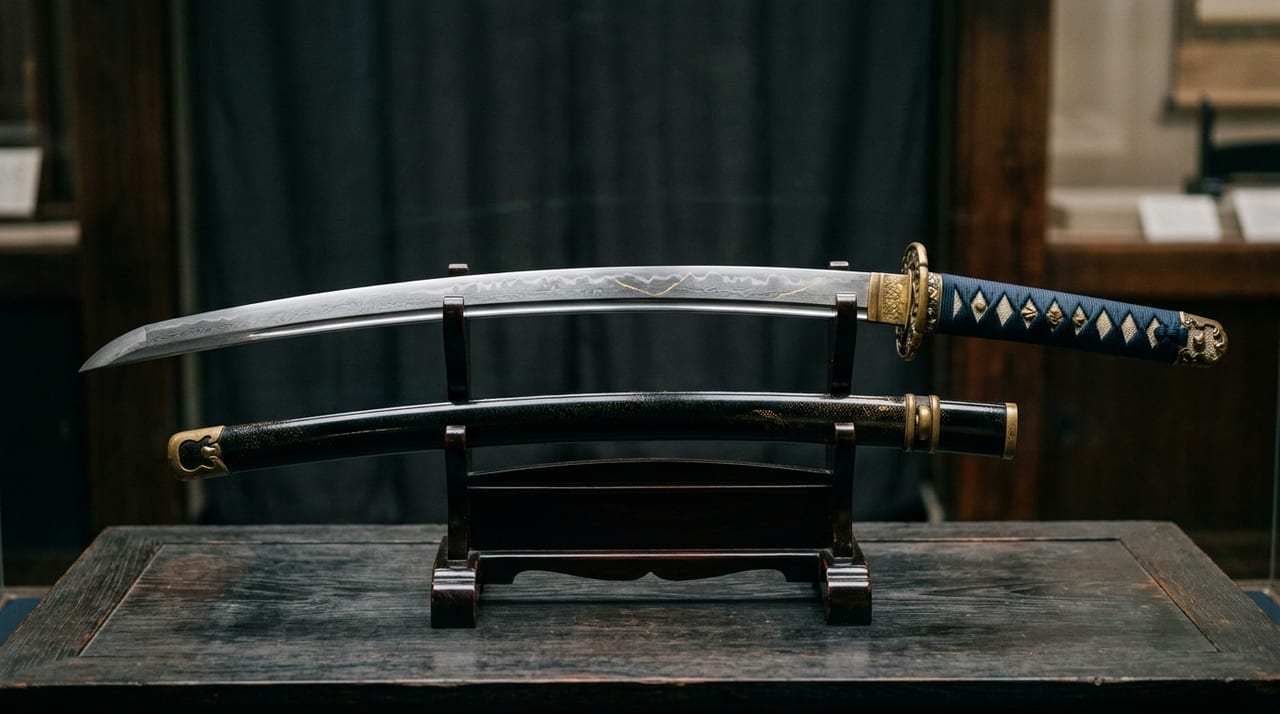
 * Image is for illustrative purposes only.
Fudō Yukimitsu
不動行光
Also known as: Fudō Yukimitsu: Supreme Masterpiece of Sōshū Yukimitsu, One of Masamune's Ten Masters
Description
Sword Overview
Fudō Yukimitsu is a tantō believed to have been forged by the renowned swordsmith Sōshū Yukimitsu (birth and death dates unknown), active in Sagami Province (present-day Kanagawa Prefecture) during the late Kamakura Period and designated as an Important Cultural Property. The name "Fudō" derives from the fact that sculptural depictions of Fudō Myōō and Sanskrit characters (the Kaan syllable representing Fudō Myōō) are carved onto the blade surface. Such blade carvings were a particularly developed technique in the Sōshū tradition. Yukimitsu (also called Tōzaburō) descends from Shintogoro Kunimitsu's lineage and is evaluated as a master craftsman from the foundational period of the Sōshū tradition, claimed by some sources to be either the father or adoptive father of Masamune.
Position of Sōshū Yukimitsu
Sōshū Yukimitsu was an accomplished swordsmith active in the late Kamakura Period and is counted among Masamune's Ten Masters—his ten most distinguished disciples. Yukimitsu's forging style is remarkably close to Masamune's own, exhibiting the typical Sōshū tradition characteristics of abundant nie, jinie, and jikei (metal grain patterns). The technical standard is so high that distinguishing his work from his teacher Masamune is often difficult, and authentic works by Yukimitsu with confirmed provenance frequently receive evaluations of "equal to or second only to Masamune." His tantō especially are highly regarded, standing alongside the short swords of Masamune and Sadamune as the pinnacle of Sōshū tantō craftsmanship.
Fudō Myōō Carving and the Spirituality of Japanese Swords
The defining feature of Fudō Yukimitsu is the carving of Fudō Myōō or its symbolic representation (relief images of Fudō Myōō flanked by his attendant deities Kongara and Shoitaka) on the blade surface. Fudō Myōō is one of the most important wrathful deities in Esoteric Buddhism, depicted standing amidst flames wielding a sword and rope, possessing the power to sever earthly desires and karmic obstacles. Carving Fudō Myōō's sword onto a blade served as a symbolic act demonstrating that the sword itself was "a sacred implement channeling the power of Fudō Myōō," directly embodying the fundamental Japanese cultural principle that the sword functions simultaneously as a weapon and as a conduit for shamanistic and religious power. In Yukimitsu's tantō, this carving is executed with both precision and commanding presence, and combined with the turbulent nie landscape of the blade's edge creates an overwhelming spiritual power.
Blade Form and Appreciation Points
Fudō Yukimitsu is a hirazukuri tantō with a blade length of approximately two sun (roughly 22–25 cm). The metal shows a Sōshū-characteristic iron color with mokume (wood-grain patterns) mixed into itame (board-grain), with thick jinie (ground nie) and well-defined jikei. The hamon is based on the gunome-midare (cluster irregular) pattern with intense nie characteristic of what is called "ō-nie" (large nie)—the signature hallmark of the Sōshū tradition. This ō-nie appears as a breathtaking landscape where tiny nie particles sparkle like stars explosively across the edge, a visual phenomenon seen only in Sōshū swords and unmatched by other schools. The boshi (tip hardening pattern) approaches a kaen-bōshi (flame-like form) with dynamic movement, bringing Sōshū's grandeur to its apex. The Fudō Myōō carving extends from the upper tang area through the blade, with the overall composition perfectly integrating three elements: carving, blade pattern, and iron quality.
Transmission and Current Provenance
Fudō Yukimitsu passed through the hands of various samurai families during the Sengoku Period, though some sources claim it was lost in the fire that destroyed the Honnō-ji temple during the Honnō-ji Incident, with subsequent location unclear. Currently held in private collection, it is recognized as an authentic Yukimitsu work of the highest standard. Signed works by Yukimitsu are exceptionally rare overall, with only a handful of specimens in good condition surviving. Fudō Yukimitsu is positioned among these rare works as a "singular example where carving, blade pattern, and metal quality all attain the highest standards simultaneously," ranking as one of the most academically and artistically significant swords in existence.
The Technical Essence of the Sōshū Tradition—Ō-nie and Jikei
Two indispensable concepts in discussing Sōshū technical characteristics are "ō-nie" (large nie) and "jikei" (ground patterns). Nie refers to fine iron particles that form within the blade's edge; those individually visible to the naked eye are specifically called "ō-nie." In the Sōshū tradition, ō-nie scatters across the blade edge like stars, and this intensity imparts overwhelming visual impact to the observer. Jikei refers to fine linear patterns appearing on the metal's surface—the more advanced the forging, the more complex and beautiful the jikei becomes. Yukimitsu's iron, like his teacher Masamune's, displays mixed itame and mokume, and the richness of this jikei serves as an indicator of the high quality of Yukimitsu's works. In Fudō Yukimitsu, this ō-nie and jikei harmonize perfectly with the religious motif of the Fudō Myōō carving, with the fierce form of the wrathful deity and the intensely burning ō-nie visually creating a single powerful world. As a tantō embodying most purely the Sōshū school's pursuit of "the fusion of martial valor and spirituality," Fudō Yukimitsu ranks among the supreme masterpieces of Japanese sword craftsmanship.
Fudō Yukimitsu's Evaluation in Sword Culture
Since the Edo Period, in sword authentication documents and sword literature, Yukimitsu's works have consistently received high evaluation as "creations by one of Masamune's finest disciples." Particularly during the era of Honami Kōetsu and his son Kōshitsu (early Edo Period), sword authentication became a highly systematized discipline, and works like Fudō Yukimitsu that unite the three elements of carving, blade pattern, and metal quality came to be positioned as special examples of "three-part perfection masterpieces." In modern sword research since the Meiji Period, Fudō Yukimitsu has continued to serve as a benchmark work for measuring the technical standards of the Sōshū tradition; contemporary researchers regard this tantō as "the finest evidence of how closely Yukimitsu's technique approached that of Masamune." The official national designation as an Important Cultural Property underscores this scholarly consensus, establishing Fudō Yukimitsu as a work near the very pinnacle within Japanese sword culture as a whole.
Legends & Stories
Fudō Myōō and the Sword—The Fusion of Esoteric Buddhism and Martial Culture
Fudō Myōō (Acala) is the principal deity among the Five Wisdom Kings in Esoteric Buddhism, depicted standing in flames wielding a sword and rope as a fierce guardian king. The sword he carries is the "Sword of Wisdom" that severs all earthly desires, ignorance, and karmic obstacles. For military commanders who revered Fudō Myōō, the blade inscribed with this sword's power became the ultimate protective weapon. The carving of Fudō Myōō or his symbolic forms onto a blade surface was a widespread practice among medieval commanders, and the Sōshū swordsmiths were particularly renowned for their carving mastery. Various subjects—the Kuriragaramaru (dragon coiled around a sword), Sanskrit syllables, and standing Fudō Myōō figures—were rendered vividly in steel. The carving by Yukimitsu represents one of the highest peaks of this tradition, and through the work of supreme masters such as Yoshimitsu, Masamune, and Yukimitsu who integrated religious motifs into weapons, the Japanese sword transcended mere iron blade to embody the fundamental Japanese cultural principle that it is "a sacred instrument channeling spiritual power."
The Institution of Masamune's Ten Masters—A Japanese Form of Teacher-Student Relationship
Masamune's Ten Masters (Masamune Jūtetsu) designates the ten most distinguished disciples of Masamune, with Yukimitsu numbered among them. This concept of "Ten Masters" follows the model of Confucius's Ten Disciples (Yan Hui, Zilu, and others), a designation that became a traditional Japanese art-world institution for legitimizing groups of master successors who inherited their teacher's techniques and spirit at the highest level. While the composition of the Ten Masters shows minor variations across historical sources, Yukimitsu invariably appears among them as a central figure, recognized as "one of teacher Masamune's most faithful inheritors." Works by craftsmen bearing the title of Ten Master are assigned a rank second only to the master Masamune himself, with Fudō Yukimitsu evaluated as exemplifying this highest standard.
The Meaning of "Fudō"—Symbol of an Unshakable Soul
"Fudō" (literally "unmoved/unshaken") symbolizes Fudō Myōō's "immovable resolve." In the world of military commanders, "fudō-shin" (unshakable spirit)—a state of mind that remains unwavering in any circumstance—represented the ultimate spiritual ideal. Possessing this short sword was tantamount to wearing that ideal on one's person. That Yukimitsu's sword was given the name "Fudō" symbolizes the moment when metalworking technique achieved perfect fusion with religious and spiritual dimensions, succinctly expressing the most essential aspect of Japanese sword culture—the sword functions simultaneously as a weapon and as a mirror of its bearer's spirit. In modern sword appreciation, the name "Fudō Yukimitsu" continues to be invoked to represent the highest form of Japanese sword: one unified in both technical excellence and spiritual depth.
The Rarity of Yukimitsu Works and Cultural Value
Authentic signed works by Sōshū Yukimitsu are few in number, and a work like Fudō Yukimitsu—in which form, carving, blade pattern, and metal quality all attain high standards—is extraordinarily rare. Currently preserved in private hands and carefully maintained, this short sword stands as one of the most essential research materials and primary sources for understanding the Sōshū tradition. While Masamune's greatness can be studied across many surviving works, Yukimitsu's greatness is fully comprehensible only through rare masterpieces such as Fudō Yukimitsu, and this very rarity further elevates the sword's cultural value. Among sword enthusiasts, there is an observation that "Masamune is celebrated as a genius while Yukimitsu is cherished as a faithful successor," with Fudō Yukimitsu serving as the most direct proof of Yukimitsu's integrity and technical mastery.
The Kuriragaramaru and Flames—Cosmic Significance of the Carving
Among the carvings on Fudō Yukimitsu's blade, particular note should be made of the "kuriragaramaru" motif—a dragon coiled around a sword. The kuriragaramaru depicts the sword of Trailokavijaya (the descending-conqueror's sword) that Fudō Myōō wields with a dragon coiled about it. In Esoteric Buddhism, this image carries symbolic meaning: "the wisdom sword conquers earthly desires (represented as the dragon)." When this figure is carved into a blade, a religious belief emerges that the sword itself functions as "a sacred implement severing karmic obstacles." The swordsmith's act of carving, breathing life into metal, carried shamanic significance and was considered sacred work—the privilege of only the most accomplished craftsmen. Yukimitsu's execution of this carving demonstrates that he was recognized not merely as a blacksmith but as a craftsman qualified to invest swords with religious and spiritual meaning.
Commanders and Fudō Veneration—Heroes Who Cherished "Fudō"
Veneration of Fudō Myōō was widespread among medieval and Sengoku Period military commanders. Uesugi Kenshin proclaimed himself an avatar of Fudō Myōō, making deep devotion to both Bishamonten and Fudō Myōō his spiritual foundation on the battlefield. Though critical of Buddhism in some respects, Oda Nobunaga is known to have strategically weaponized religious symbols rooted in Fudō veneration for military purposes. Within the context of such commander culture, the short sword named "Fudō Yukimitsu" could function beyond mere tool as a spiritual talisman. Although the precise lineage of earlier owners and how Fudō Yukimitsu reached the present era remains partially unknown, the fact that this finest-quality Yukimitsu short sword bearing the name "Fudō" has been carefully preserved across centuries testifies that successive owners recognized it as bearing special spiritual value.