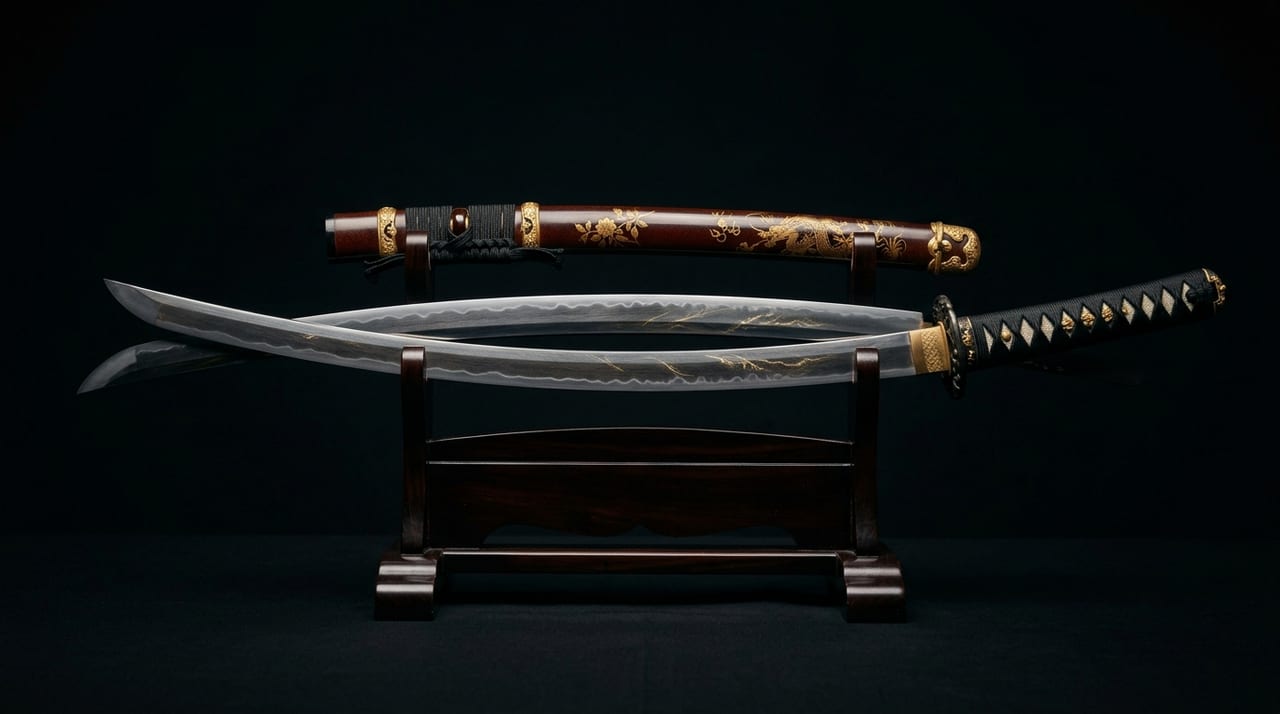
 * Image is for illustrative purposes only.
Fudō Kuniyuki
不動国行
Also known as: Fudō Blade; Supreme Work of Kuniyuki
Description
Overview of the Sword
Fudō Kuniyuki is a tachi transmitted as the work of the celebrated master Rai Kuniyuki of the mid-Kamakura period, and is a masterpiece of the Yamashiro tradition once designated as an Important Cultural Property. With a blade length of just over 2 shaku 2 sun 4 bu (approximately 67.9 cm), it displays the magnificent bearing characteristic of a tachi; its refined form, with deep curve at the machi, exemplifies the typical tachi shape of the Yamashiro tradition in the Kamakura period. Rai Kuniyuki was either the founder or a direct descendant of the Rai-ha, a smith family from Yamashiro Province (Kyoto), and is regarded as the supreme master of Yamashiro tradition smiths in the mid-Kamakura period. The name "Fudō" derives from a carving of Fudō Myōō engraved near the tang (nakago). As a tachi known to be by Rai Kuniyuki, this blade represents the apex of sword aesthetics produced by Yamashiro Province—the cultural center of the Heian and Kamakura periods—and, alongside the Awataguchi school active in the same era, stands as a shining exemplar of the Rai school, which formed the twin pillars of the Yamashiro tradition; it commands unwavering trust among sword scholars.
Rai Kuniyuki and the Rai School Sword-Smith Tradition
The Rai-ha was a smith family from Yamashiro Province (Kyoto), with Rai Kuniyuki as its founder, and produced many celebrated masters including Kunishun, Kunimitsu, Kunitsugu, and Rinmitsu. The swords of the Rai school, based on characteristic features of the Yamashiro tradition—densely packed ko-itame hada, uniform distribution of fine nie, and the quiet refinement of straight hamon or small ko-midare—established their distinctive beauty through combination with the magnificent tachi forms peculiar to the Kamakura period. Among the Rai school, which formed the twin pillars of the Yamashiro tradition alongside the Awataguchi school, the works of Kuniyuki stand foremost and are highly valued in connoisseurial circles as supreme testimony to his mastery. In Fudō Kuniyuki's ji-gane, the Rai school's characteristic ko-itame hada is densely packed; the ji-nie distributes finely and uniformly with a deep luster, concentrating the very essence of Rai school aesthetics. The swords of the Rai school embody a "miyabi" (elegance) aesthetic unique to Yamashiro Province (Kyoto), distinct from the intensity of the Sōshū tradition and the rigor of the Yamato tradition; they represent the supreme achievement of smith artistry born from the cultural environment of Kamakura-period Kyoto—the successor city to Heian-kyō where courtly culture remained deeply rooted.
The Hamon Landscape—Hamon Housing the Flames of Fudō Myōō
The hamon of Fudō Kuniyuki is based on a straight-edge ko-midare pattern, with fine nie distributed uniformly along the edge. The hamon interior is rich in ashi and ha, displaying the ethereal hamon landscape characteristic of Kuniyuki's work. The hamon scenery, also said to be the origin of the name "Fudō," exhibits characteristic features such as kinsuji and inazuma patterns that evoke the flames of Fudō Myōō (karura-en), according to one interpretation. Fudō Myōō, as a Buddhist wisdom king, is typically depicted wielding a sword to vanquish evil, surrounded by fierce flames (the Kurikara-dragon sword and karura-en). In Japanese warrior society, Fudō Myōō was deeply venerated as the buddha of "victory in battle, disaster prevention, and national protection," and naming a sword Fudō imbued it with the meaning of the supreme protective charm. The combination of Fudō Myōō-like hamon scenery and its religious naming condenses the deep bond between Kamakura-period warriors and Buddhism into the blade itself, and even today serves as a historical testament that imparts a profound impression on all who view it.
The Mystery Surrounding the Rai School's Origins and the Heart of the Yamashiro Tradition
Regarding the character "Rai" in Rai-ha, it has been suggested that it may signify "Kuniyuki who came"—that is, a smith who came to Kyoto from a foreign land or another region. The theory that immigrant craftsmen from the Korean Peninsula and Chinese mainland influenced Japanese sword-making culture is a long-standing point of discussion in theories about the origins of the Japanese sword, and the Rai school's name is one focal point of this scholarly debate. While there is no definitive proof, this mysterious lineage deepens scholarly interest in Rai Kuniyuki and is carried forward by modern sword scholars as an important question in Yamashiro tradition research. Because extant swords by Kuniyuki are few in number, authenticated works bearing his signature are particularly prized by connoisseurs, and Fudō Kuniyuki holds a place of special distinction as the representative example among them.
Provenance and Modern Custody
Although the detailed provenance of Fudō Kuniyuki does not extend before the Muromachi period, by the Edo period it was recognized as a celebrated object in the possession of the shogunate and daimyo houses, and was recorded in the Kōhō Meibutsu-chō (Register of Famous Objects). After its transmission to the Ashikaga shogunal house, it passed through the hands of successive unifiers of the realm—Oda Nobunaga, Toyotomi Hideyoshi, and Tokugawa Ieyasu—before being transmitted to the Tokugawa main house. It was designated as an Important Cultural Property in 1937 (Shōwa 12), but its specific location after the Meiji period remains unclear.
The Beauty of the Yamashiro Tradition—Proof of Rai Kuniyuki's Supreme Mastery
The reason Fudō Kuniyuki has been valued since antiquity as a masterpiece of the Yamashiro tradition lies in the level of "completion" that Rai Kuniyuki's technique demonstrates. This tachi, eschewing excess ornamentation and theatrical flourish, demonstrates the highest standard in achieving balanced completion between the essential beauty of the steel and the hamon, embodying the aesthetic endpoint that the Yamashiro tradition accumulated over its long history. The name of the smith Rai Kuniyuki is eternally bound to this single blade, Fudō Kuniyuki; as the legacy this meeting left in Japanese sword history, this tachi continues to move deeply all who encounter it—collectors and scholars alike.
Legends & Stories
The 'Rai' in Rai Kuniyuki's school name has generated centuries of debate: does it mean the family name 'Rai,' or does it mean 'one who has come' — pointing to an origin outside Japan, perhaps from the Korean peninsula or China? The theory of continental origins for the Rai school has never been conclusively proven or disproven. What it reflects is a truth about the Yamashiro tradition itself: Kyoto in the Kamakura period was a city of extraordinary cultural synthesis, absorbing influences from Tang and Song China, from Buddhist monasteries that maintained their own continental connections, from trade routes that brought metal, techniques, and ideas from across Asia. That the finest school of Kyoto swordsmiths might have begun with a craftsman who came from elsewhere is not implausible — it is, in fact, a characteristically Japanese story, the story of how continental techniques were absorbed, transformed, and refined until they became something entirely Japanese and entirely new. Fudō Kuniyuki is the proof that the transformation succeeded.