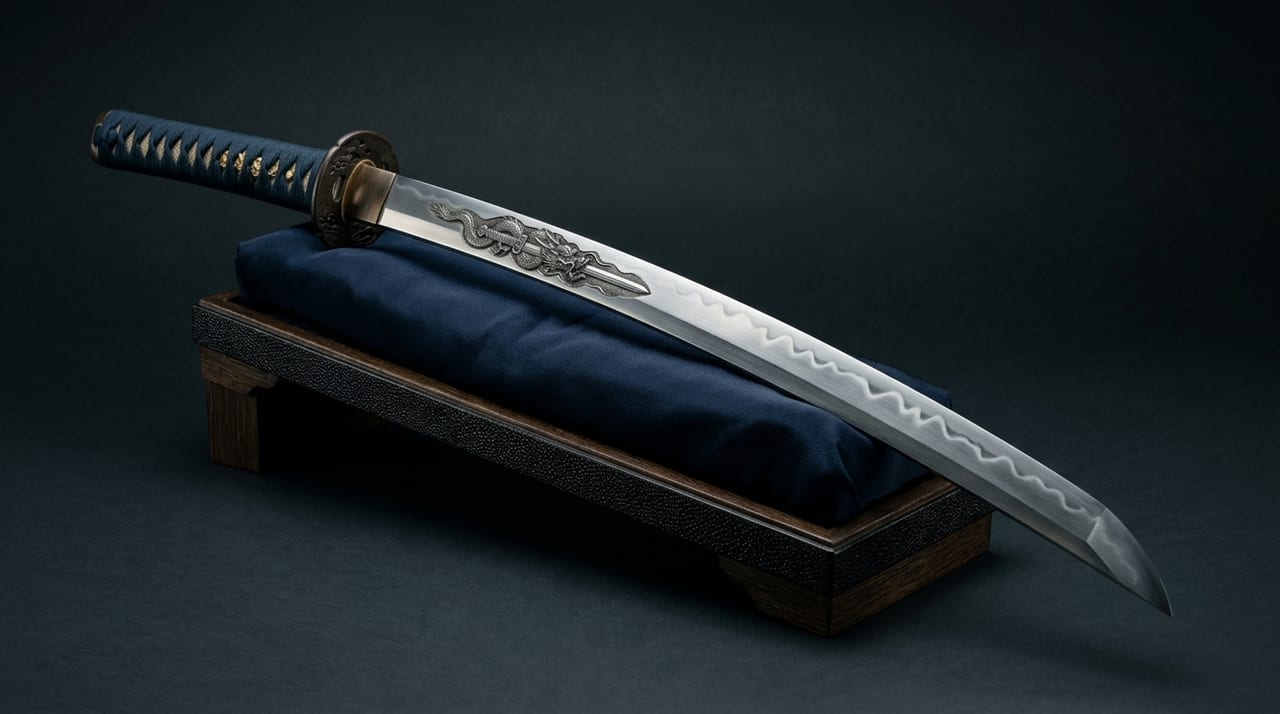
 * Image is for illustrative purposes only.
Beloved Swords of Date Masamune
伊達政宗の愛刀
Also known as: Record of Masamune's Swords (Ōkurikara, Black-lacquered mounts, Swords of the One-eyed Dragon of Ōshū)
Description
Date Masamune (1567–1636), known by the alias "Dokuganryū Masamune" (the "One-Eyed Dragon"), was an eminent general of the late Sengoku and early Edo periods who dominated Ōshū (present-day Tōhoku region). He is renowned as a daimyo who possessed both martial spirit and refined cultural accomplishments. Masamune possessed keen connoisseurship of swords and actively collected "famous swords under heaven" while fostering a distinctive sword culture in Ōshū. Among his treasured blades, the "Ōkurikara" stands foremost among a collection of celebrated swords.
### Ōkurikara—A Famous Ōshū Blade Carved with the Kurikara Dragon
The Ōkurikara is a sword attributed to Hiromitsu, a swordsmith of Sagami Province (present-day Kanagawa Prefecture) during the Nanboku-chō period. The name derives from the carved depiction of the Kurikara dragon—the serpent that coils around the Kurikara sword—etched upon the blade. The Kurikara symbolizes the Dragon-Sword manifestation of Fudō Myōō and was revered by the warrior class as "the sword that severs evil." The Date clan held this blade in particular esteem as a family treasure and transmitted it to posterity as one of the symbolic swords of the Sendai domain. Originally a large tachi of approximately three shaku in length, it was substantially re-ground during the Sengoku period to become a blade of approximately 67.6 cm. The steel displays the reciprocal-pattern gunome-midare characteristic of the Sagami tradition, with profuse nie, and the carved Kurikara dragon is skillfully positioned in harmony with the natural curvature of the blade. According to tradition, this sword was bestowed upon Tadamune, the second lord of the Date clan, by Tokugawa Hidetada, the second shogun, as a reward for meritorious service in the 1620 construction of Edo Castle's stone walls. It is currently designated as an Important Cultural Property.
### Black Lacquer Mounts—Manifesting Masamune's Aesthetic Sensibility
The swords of Date Masamune are distinguished by their "black lacquer koshirae" (mounting), a martial aesthetic centered on the color black. Masamune possessed an intense attachment to jet-black lacquer and created a unified visual statement by coordinating his armor (the famous black lacquer five-plate lamellar dō), horse gear, and sword mounts entirely in black, thereby dramatizing "the authority of the One-Eyed Dragon." The scabbard is polished to a lustrous black lacquer finish; the handle grip employs black-dyed ray skin bound with black braided cord. For Masamune, black transcended mere pigment—it embodied the "aesthetic of Masamune," a symbolic expression concentrating the image of a supreme ruler commanding the dark earth and night sky of Ōshū. The Sendai City Museum currently holds multiple sword fittings associated with Masamune, and the mountings exemplifying this aesthetic of black continue to draw the interest of scholars and sword enthusiasts.
### The Sword Culture of Ōshū—The Northeastern Sword Tradition Nurtured by Masamune
Within the domain governance of Sendai, Masamune devoted considerable effort to the promotion of sword culture, inviting accomplished smiths to the domain to develop a distinctive style also known as "Sendai-uchi." During the Sengoku period, he sought swords that prioritized practical functionality for actual combat, but upon the advent of peace, he focused on collecting celebrated swords that combined artistic merit with martial purpose. It is also recorded that Masamune was exposed to the swords and sword culture of the Korean peninsula during the Korean campaigns (1592–1593), thus harboring an interest in foreign sword traditions.
The cherished swords of Masamune embodied "the martial authority of the One-Eyed Dragon" and became objects of popular reverence from the Edo period onward, serving as material for kōdan storytelling and kabuki drama. Today, the Sendai City Museum and Zuihōden preserve multiple swords and sword mountings associated with Masamune, which are carefully safeguarded as cultural heritage representing the martial culture of the Tōhoku region.
Legends & Stories
The most celebrated legend surrounding Date Masamune's swords concerns the "miraculous power" of Ōkurikara. On the night Masamune first held the blade, the carved Kurikara dragon is said to have appeared to move, or a blue flame to have dwelt in the steel. From that point on, Masamune prayed before Ōkurikara before every major battle, seeking the protection of Fudō Myōō — and the belief spread that Masamune's indomitable spirit, which allowed him to survive the era of the three great unifiers (Nobunaga, Hideyoshi, Ieyasu) without final defeat, was due to the blade's spiritual power. Regarding his black-lacquered sword mounting, a tradition holds that after the Battle of Sekigahara (1600), Tokugawa Ieyasu was struck by the beauty of Masamune's black koshirae and asked, "Who made this mounting?" When Masamune replied, "Craftsmen of Ōshū made it at my command," Ieyasu declared, "The craftsmen of Ōshū possess a skill to be proud of before the realm" — a story that has been passed down as testimony to the cultural excellence of the Tōhoku region.