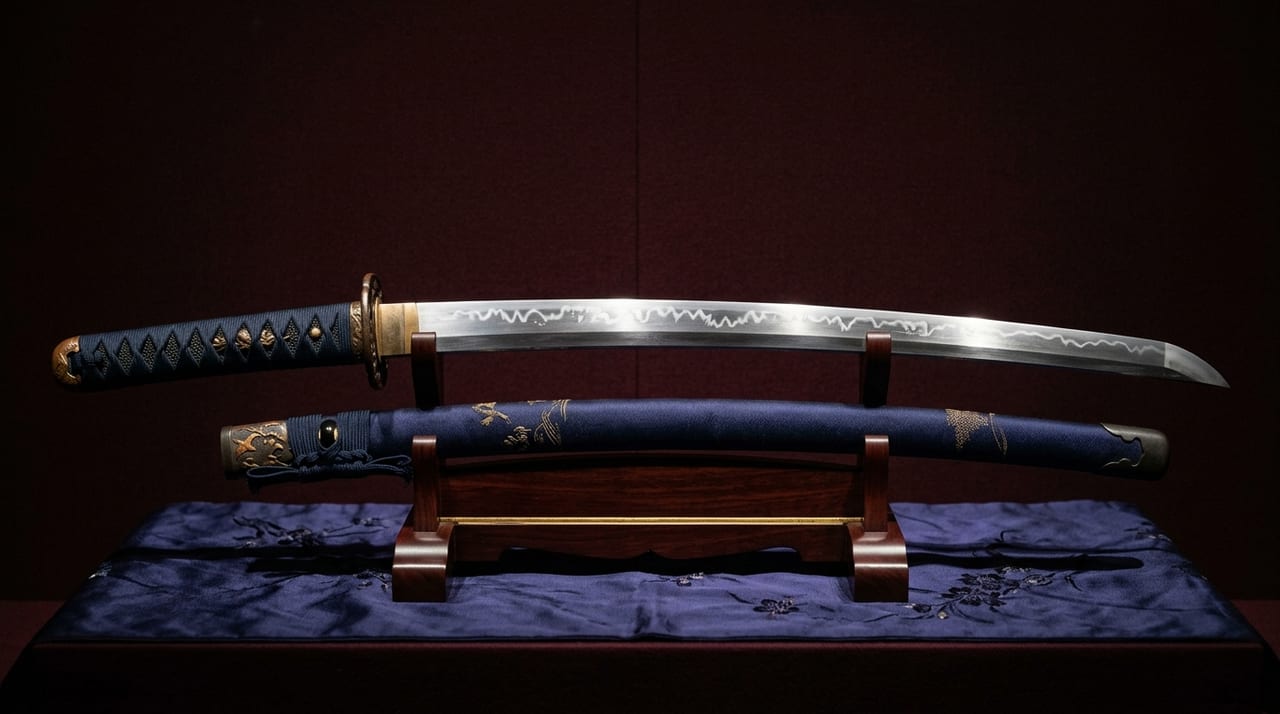
 * Image is for illustrative purposes only.
Tachi by Bizen Norimune
備前則宗の太刀
Also known as: Norimune Tachi
Description
Ichimonji Norimune was a swordsmith active in Bizen Province (present-day Okayama Prefecture) in the early Kamakura period, and is also regarded as the founder of the Ichimonji school, which produced swords of the highest standard of its time. This tachi has a slender body with a small kissaki, high koshi-zori and strong fumbari, displaying the elegant form typical of the early Kamakura period. The hamon is suguha-chō, consisting mainly of ko-chōji mixed with ko-midare, with ko-nie. The jigane is composed of tightly packed ko-itame with ji-nie, and distinct midare-utsuri appears. Signed 'Norimune' on the nakago, this tachi is held in the highest regard as a work representing the technical pinnacle of the Ichimonji school, and is designated a National Treasure.
Legends & Stories
In the 3rd year of Shōhō (1646), at the hatsumiyamairi (first shrine visit) of Tokumatsu, the fourth child of third shogun Tokugawa Iemitsu (later the fifth shogun Tokugawa Tsunayoshi), this tachi was donated to Hie Shrine. Norimune is traditionally said to have been the head of the goban-kaji (sword smiths on rotation) for Retired Emperor Go-Toba, and he is also known by the name 'Kiku Ichimonji', after the 'Kiku-gosaku', a work said to have had its yakiba (hardening of the blade) performed by the retired emperor himself. However, no sword by Norimune is inscribed 'Kiku Ichimonji'.
Related Famous Swords
姫鶴一文字
Important Cultural PropertyHimetsuru Ichimonji
Ichimonji School (Bizen)
同田貫正国
Kumamoto Prefecture Important Cultural Property (a Masakuni blade held by Honmyō-ji), among othersDōtanuki Masakuni
Dōtanuki Masakuni (Higo Dōtanuki school)
毛抜形太刀
National Treasure / Important Cultural Property (multiple designated examples)Kenuki-gata Tachi
Unknown (Heian period)
一期一振
Gomotsu (Imperial Collection)Ichigo Hitofuri
Awataguchi Yoshimitsu