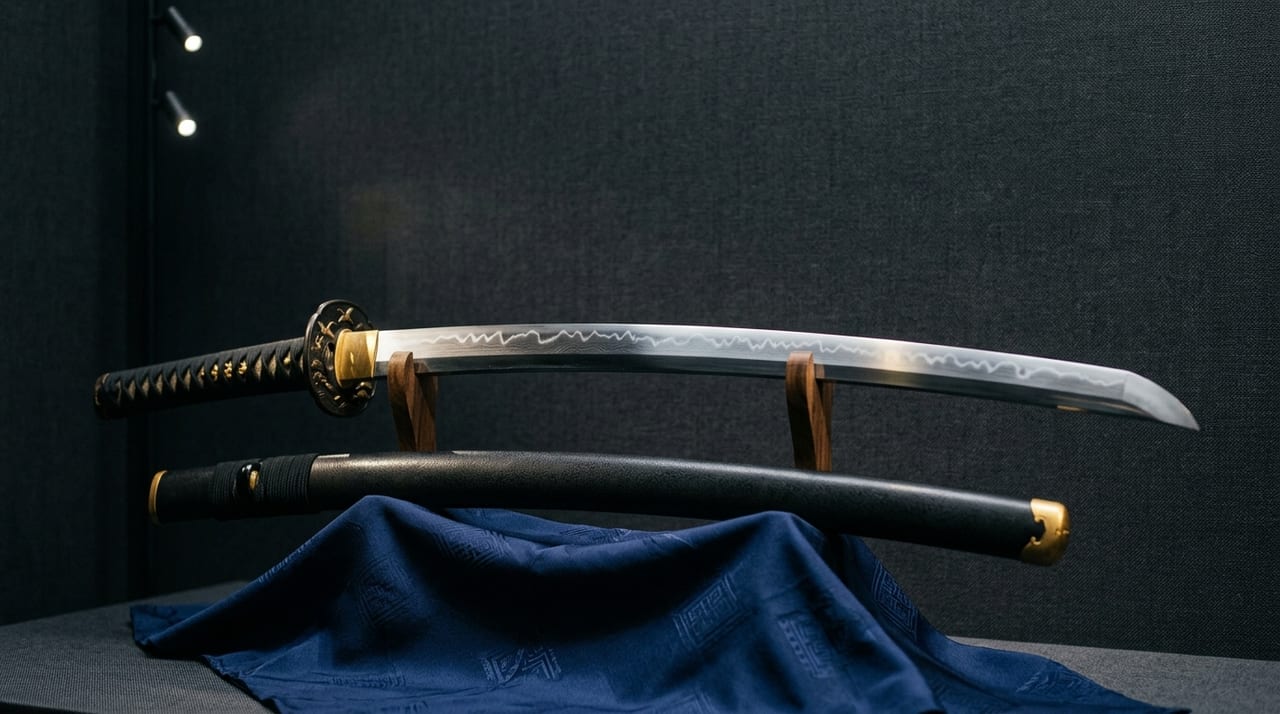
 * Image is for illustrative purposes only.
Azuki Nagamitsu
小豆長光
Also known as: Azuki Bean Sword
Description
Sword Overview
Azuki Nagamitsu is a masterwork tachi forged by Nagamitsu, the celebrated smith of Bizen Osafune, and is known as the beloved sword of Uesugi Kenshin, one of the greatest warlords of the Sengoku period. The legend that gave rise to its name—'when an azuki bean was placed on the blade, it split perfectly in two'—exemplifies the extraordinary sharpness of Nagamitsu's cutting edge, a tale passed down through generations of sword connoisseurs. Nagamitsu, together with his son Kagemitsu, was among the supreme masters representing Bizen Osafune in the late Kamakura period, and his swords have been regarded since antiquity as 'the finest treasures under heaven.'
Creator: Nagamitsu of Bizen Osafune
Nagamitsu was a swordsmith of the late Kamakura period who lived in Bizen Province (present-day Okayama Prefecture), and is said to have been the son of Mitsutada, the reputed founder of the Bizen Osafune school. The Bizen Osafune school, continuing an unbroken tradition of swordmaking stretching from the late Heian period through Bizen Province, reached its pinnacle of technical excellence in the late Kamakura period—a prestigious lineage. Nagamitsu's swords have been renowned since antiquity for the refined quality of their ji-tetsu (ground steel) and the exquisite beauty of their hamon (blade patterns), particularly the choji-midare formation. 'Nagamitsu's choji' is universally praised by later sword scholars as the signature characteristic of the Bizen tradition. The ji-tetsu displays a finely compacted koita-meshada (small-plank grain structure), with ji-nie (ground bloom) adhering throughout in finest particles, presenting a lustrous iron color. The hamon is based on choji-midare, with abundant ashi (foot marks) and ha (leaf marks), the nioiguchi (aroma mouth) bright and vivid. The kissaki (point) returns in small rounded form; the nakago (tang) is in its original state with a single mekugi-ana (peg hole), and the two-character mei (signature) reading 'Nagamitsu' is cut with precision. Nagamitsu's extant signed works are relatively numerous, and among them Azuki Nagamitsu is particularly distinguished as a masterwork of exceptional condition and clear provenance.
Connection with Uesugi Kenshin
Uesugi Kenshin (1530–1578) was one of the greatest warlords of the Sengoku period, based in Echigo Province, celebrated as the 'Dragon of Echigo' and the 'God of War.' Kenshin was a devoted worshiper of Bishamonten and fought under the banner of 'righteousness' (gi), earning reverence through the ages. Kenshin's sword collection was extraordinarily extensive, and many masterwork swords that he possessed have been transmitted through the Uesugi family. Azuki Nagamitsu is known to have been a tachi that Kenshin especially cherished, and it is said that it was worn at Kenshin's side in battle. The spirit of 'righteousness' that was the spiritual foundation of Kenshin's life and the flawless cutting power of Nagamitsu's tachi—this combination perfectly symbolizes Kenshin as a warrior. After Kenshin's death, Azuki Nagamitsu was transmitted through the Uesugi family, but it left the family in the modern era, and its current whereabouts are unknown. (It was designated an Important Cultural Property during the Showa period, but it is said to have been sold thereafter.)
The Azuki Bean Legend and Sharpness
The legend that gave rise to the name of Azuki Nagamitsu is widely known as a vivid expression of this tachi's extraordinary sharpness. When an azuki bean was placed on the blade, the bean split perfectly in two and flew to both sides. The azuki bean is an extremely small and hard legume; with an ordinary blade, it would only be struck and pulverized, or deflected. To bisect it the instant it comes to rest on the blade requires the blade edge to be honed to an extremely acute angle, and the hardness and toughness of the steel must maintain perfect balance. This legend represents a 'mythology of sharpness' born from the combined skill of the polisher and the superior quality of the sword's steel, and it has been transmitted to later generations as an emblematic expression of a masterwork's cutting ability.
Uesugi Shrine and Yonezawa Sword Culture
After Kenshin's death, the Uesugi family was reduced to 300,000 koku in Yonezawa following their support of the Western Army at the Battle of Sekigahara. Uesugi Kagetoshi and Naoe Kanetsugu preserved the Uesugi family's cultural heritage amid severe financial constraints and transmitted the sword collection associated with Kenshin. Uesugi Shrine in Yonezawa currently houses numerous relics of successive Uesugi lords—Kenshin, Kagetoshi, and Takayama—but Azuki Nagamitsu itself left the Uesugi family in the modern era and its current whereabouts are unknown. That Uesugi's sword culture was transmitted to the Tohoku region in Yamagata Prefecture stands as historical testimony to the richness and depth of the region's samurai culture.
Legends & Stories
The Legend of the Azuki Bean Split
The anecdote that gave the name Azuki Nagamitsu to the world is known as one of the most elegant and memorable among the many legends that speak of a blade's sharpness. To split a single small bean cleanly in two — why has this seemingly trivial event been passed down as a test of a great sword?
The traditional methods of testing a blade's sharpness include test-cutting (cutting paper or bamboo) and actual test-cutting (using bundled straw, rolled straw, or the bodies of executed criminals). However, the story of "splitting an azuki bean in two" is distinctive because of its delicacy. Cutting through bundled straw certainly requires considerable sharpness, but to "thin-cut" rather than "smash" something as small and hard as an azuki bean requires the edge to reach an ultimate level of acuteness. When the blade is held upright and the bean is placed on the tip, a sharpness such that the bean is cut through by its own weight alone — this is what "an edge that splits azuki beans" means.
This anecdote is said to have been attached to this tachi either before Kenshin possessed it, or to have occurred when Kenshin himself tested it. In any case, the fact that Uesugi Kenshin, the greatest of warriors, chose it as his beloved sword increased trust in the legend's truth. If such a general as Kenshin had selected this tachi, there would be nothing surprising about its possessing a sharpness capable of splitting azuki beans — such confidence gave the legend its persuasiveness.
Kenshin's Faith and the Sword
Uesugi Kenshin held Bishamonten as his tutelary deity with deep devotion. Before each campaign, he invariably prayed to Bishamonten and advanced to the battlefield under the banner of "Bi" — the character for Bishamonten. Bishamonten is one of the Four Heavenly Kings in Buddhism, guardian of the north and the bestower of victory upon warriors. That Kenshin chose Azuki Nagamitsu as his beloved sword may be understood to reflect not merely its superior sharpness, but also his trust in it as a sacred blade infused with prayers to Bishamonten. The graceful and dignified bearing of Nagamitsu's tachi matched well the spirit of the "righteous warrior" that Kenshin idealized.
The Uesugi Family's Move to Yonezawa and the Preservation of Swords
Defeated at the Battle of Sekigahara, the Uesugi family underwent a massive reduction in domain from 1.2 million koku in Aizu to 300,000 koku in Yonezawa. Many retainers were compelled to enter the service of other houses, but Uesugi Kagekatsu and Naoe Kanetsugu upheld the spirit of "righteousness" that defined the Uesugi house, and despite the severe finances of the reduced domain, they continued to preserve with care the collection of swords that had been passed down since Kenshin's time. However, the whereabouts of Azuki Nagamitsu itself remain unclear, and it is said that its current location is unknown (not even a rubbing of the tang has been confirmed). Meanwhile, at Uesugi Shrine, other swords associated with Kenshin — such as Himetsuru Ichimonji — have been transmitted to the present day.