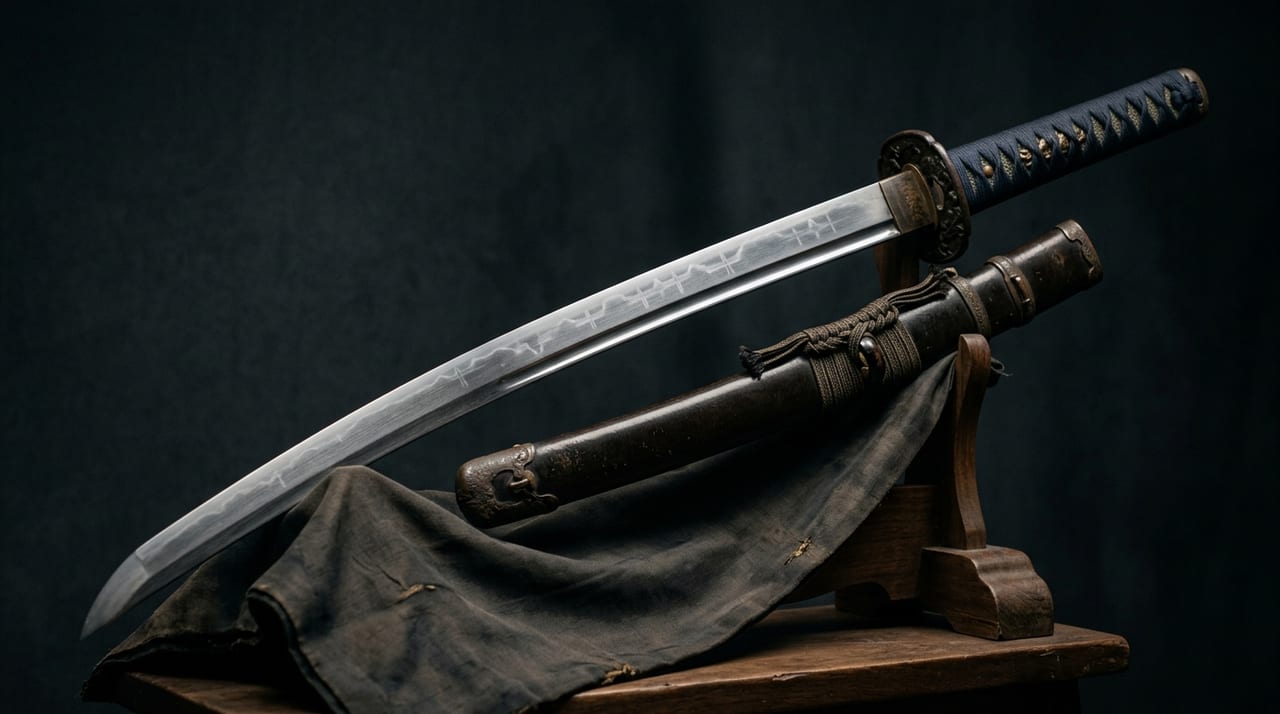
 * Image is for illustrative purposes only.
Atakigiri
安宅切
Also known as: Ataki-giri / The late-Bizen blade of the Kuroda house
Description
A late-Bizen blade handed down in the Kuroda house
The Atakigiri is an uchigatana by Sukesada, a smith active at Osafune in Bizen province in the late Muromachi period, dated to the eighth month of Daiei 4 (1524). Blade length 61.2 cm, curvature 2.4 cm. It is a sound example representative of the group known as "late Bizen" (sue-Bizen), which supplied large numbers of practical battle blades after the Ōnin War. It was handed down in the Kuroda house of Fukuoka domain.
The name: the battle at Yura Castle on Awaji
The name derives from the sword's exploits in battle. In 1581 (Tenshō 9), ahead of Toyotomi Hideyoshi's campaign against Shikoku, Kuroda Josui (Kanbei Yoshitaka) crossed to Awaji province and attacked Ataki Kawachi-no-kami Takayasu of the Miyoshi clan, who held Yura Castle (present-day Sumoto, Hyōgo Prefecture). It is said that because Josui cut down Ataki Kawachi-no-kami with this very blade, it came to be called "Atakigiri." The front face of the tang bears a gold-inlaid cutting-test inscription reading "Ataki-giri / wakige otoshi." "Wakige" denotes the test cut through the armpit, considered more demanding than cutting through the torso, and the inscription serves as proof of the blade's sharpness.
A Momoyama masterpiece of mounting: kin-arare-zame ao-urushi uchigatana koshirae
The blade is also renowned as a masterpiece of mounting. The scabbard has blue lacquer applied over a gold hail-pattern (kin-arare) ground, and the hilt is wrapped in vermilion-lacquered ray skin. This mounting, "kin-arare-zame ao-urushi uchigatana koshirae," vividly displays the extravagant spirit of the Momoyama period. The habaki is a two-layer solid-gold habaki attributed to the master Umetada Myōju. The Important Cultural Property designation was made for this mounting, and the blade is designated together with it as an attached item (tsuketari). It is currently held by the Fukuoka City Museum, which houses the Kuroda family materials.
The age of late Bizen
Sukesada was a hereditary name passed down through generations at Osafune. During the Sengoku period, many smiths bore the name, including Yosozaemon-no-jō Sukesada and Hikobei-no-jō Sukesada. The Bizen blades of this era, made to meet the surge in demand for practical weapons after the Ōnin War, are collectively called "late Bizen." They divide into mass-produced kazuuchimono and carefully forged blades made to order for daimyo and senior samurai. The Atakigiri, handed down with its date inscription, name, cutting-test inscription and Momoyama mounting, is a superior example of the made-to-order blades. It is regarded as one of the benchmark works that convey the capability of late Bizen to the present day.
Legends & Stories
A strategist who wielded the blade himself
Kuroda Josui is usually remembered as the strategist behind Hideyoshi's campaigns rather than as a swordsman. The tradition that he personally cut down the enemy commander Ataki Kawachi-no-kami has therefore always been told with relish, as evidence that the great tactician was no mere armchair planner. That the sword takes its name directly from the man it killed is itself a reminder of how plainly Sengoku sword culture recorded such deeds.
The "wakige otoshi" inscription
The gold-inlaid characters on the tang record the result of an Edo-period cutting test. Such tests commonly involved stacking torsos — futatsu-dō, mitsu-dō and so on — but wakige, a cut passing through the armpit where bone and sinew gather, was regarded as far more difficult, testing the skill of the cutter as much as the sharpness of the blade. The Atakigiri thus combines the pedigree of a celebrated name with documented proof of its cutting power.