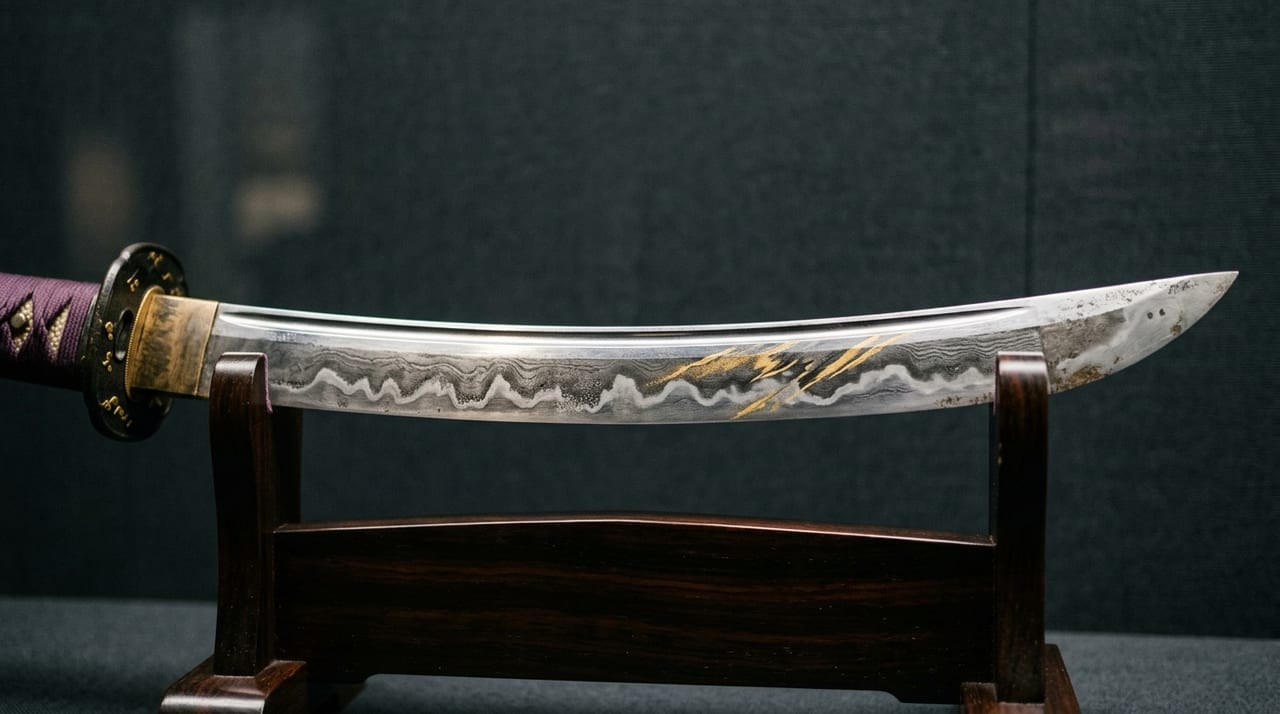
 * Image is for illustrative purposes only.
Aoki Kanemoto
青木兼元
Also known as: Magara-giri Kanemoto; Katana inscribed 'Kanemoto'
Description
Aoki Kanemoto is an uchigatana forged in the Muromachi period by the master smith Magoroku Kanemoto (Seki no Magoroku) of Seki in Mino Province (present-day Seki, Gifu Prefecture), and it is designated as an Important Art Object. It is regarded as the finest masterpiece among the swords made by Magoroku Kanemoto.
Magoroku Kanemoto (also called second-generation Kanemoto) was a master smith representing Seki in Mino Province, widely known today as "Seki no Magoroku," and was particularly skilled in the distinctive gunome known as sanbon-sugi ('three cedars') in the hamon. Sanbon-sugi is a distinctive hamon in which gunome form in groups of three and continue in succession, embodying the practical beauty of the Mino tradition. Aoki Kanemoto bears the two-character signature "Kanemoto" on the sashi-omote, and its hamon displays the distinctive gunome-midare known as "Seki no Magoroku sanbon-sugi."
The blade length is 70.6 cm (2 shaku 3 sun 3 bu), a standard length for a practical blade. Its form combines practical beauty, with the shinogi-suji standing out in a well-balanced silhouette.
As for its provenance, it is said that in the Battle of Anegawa in Genki 1 (1570), Aoki Kazushige, a warrior on the Tokugawa side, used this sword to slay the fierce Asakura generals Magara Naotaka and his brother Magara Naozumi (some accounts say Naotaka's son Takamoto). This gave rise to the names "Aoki Kanemoto" and "Magara-giri Kanemoto." Magara Naotaka was known as a towering giant of a warrior who wielded a great sword called the "Tarō-tachi," and the renown of Aoki Kanemoto, which had struck down Naotaka, spread among the Sengoku warlords. After Aoki Kazushige's death, in accordance with his will, the sword was presented to Niwa Nagashige, eldest son of Niwa Nagahide, and was passed down in the Kodama Niwa family until modern times. In September 1939 (Shōwa 14), it was designated an Important Art Object (the owner at the time was Viscount Niwa Nagatoku).
Legends & Stories
Aoki Kanemoto is said to be the sword with which Aoki Kazushige defeated the Magara clan of the Asakura forces, who fought fiercely wielding great swords, in the Battle of Anegawa in Genki 1 (1570), and the name "Magara-giri" also derives from this anecdote. The great sword "Tarō-tachi," said to have been used by Magara Naotaka, is currently housed at Atsuta Jingū.