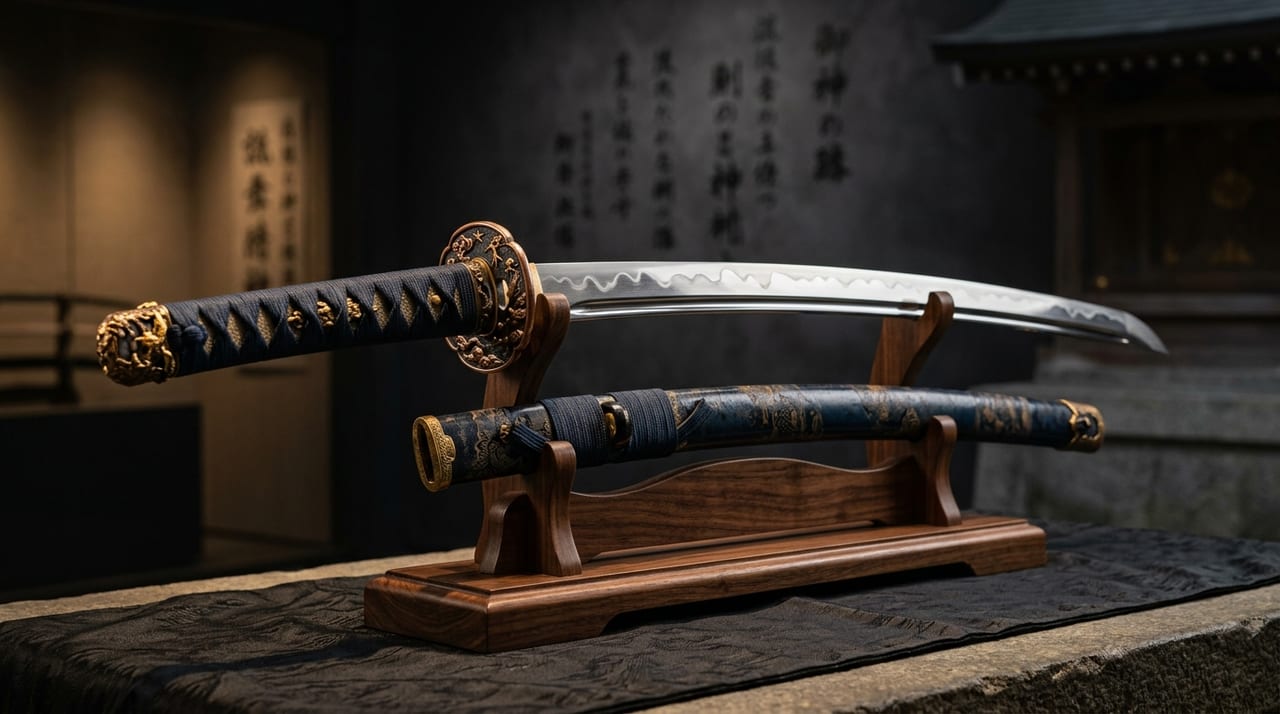
 * Image is for illustrative purposes only.
Ama-no-Habakiri
天羽々斬
Also known as: Heaven's Feather Cutter; Snake-Slaying Sword of Susanoo
Description
Overview of Ama-no-Habakiri — Susanoo's Serpent-Slaying Sword
Ama-no-Habakiri (Heaven's Feather Cutter) is the sword that Susanoo-no-Mikoto wielded when he slew the eight-headed serpent Yamato-no-Orochi in the Kojiki and Nihon Shoki, and it is distinguished from the Kusanagi-no-Tsurugi as a "separate divine sword" recorded in these texts. According to the Kojiki, after Susanoo defeated Yamato-no-Orochi, he drew the Kusanagi (Ama-no-Murakumo-no-Tsurugi) from the serpent's tail; the sword he wielded in that battle came to be called "Ama-no-Habakiri" or "Orochi-no-Aramasa" (Serpent's Rough Rectitude). In other words, Ama-no-Habakiri is "the sword Susanoo carried and fought the serpent with," while Kusanagi is "the sword discovered within the serpent's body." This distinction is crucial to understanding the Kojiki/Nihon Shoki narratives: Ama-no-Habakiri must be understood as a separate divine sword with its own divine character and narrative, distinct from Kusanagi as "the sword that cut down the serpent."
The Meaning of Ama-no-Habakiri's Name and Its Mythological Positioning
"Haha" (羽々) is an ancient word for serpent, and "Ama-no-Habakiri" is understood to mean "the heavenly (honorific) + serpent-cutting sword," and its name indicates a divine sword with absolute sharpness deriving from the heavens. In the Kojiki account of the serpent slaying, Susanoo is described as wielding a Ten-Fist Sword (Totsuka-no-Tsurugi) and successively cutting off the heads of Yamato-no-Orochi. "Totsuka" (ten-fist) refers to "the length of ten fists," an expression indicating the standard sword length of that era. Whether the multiple names "Ten-Fist Sword," "Ama-no-Habakiri," and "Orochi-no-Aramasa" refer to the same sword or different swords has been debated among scholars since ancient times, reflecting the complex formation process of the Kojiki/Nihon Shoki mythologies. In any case, Ama-no-Habakiri is a divine sword at the heart of mythology as "the sword of order restoration by which a god cut through the chaos of the serpent."
Its Relationship with Isonokami Jingū
The "physical object" identified as Ama-no-Habakiri is said to be enshrined as a sacred body (shintai) at Isonokami Jingū. Located in Tenri City, Nara Prefecture, Isonokami Jingū is recognized in the Kojiki and Nihon Shoki as the place where the divine swords borne by the kami Takemikazuchi and Futsunoushi descended, and it is acknowledged as one of Japan's oldest shrines with supreme sacred character. The shrine preserves numerous ancient swords as divine objects, including the Seven-Branched Sword, and possesses the character of a "sacred sanctuary of divine swords." The tradition that Ama-no-Habakiri is kept in this "sacred sanctuary of divine swords" positions Isonokami Jingū as a "physical monument to the myth of Susanoo and Yamato-no-Orochi," making the shrine a place where the boundary between myth and reality becomes thinnest, and imbuing it with special religious and cultural significance. No detailed scholarly investigation has been conducted on the "Ama-no-Habakiri" that currently survives, but it is carefully protected as part of Isonokami Jingū's sacred treasures.
The Religious and Cultural Meaning of the Serpent-Slaying Myth
The role that Ama-no-Habakiri plays in the myth of Yamato-no-Orochi's subjugation carries deep religious and cultural significance transcending the mere function of a weapon. The overwhelming eight-headed serpent symbolizes "disorder, chaos, and the violence of nature," and the narrative of the divine sword cutting down the serpent is understood as a civilization myth in which "order overcomes chaos" and "divine power triumphs over nature's violence." The mythological motif of "dragon (serpent) and hero" is found in myths worldwide, but the Japanese Yamato-no-Orochi myth adds a unique element: "treasure is born within the serpent's body," embodying the profound philosophical insight that "creation emerges from destruction." The interpretation that Ama-no-Habakiri, as "the sword that brought destruction," and Kusanagi, as "the sword of creation born from that destruction," form a "pair of destruction and creation," represents one of the most fascinating ways of reading the profound philosophical structure of Kojiki/Nihon Shoki mythology.
The Ancient Concept of "Divine Swords" and the Spiritual Foundation of Japanese Sword Culture
The concept of "the sword of a god" demonstrated by the Ama-no-Habakiri myth forms one of the spiritual foundations of later Japanese sword culture. The oldest stratum of the Japanese concept of swords — "a kami dwells in the sword," "the sword is a sacred existence transcending mere weaponry" — traces its source to the myth of Ama-no-Habakiri, which Susanoo wielded against the serpent. In later periods, the belief that "spiritual power resides in a famous sword" becomes a core element of Japanese sword culture, and the mythological prototype of this belief lies in the tale of Ama-no-Habakiri and Susanoo. The sword narrative of the Kojiki and Nihon Shoki — "created by a kami, wielded by a kami, divine sword born from within a kami's body" — is the most primitive and pure expression of Japanese sword theology, which holds that "the sword is the embodiment of divine power." The deep cultural resonance that, even after more than 1,400 years, stirs in the Japanese heart upon hearing the name Ama-no-Habakiri is proof of this enduring truth.
The Cultural Role of Ama-no-Habakiri in the Modern Age
In the modern era, Ama-no-Habakiri's significance is overwhelmingly greater as a "mythological symbol" than as a physical sword. The story of Susanoo and Yamato-no-Orochi continues to be reinterpreted in modern Japanese culture through anime, film, games, and literature, and Ama-no-Habakiri lives on in contemporary expressive culture as a central prop in these narratives. Particularly in games and fantasy literature, the motif of the "serpent-cutting sword" or "serpent-slaying blade" is influenced directly or indirectly by the Ama-no-Habakiri myth, and the tale of Ama-no-Habakiri holds special significance as an example of cultural continuity in which ancient mythology continues to live through to modern popular culture. The "physical Ama-no-Habakiri" enshrined at Isonokami Jingū is not open to the general public, but its existence embodies the fundamental Japanese cultural belief that "myths are sealed within physical objects," quietly exerting influence on the religious and cultural sensibilities of contemporary Japanese.
Legends & Stories
The mythological drama of Ama-no-Habakiri centers on the greatest battle in Japanese mythology: Susanoo against Yamato-no-Orochi, the eight-headed serpent that had consumed seven daughters of an aged couple, and was about to consume the eighth, the beautiful Kushinada-hime. Susanoo's strategy — to brew eight great vats of intensely concentrated sake, wait for the serpent's eight heads to drink them all and fall into a stupor, then descend with his divine sword and cut each head — is notable for winning through wisdom and patience rather than raw force. The scholars of folklore see in the Orochi myth a layer of historical memory: the Izumo region of Shimane Prefecture was the greatest iron-producing area of ancient Japan, using the 'tatara' iron-smelting process that required great earthwork channels to direct river water. The 'eight-headed serpent with blood-red eyes and a belly bright as fire' is plausibly an image of the smelting furnace and its molten outflow — and Susanoo, the storm god whose rain quenches fire, slaying it with a sword and finding the supreme sword within is a mythological encoding of 'the smith masters the furnace and produces the greatest weapons.' The sword identified as Ama-no-Habakiri is kept at Isonokami Jingū — the same sacred preinct that houses the Seven-Branched Sword — in the divine treasury of Japan's oldest shrine of swords, where it remains inaccessible and veiled in sanctity, the first sword in the Japanese mythological imagination and the progenitor of all the divine power attributed to blades in the tradition that follows.