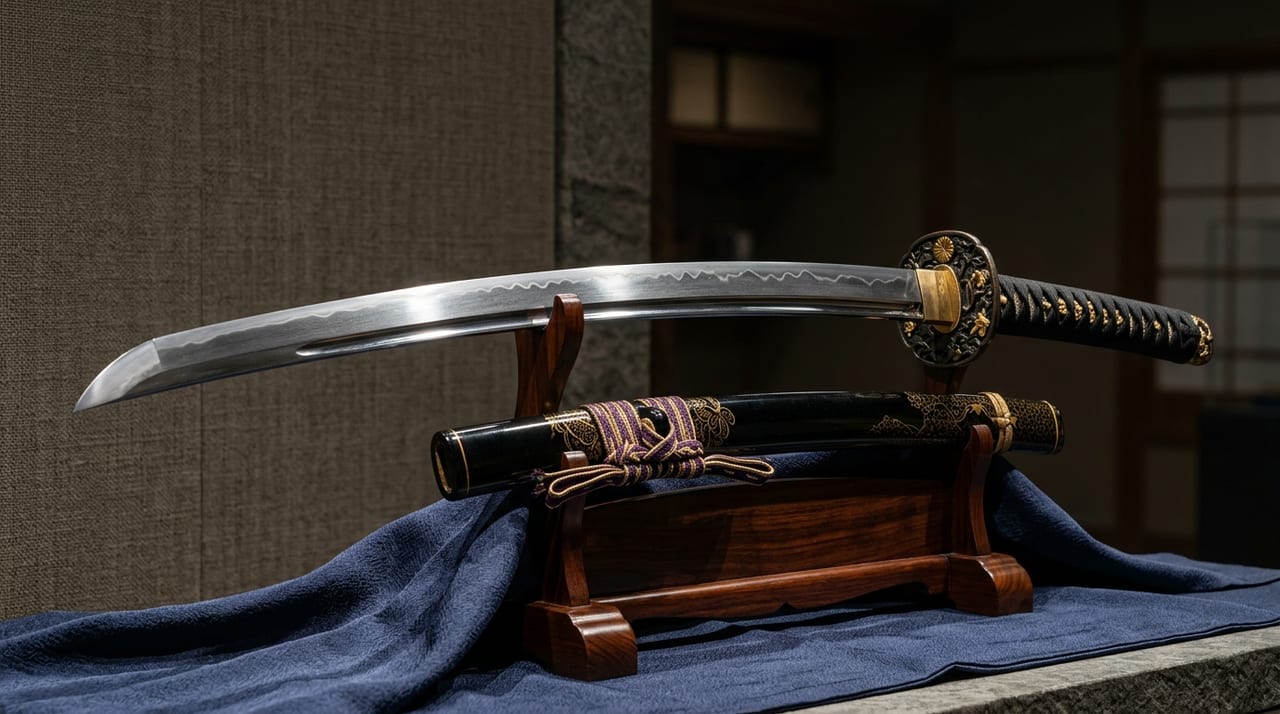
 * Image is for illustrative purposes only.
Aizu Shintōgo
会津新藤五
Also known as: Tantō, signed Kunimitsu (meibutsu Aizu Shintōgo)
Description
Aizu Shintōgo is a tantō made by the swordsmith Shintōgo Kunimitsu, who was active in Kamakura in Sagami Province (present-day Kanagawa Prefecture) during the Kamakura period, and it is designated a National Treasure. The official designation is 'Tantō, signed Kunimitsu (meibutsu Aizu Shintōgo)'.
Shintōgo Kunimitsu is regarded as the founder of the Sōshū tradition (a sword-making school originating in Sōshū Kamakura), and is a swordsmith positioned at the source of the lineage of Sōshū smiths that later produced master smiths such as Masamune and Sadamune. He is renowned as a master of tantō making, and this tantō is well known as one of his representative works that fully displays his skill.
The blade length is 25.5 cm, moto-haba 2.48 cm, uchizori, hira-zukuri, mitsu-mune. The forging is based on ko-itame, with ji-nie scattered evenly throughout and fine chikei present. The hamon is a suguha with a crisp nioi-guchi. Kinsuji appear frequently, and the hataraki (activity) within the blade is considered superb.
Its provenance dates back to the Azuchi-Momoyama period. When Gamō Ujisato governed Aizu in Mutsu as lord of Aizu-Wakamatsu, he possessed this tantō, and the prefix 'Aizu' came from this connection. After Ujisato's death it passed to his eldest son Hideyuki and then to his grandson Tadasato; in Tadasato's time it was transferred to his retainer Morikawa Han'ya, after which Maeda Toshitsune, lord of the Kaga Domain, purchased it for one hundred pieces of gold. In the 4th month of Genroku 15 (1702), it was presented by the Maeda family when the fifth shogun, Tokugawa Tsunayoshi, made an onari (formal shogunal visit) to the Maeda residence. Because the scabbard bears the inscription ('Chigen'in-sama on-sashi no uchi'), it is known that it was a protective sword (mamori-gatana) presented at the oshichiya (seventh-night celebration after a birth) of Iechiyo, son of the sixth shogun Tokugawa Ienobu, who was born in Hōei 4 (1707). It continued to be passed down within the Tokugawa shogunal family until after the Meiji Restoration. From the modern period onward, it passed through the hands of private collectors, and in 2018 it was donated to Fukuyama, Hiroshima Prefecture, by the wife of collector Komatsu Yasuhiro, and it is held by the Fukuyama Museum of Art.
It was designated a former National Treasure under the former National Treasures Preservation Law in Shōwa 8 (1933), and on 9 June 1951 (Shōwa 26) it was designated a National Treasure (shin-kokuhō) under the Law for the Protection of Cultural Properties. It is known as a masterpiece among tantō, and is also positioned as an important standard example in research on the Sōshū tradition.