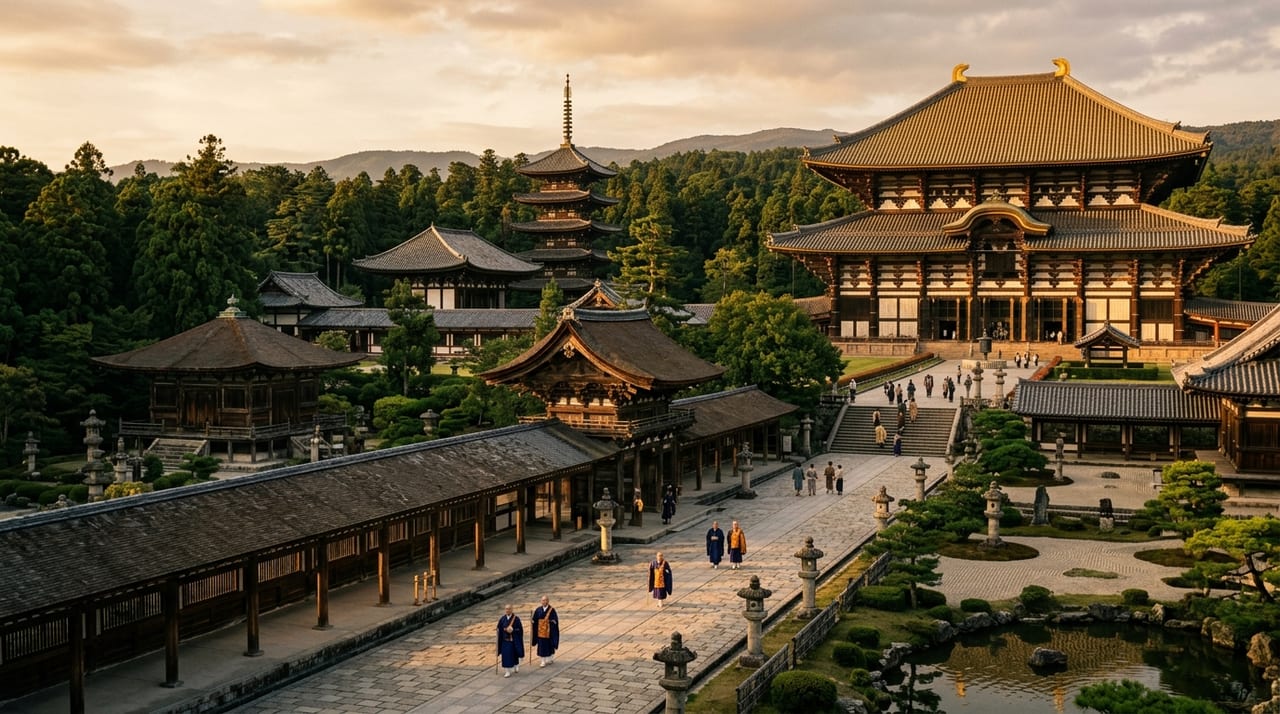
 * Image is for illustrative purposes only.
Yamato Five Schools
大和五派
The Yamato tradition, centered on Nara Prefecture, is an important regional tradition of the ko-tō period. It comprises five schools: Taima, Senjuin, Shikkake, Tegai, and Hōshō. Great temples and shrines such as Kasuga Taisha, Tōdaiji, Kōfukuji, and Kinpusenji systematically sponsored smiths and supplied large quantities of practical tachi and naginata to meet the demands of sōhei warrior monks. The straight-grained masame-hada jigane and the plain suguha and chū-suguha hamon express a sincere, powerful aesthetic unique to the Yamato-den, distinct from both the elegance of the Yamashiro-den and the splendor of the Bizen-den.
Description
Institutional Background of Yamato-den
What fundamentally sets Yamato-den apart from the other Gokaden is that its smiths made swords not for secular warriors or the commercial market, but for large temples and shrines, which were institutional organizations. Nara was the ancient capital as Heijō-kyō (710–784), and it was Japan's largest religious center, home to the Nanto Shichidaiji: Tōdaiji, Kōfukuji, Gangōji, Daianji, Yakushiji, Saidaiji, and Hōryūji. These great temples and shrines organized armed forces called "shuto" or "akusō" (so-called "sōhei"), and they waged power struggles, territorial disputes, and gōso (armed petitions) to the imperial court. The demand from these armed monks sustained the smiths of Yamato, and temples and shrines as "stable, large-scale customers" supported the lasting development of Yamato-den.
Five Schools and Their Centers
The bases of the five Yamato schools were scattered across the Nara Basin. The Taima school was based in Taima, Katsuragi City (present-day Katsuragi City, Nara Prefecture), and bears the name "Taima" from its deep relationship with Taimadera. The Senjuin school is said to have resided at Senjuin near the East Pagoda of Tōdaiji, or at the Senjuin of Kōfukuji. Several theories exist about the residence of the Shikkake school, including Tamukeyama Hachimangū, Shikkake in Kishida-chō, Tenri, and Shikkake in Mitsue, Uda District. The Tegai school takes its name from its base around Tegaimon of Tōdaiji. The Hōshō school left works inscribed "resident of Takechi District, Yamato Province," and made Takechi District its sword-making area. Although these five are independent schools, they share the technical foundation of Yamato-den and developed while influencing one another.
Masame-hada as a Technical Feature
The technical feature that most clearly distinguishes Yamato-den from the other dens is the masame-hada jigane (straight-grain steel surface). Masame-hada is a "straight, vertically running wood-grain pattern," in contrast to the itame-hada (flat-grain pattern) of wood, and it is produced by repeatedly folding and forging the steel in the longitudinal direction. Jigane with masame-hada has high jinsei (toughness) and a structure resistant to bending stress, suited to long weapons such as naginata and tachi. In general, masame-hada is harder to produce than itame-hada, and producing uniform masame in particular requires advanced forging skill. The background to Yamato-den's adoption of masame-hada as a tradition is that Nara smiths developed their techniques under temple and shrine demand that prioritized blade strength and reliability.
Suguha and Hamon Expression
The hamon of Yamato-den is mainly suguha or chū-suguha, and the edge border is covered with fine, uniform nie. "Nie-deki no suguha" (suguha with nie-based formation) is an expression that symbolizes Yamato-den: the outline of the hamon is clear yet not rough, combining the functional beauty of a practical blade with a sensibility of plain, sturdy simplicity. The Taima school shows a relatively varied expression of "chū-suguha mixed with ko-midare," the Senjuin school is especially known for its refined suguha, and the Tegai school has its own interpretation of "a powerful suguha with coarsely set nie." These differences are the diversity born from the common foundation of Yamato-den, and in appraisal, identifying the individuality of each of the five schools is one of the central issues of Yamato-den research.
Spread Across the Country and Influence
During the Nanboku-chō and Muromachi periods, Yamato smiths migrated to various regions and spread Yamato-den techniques nationwide. The migration of Yamato smiths to Mino Province (present-day Gifu Prefecture) is important as the source of Mino-den, and it formed the technical foundation of the later Mino swords (Seki kaji). The techniques of Yamato smiths broadly influenced surrounding regions through technology transfer. Entering the Edo period, the number of Yamato smiths sharply declined and the lifeline of Yamato-den in its home region grew thin, but the techniques inherited in the regions they moved to supported the diversity of early-modern swords. In modern research, the masame-hada and suguha features of Yamato-den are being reappraised as the origin of the functional aspects of Japanese swords, and its importance in the history of technology is being recognized anew.
Characteristics of This Era
- Masame-hada jigane: characterized by a uniform, vertical wood-grain pattern. A practical forging texture with high toughness and a structure that resists the bending stress of long weapons (tachi and naginata)
- Suguha and chū-suguha nie-deki hamon: refined hamon that embody a plain, sturdy aesthetic. A distinctly Yamato-den style, nurtured by temple and shrine demand that valued practicality and reliability over splendor
- Systematic institutional patronage by great temples and shrines: Tōdaiji, Kōfukuji, Kasuga Taisha, and others systematically sponsored smiths. Religious institutions, rather than commercial markets, supported sword production, a unique institutional background in the history of Japanese swords
- Five schools with distinct identities (Taima, Senjuin, Shikkake, Tegai, Hōshō): on the shared foundation of masame-hada and suguha, each school developed its own hamon character. Distinguishing the five schools is a core issue in Yamato-den research
- Source of the Mino tradition: Yamato-affiliated smiths who migrated to Mino during the Nanboku-chō and Muromachi periods formed the technical foundation of the later Seki kaji (Mino-den). They are the distant origin of Mino swords, the largest sword-producing center of the Sengoku period
- Excellent producer of naginata and nagamaki: met the practical demand of armed temple and shrine forces for long-shafted weapons. Also supplied high-quality material for naginata-naoshi (remade naginata), many of which were later reworked into uchigatana