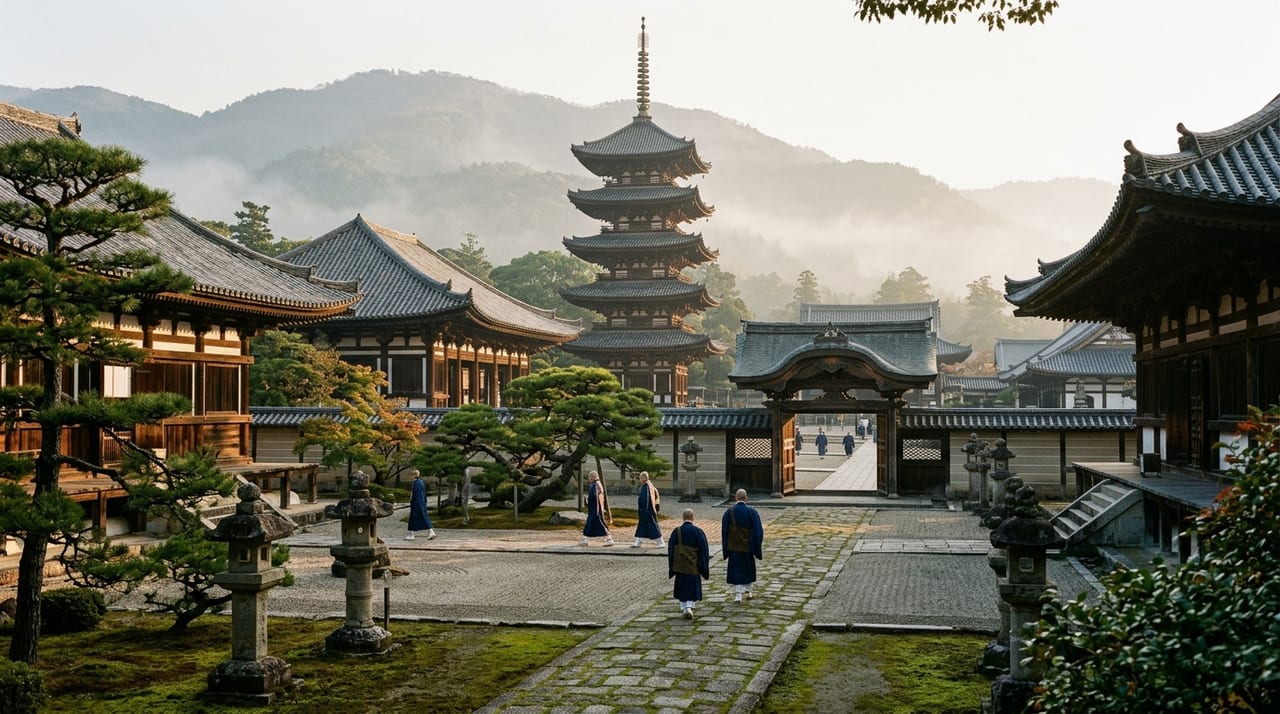
 * Image is for illustrative purposes only.
Senjuin School
千手院派
One of the Five Yamato Schools, a distinguished Nara lineage closely tied to Tōdai-ji. Based in Senju Valley (Senjuin) at the foot of Mount Wakakusa, its smiths forged swords that embodied the bold yet practical character of Yamato-den. Although centered on masame-hada and sugu-ha, it showed an individual character distinct from the other four Yamato schools.
Description
Establishment of the Senjuin School and Its Ties to Temples
Yamato Province (present-day Nara Prefecture) had long been dominated by powerful temple and shrine organizations, and the religious authority centered on Kōfuku-ji, Tōdai-ji and Kasuga Taisha extended its influence over politics, the economy and culture as a whole. Sword production was also closely bound to these temples and shrines, and each of the Five Yamato Schools (Senjuin, Tegai, Taima, Shikkake and Hōshō) had a deep relationship with a particular temple or region.
The Senjuin school belonged to Tōdai-ji and was a group of smiths who forged blades in Senju Valley (Senjuin) at the foot of Mount Wakakusa, producing swords to meet the demand of the warrior monks of Tōdai-ji. The origins of the school are traced to the late Heian period, but datable extant works are confirmed only from the early Kamakura period onward. The Senjuin school is regarded as the oldest of the Five Yamato Schools.
As for the origin of the school's name, the prevailing view holds that it derives from smiths who belonged to the Senjuin, a temple whose principal image is the Thousand-Armed Kannon, and who formed a group together. A system in which smiths were incorporated under temple organization guaranteed large and stable orders, which made possible the accumulation and transmission of the school's techniques.
Stylistic Features and Technical Achievements
The jigane of the Senjuin school shows itame with flowing masame mixed in, and fine ji-nie. Masame refers to a forging texture in which the iron fibers run vertically, corresponding to itame in wood. A masame-gakaru skin is a characteristic of Yamato-den as a whole and an important criterion in appraisal.
The hamon is basically sugu-ha, but it is not a simple straight line. Fine ko-nie appear evenly along the hazakai (the boundary of the temper), and ko-ashi and yō are sparingly present, creating a refined expression. The activity (hataraki) within the hamon is not showy, but the longer one looks, the deeper the flavor becomes. This is the charm of the Senjuin school that appraisers describe as an understated beauty.
The construction is sturdy and practical, with a high shinogi and a relatively thick kasane (thickness). This is a functional design that assumes close combat by sōhei, and the result of prioritizing blade strength able to withstand powerful use. Works in a variety of forms are confirmed, including tachi, naginata and tōsu. Naginata in particular were a specialty of the Five Yamato Schools, including the Senjuin school.
Major Smiths and Works
The founders of the Senjuin school are said to be Yukinobu and Shigehiro of the late Heian period, but only their names are transmitted, and no certainly extant works are known. Among the extant signed works is an ō-dachi (National Treasure, Ōyamazumi Shrine) by Nagayoshi of the Nanboku-chō period, bearing an inscription dated Jōji 5 (1366).
Works by Shigeyoshi (Shigeyoshi Nyūdō) are known, including the sankozuka-ken (Important Cultural Property) bearing a Genkō-era date.
Also, many smiths of the Senjuin school bore names with the character 重 (shige) across generations, which is said to be based on a naming custom that shows the continuity of the school's lineage. Smiths with the character 重, such as Shigehiro, Shigeyuki, Shigeyoshi and Yasushige, supported the school over several generations.
Position Within the Five Yamato Schools
Whereas the Tegai school set up its forge in front of the Tengai-mon of Tōdai-ji, the Senjuin school, though likewise belonging to Tōdai-ji, was based in Senju Valley at the foot of Mount Wakakusa.
Also, Yamato blades that are difficult to classify under any of the other four Yamato schools (Taima, Tegai, Shikkake and Hōshō) may sometimes receive kiwame attribution to the Senjuin school.
Decline and Influence
From the mid-Muromachi period onward, amid the social upheaval triggered by the Ōnin War (1467), the temple and shrine powers of Yamato declined rapidly, and the Senjuin school also lost its reality as an organization. Throughout the Nanboku-chō and Muromachi periods, sword production in Yamato was pressed by the dominance of Bizen and Sagami, but the techniques of the Senjuin school were passed on to later Yamato-den practitioners and also influenced the revival of Yamato-den during the Edo period.
Extant works of the Senjuin school are rare, and certainly datable old signed works in particular are kept as cultural properties in museums and shrines. The beauty of the masame-gakaru jigane and the dignified quality of the sugu-ha are highly valued today as art representative of Yamato-den.
Characteristics of This Era
- Itame jigane with flowing masame mixed in: fine ji-nie and a masame-gakaru forging texture typical of Yamato-den. A feature of the Senjuin school emphasized in appraisal comparisons with other schools
- Well-balanced sugu-ha: fine ko-nie appear evenly along the hazakai, with ko-ashi and yō sparingly present. A refined hamon that holds deep craft within restraint, without showiness
- High shinogi and thick kasane: sturdy construction meeting the practical needs of sōhei and warriors. A functional cross-section suited to both thrusting and cutting
- Abundant naginata: the Senjuin school produced naginata alongside tachi, broadly meeting the armament needs of Yamato's temple and shrine powers