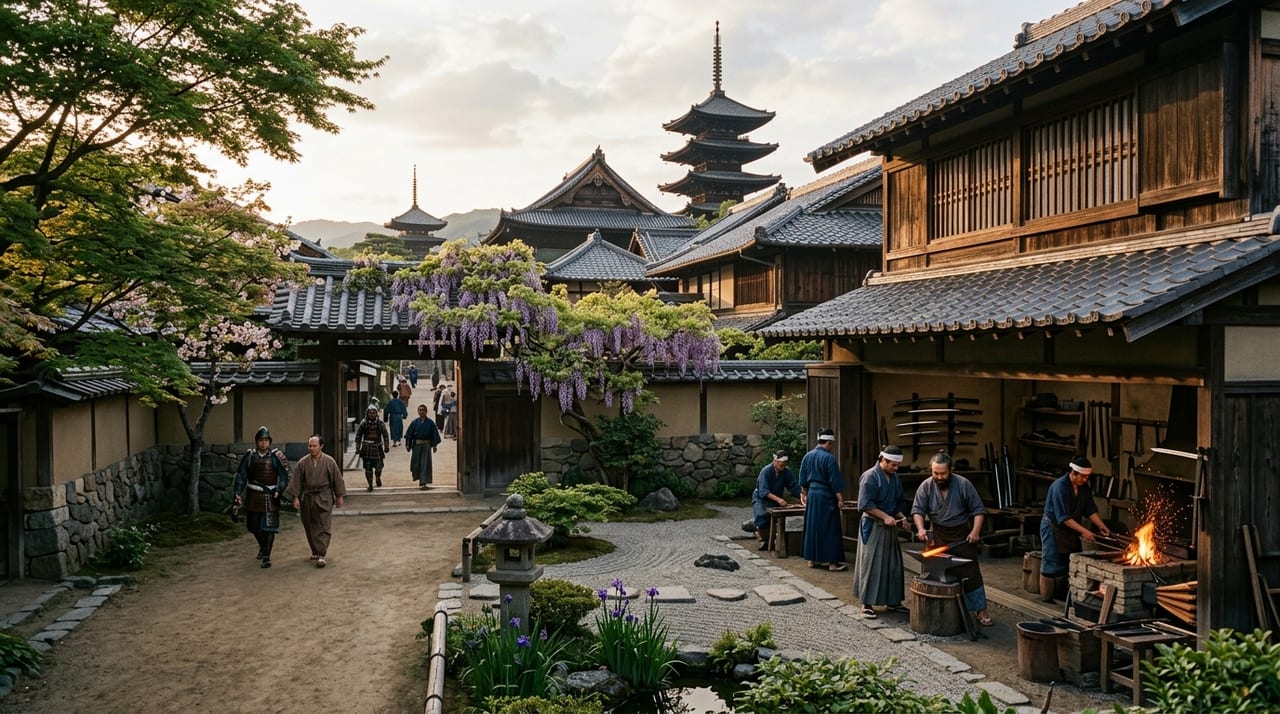
 * Image is for illustrative purposes only.
Ayanokōji School
綾小路派
A celebrated Yamashiro school based in Kyoto's Ayanokōji district, active alongside the Sanjō and Awataguchi schools in the Yamashiro tradition. The school's signature smith, Sadatoshi, produced tachi of great refinement that remain among the most prized Yamashiro-tradition works.
Description
The Ayanokōji District and the School's Formation
The Ayanokōji (綾小路) district in Kyoto, corresponding to the area around present-day Shijō-Karasuma, was an elegant region in the Heian and Kamakura periods where the residences of court nobles and aristocrats stood in succession. The origin of the Ayanokōji school lies in blacksmith collectives who settled in this district and produced high-quality blades to meet the demand of the imperial court, court nobles, and major temples and shrines. Together with the Sanjō school, founded by Sanjō Munechika, the Awataguchi school, centered on the six Awataguchi brothers, and others, it carried the Yamashiro tradition of the Kamakura period.
The Ayanokōji school is believed to have been established in the mid-Kamakura period (mid-thirteenth century), and surviving authenticated works are predominantly from the Kamakura period.
The environment adjacent to the residences of court nobles and aristocrats brought the Ayanokōji swordsmiths a deep understanding of courtly aesthetic sensibility. The aesthetic character of Ayanokōji blades, nurtured amid Kyoto's advanced crafts culture of costume, lacquerware, ceramics, and painting, embodied from an early period the Japanese sword as artwork transcending mere weaponry.
Sadatoshi: The School's Supreme Work
Among Ayanokōji school works, the tachi of Sadatoshi (定利) is today the most celebrated. Sadatoshi is believed to have been active in the mid-Kamakura period (mid-thirteenth century); surviving signed works are extremely scarce, yet his artistic achievement is evaluated as occupying the supreme rank of the Yamashiro tradition.
The foremost characteristic of Sadatoshi's tachi is the refinement of the jigane. The ko-itame hada flows densely and develops fluidly; the ji-nie appears in fine, even distribution, and the chikei runs with delicacy. This quality of jigane possesses distinction and refinement within the Yamashiro tradition and forms the basis for connoisseurs calling it "one of the supreme peaks of Yamashiro."
The hamon is ko-midare mixed with ko-chōji and ko-gunome, becoming suguha-like in places, and fine ko-nie appears along the edge line. Overall, within its orderly composition lies a richness of detail and variation, yielding a landscape that never tires the eye.
The curve features pronounced koshi-zori, and the kissaki is a refined ko-kissaki, showing the elegant form of the late Heian to early Kamakura period.
Other Ayanokōji Smiths
Apart from Sadatoshi, the name of another Ayanokōji smith, Sadayoshi (定吉), appears in historical sources, though surviving authenticated signed works are extraordinarily rare.
Comparison with the Sanjō and Awataguchi Schools
Comparing the individual characteristics of the Sanjō, Awataguchi, and Ayanokōji schools of the Yamashiro tradition yields interesting contrasts. The Sanjō school, possessing the oldest tradition, is known for its archaic elegance, exemplified by Munechika's "Mikazuki Munechika." The Awataguchi school, through the work of the six brothers and Yoshimitsu, elevated the art of the tantō to its zenith and established the unique jigane of nashiji-hada. The Ayanokōji school, distinct from these two, demonstrated its true character in the tachi.
The refinement of ko-itame hada in Sadatoshi's tachi represents a unique quality distinct from the contemporaneous nashiji-hada of Awataguchi and the densely worked itame-hada of the Rai school.
Rarity and Evaluation of Extant Works
Ayanokōji school works are particularly scarce within the Yamashiro tradition, and some of Sadatoshi's signed tachi are designated National Treasures or Important Cultural Properties. A Sadatoshi tachi in the Tokyo National Museum is designated a National Treasure.
For collectors and sword enthusiasts, the Ayanokōji school represents "one of the most mysterious presences in the Yamashiro tradition," and new discoveries or reevaluations can generate significant academic and market impact. Opportunities to encounter signed old works are limited to museum special exhibitions and the like, yet their refined jigane and the elegant beauty of the hamon continue to move visitors as the essence of Heian and Kamakura aesthetic sensibility.
Characteristics of This Era
- Densely refined ko-itame hada with ji-nie and chikei — distinct quality from other Yamashiro schools
- Elegant ko-midare mixed with ko-chōji and ko-gunome, suguha-like in places — understated complexity prized by connoisseurs
- Koshi-zori tachi with ko-kissaki — classic Yamashiro mid-Kamakura form of great elegance
- Extreme rarity — surviving signed examples are among the fewest of any major Yamashiro school