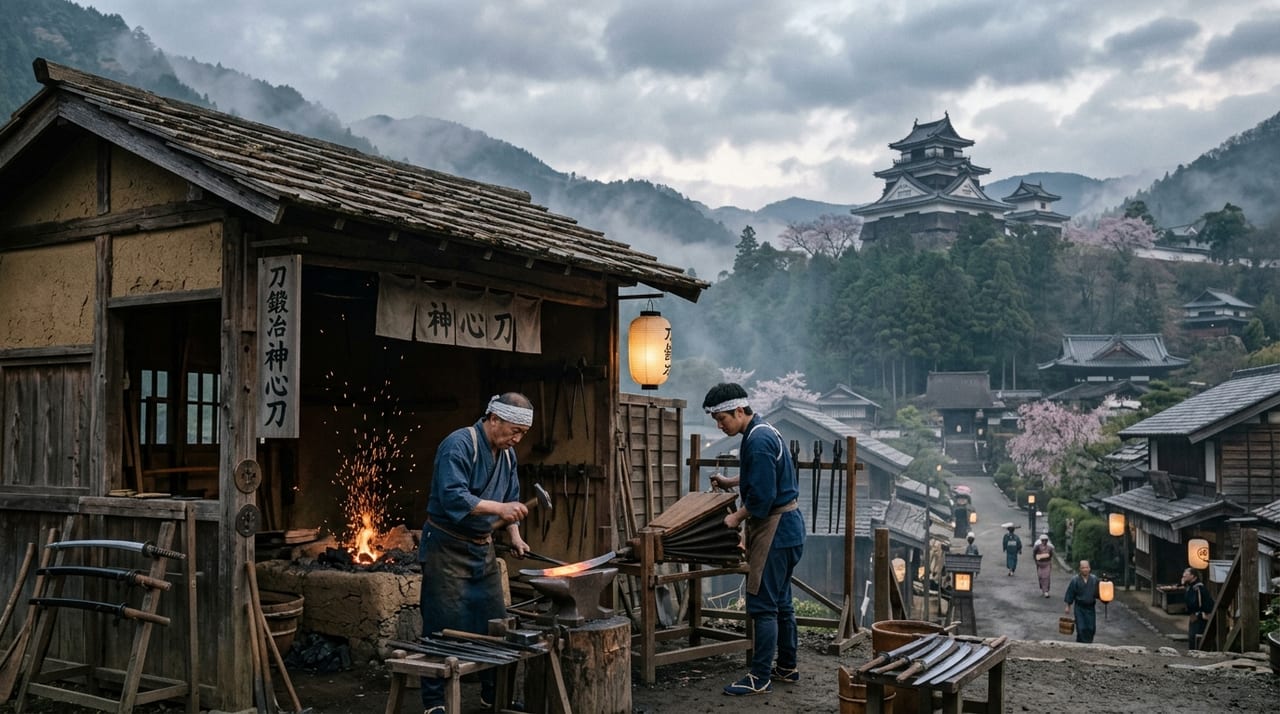
 * Image is for illustrative purposes only.
Theoretical Foundations of the Shinshintō Movement
新々刀の理論的基盤
The shinshintō era (1781–1876) was not merely a technical revival but the product of a complex intellectual movement in which kokugaku nativism, Confucian scholarship, and systematic sword connoisseurship converged to transform swordmaking into a self-conscious artistic and scholarly project. Suishinshi Masahide's theoretical program, Taikei Naotane's practical Bizen revival, and Minamoto Kiyomaro's intuitive Sōshū genius each represent a different approach to the shared challenge of recreating lost mastery.
Description
Criticism of Shintō and the Demand for Revival
In the mid-Edo period (1680s–1780s), sword connoisseurs and enthusiasts came to accept that “shintō (new swords, made after 1596) do not match kotō (old swords).” Shintō did have polished finishes that showed well under polishing, but criticism grew that they fell far short of the finest old swords, Masamune, Yoshimitsu, and Nagamitsu, in the depth of the jigane, the complex workings of the hamon, and overall dignity. Suishinshi Masahide (1750–1825) theorized this problem. His work “Tōken Jitsuyō-ron” diagnosed the technical decline of the shintō period and gave a clear prescription: the qualities that had been lost should be recovered by studying and reconstructing the techniques of the old swords.
Suishinshi Masahide's Theory and Practice
Suishinshi Masahide's “kotō fukko-ron” (theory of returning to old swords) had the following concrete content. First, to restore the traditional forging processes that had been omitted or simplified in the shintō period, such as the number of folding cycles in forging and the control of fire. Second, to understand the characteristics of each tradition, Bizen, Sōshū, and Yamashiro, theoretically and to put them into practice consciously. Masahide himself produced a variety of works aimed at the Yamashiro, Bizen, and Sōshū traditions, trying to make theory and practice agree. Many excellent smiths grew up under him, and as the “Suishinshi school” they led the sword culture of the late Edo period.
Taikei Naotane's Bizen Revival
Taikei Naotane (1778–1857), Suishinshi Masahide's greatest disciple, most thoroughly embodied his teacher's theory in the practical revival of the Bizen tradition. Naotane studied the finest works of Ko-Bizen, Osafune, and Sue-Bizen in depth, and tackled the restoration of utsuri, the core of the Bizen tradition. Utsuri is a white, mist-like shadow that appears on the jigane of Bizen swords. It is a phenomenon produced by the delicate combination of quenching temperature and steel composition, and it had been completely lost in the shintō period. Through lifelong research and experiment, Naotane restored utsuri to a certain degree and became the symbolic figure of the revival of the Bizen tradition in the shinshintō period. His works are still designated in large numbers as Important Swords and Special Important Swords, as shinshintō of the highest standard.
Minamoto Kiyomaro's Brilliant Revival of Sōshū
Minamoto Kiyomaro (Yamaura Kiyomaro, 1813–1855), the third great master of the shinshintō, revived the Sōshū tradition for his era through intuitive genius rather than theoretical approach. Together with his elder brother Yamaura Saneo, Kiyomaro studied under the Ueda domain smith Kawamura Toshitaka. Later in Edo he received the patronage of Kubota Sugane and devoted himself to sword making. Kiyomaro's works from his peak (Tenpō to Kōka, 1830s–1840s) have wild yet beautiful nie, with kinsuji and sunagashi running vertically and horizontally. They approached the spirit of old Sōshū swords to such a degree that one doubts whether they are really shinshintō. Kiyomaro died at only forty-two, but his short life intersected deeply with the political upheaval of the late Bakumatsu period. It is said that his friendship with shishi (patriotic activists) who held sonnō (revere-the-emperor) ideas influenced the fighting spirit of his works. The nickname “Yotsuya Masamune” is no exaggeration. Kiyomaro embodies the highest artistic achievement of the shinshintō period.
Ideological Connections with Kokugaku and Confucianism
The revivalism of the shinshintō cannot be understood apart from its intellectual context. Suishinshi's “return to old swords” was an outpouring of the cultural impulse to return to Japan's own excellent qualities. It resonated with kokugaku (the study of Japanese classics and rediscovery of Japanese culture, as practiced by Motoori Norinaga and others), and it also matched the Confucian scholarly attitude of “a return to the classics.” Shinshintō smiths were not merely technicians. Many saw themselves as intellectuals, as “guardians and restorers of the culture of the Japanese sword,” and this self-awareness was one of the sources of the fighting spirit they put into their works.
Evaluation and Limits of the Shinshintō
The shinshintō achieved a certain degree of technical success, but it did not fully reproduce the highest peaks of the old swords. At the technical level of the Edo period, the sources and smelting methods of the iron sand used as the raw material for tamahagane could not be fully reproduced as they were in the old-sword era, and some secret quenching techniques may also have been lost. However, the finest works of Naotane and Kiyomaro are not “copies” (utsushi) of old swords. They established their own original beauty as shinshintō. In modern sword appraisal, the view that evaluates them as an independent genre, rather than comparing them with old swords, is considered important.
Characteristics of This Era
- Suishinshi Masahide's “Tōken Jitsuyō-ron”: a theoretical manifesto of the shinshintō. A scholarly work on swords arguing the need to return to old swords. Resonates with the “return to the classics” thought of kokugaku and Confucianism
- Revival of tradition-consciousness: sword making as an intellectual project of consciously studying and reproducing the Goka Den (five traditions)
- Restoration of utsuri: as the core technique of the Bizen tradition, utsuri, lost in the shintō period, was partly restored by Taikei Naotane through research and experiment. A symbol of shinshintō technical achievement
- Intuitive reinterpretation of the Sōshū tradition by Minamoto Kiyomaro: reinterpreted the Sōshū tradition through direct observation of old swords and genius intuition rather than theory. His masterpieces, known by the nickname “Yotsuya Masamune,” are the artistic peak of the shinshintō
- Establishment of an independent aesthetic of the shinshintō: not a simple “copy” of old swords, but an original beauty that merges the revivalist spirit with the spirit of the late Edo and Bakumatsu periods. The need for independent evaluation beyond comparison with old swords