Identifying Genuine Yasukuni Swords: A Practical Authentication Guide Using Stamps, Signatures, and Steel Characteristics
 * Image is for illustrative purposes only.
Table of Contents
What Are Yasukuni Swords—Confirming the Basic Definition
"Yasukuni swords" refer to Japanese swords manufactured from 1933 (Showa 8) until the end of World War II in 1945 (Showa 20) at the "Japanese Sword Forging Facility" established within the grounds of Yasukuni Shrine. Records indicate that approximately 8,100 swords were produced, crafted by master smiths selected and summoned from throughout the nation, using traditional tamahagane steel and authentic forging techniques.
The primary reason Yasukuni swords stand apart from other Showa-period swords is the spiritual and religious context of having been forged within the sacred grounds of Yasukuni Shrine. Their provenance of being forged in a place dedicated to the repose of the war dead and the souls of warriors creates an essential distinction from mere military swords or other Showa-period traditionally forged blades. Beyond this context, collector demand is also supported by consistent quality assurance as tamahagane swords.
It should be noted that not all Yasukuni swords were used as military blades; some were produced as donated or dedicated swords. This distinction is an important premise when verifying provenance during authentication. Confirming the intended purpose of the sword through historical records and oral transmission before beginning authentication is the most direct path to accurate assessment.
Verifying Markings and Signatures—The First Step in Authentication
The starting point for Yasukuni sword authentication is careful examination of the markings and signatures left on the nakago (tang). The main points to verify are as follows.
- "Yasukuni" Markings and Seals: Some swords bear seals belonging to the Yasukuni Shrine forging facility carved on the nakago. In addition to character markings reading "Yasukuni," some were sealed with the shrine's official stamp. However, it is important to note that not all swords bear such markings. The absence of a marking cannot be used to immediately conclude that a sword is not a Yasukuni sword.
- Smith's Signature: Signed specimens require cross-reference with smithing records and specialized literature. Records of the smiths who participated at the Yasukuni forging facility are comprehensively covered in specialized works including Nakagawa Yasuhiro's "Japanese Swords of Yasukuni Shrine," and authentication is grounded in comparing the character style and execution of signatures with actual illustrations. Unsigned specimens also exist in considerable numbers, and the absence of a signature in itself is not evidence against authenticity.
- Year Mark Verification: When "Showa [year]" is inscribed, verify whether it falls within the Showa 8–20 range. If a year outside this range is recorded, the sword may not be a Yasukuni sword or may have been altered later. The character style of the year mark, the depth of the carving, and the pattern of rust formation are also important observations.
Distinguishing Authentic Swords Through Grain and Blade Pattern
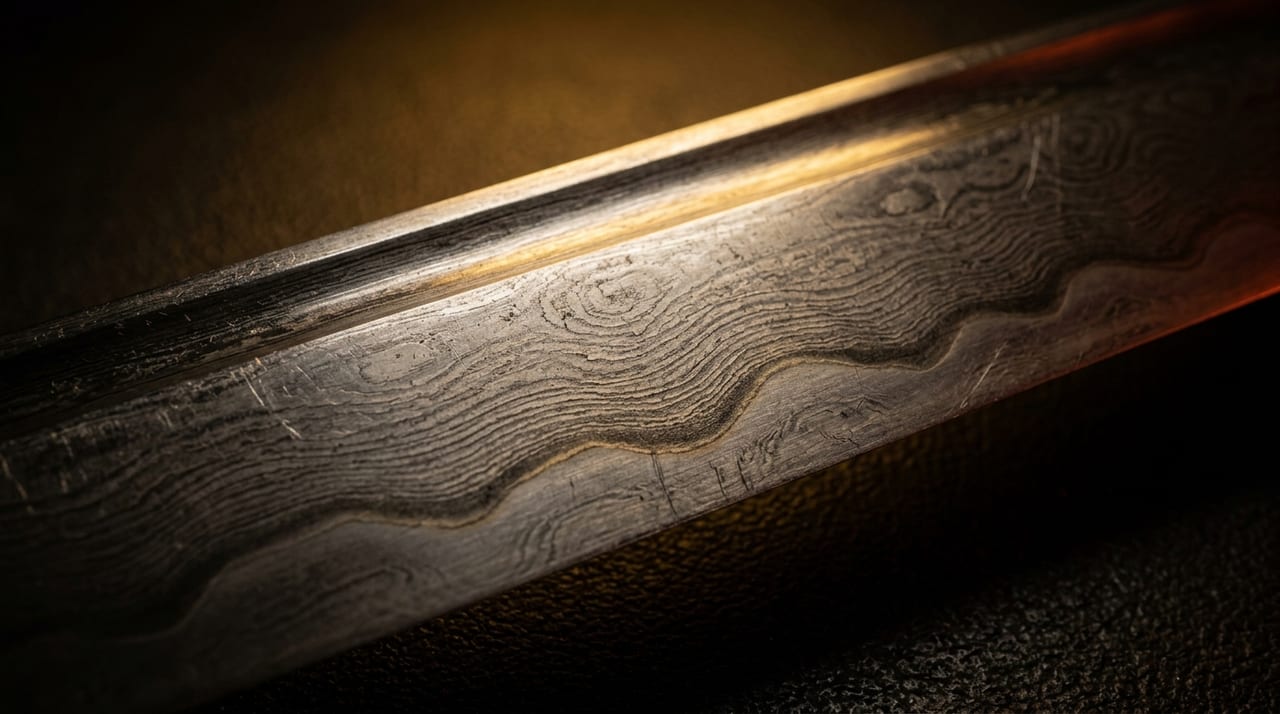
Yasukuni swords, forged traditionally from tamahagane, display jihada and hamon that are distinctly different from industrial swords (machine-forged Showa-period blades). This observation is one of the most critical processes in authentication. Elements to observe are as follows.
- Jihada (Grain): The basic pattern is itame jihada, though mokume may also appear. Fine jikei and utsuri characteristic of tamahagane may sometimes be observed. Due to the production environment and schedule constraints of the Yasukuni forging facility, the refined grain patterns seen in old swords of the five major traditions—such as the hair-thin carbon lines of Bizen work or the large-patterned itame of Soshu work—are often difficult to replicate. However, the unique moisture and depth of tamahagane grain remains distinctly different from industrial swords.
- Hamon (Blade Pattern): Straight hamon (suguha) or small irregular hamon (komidare) are the predominant patterns. Since these swords were made as military weapons, practical and regulated blade patterns are more common than complex or ornate ones. Swords with evenly granulated nie and a tight nioi-guchi tend to be of higher quality. Irregular disappearance of the hamon or patterns that are mechanically uniform should raise concerns.
- Blade Shape: Most exhibit practical moderate curvature with blade length typically around 68–73 cm. Extreme shallowness of curve or excessively standardized shapes warrant caution against confusion with industrial swords.
Counterfeits and Misidentified Swords—Common Pitfalls
Due to the high market value of Yasukuni swords, counterfeits and misidentified specimens circulate in significant numbers. Knowledge of the following typical cases is the first step in self-protection.
- Post-Forged Markings: Industrial swords (machine-forged military blades from the Showa period) to which "Yasukuni" markings or signatures of renowned smiths have been added later. Key points of distinction are the rust pattern around the marking (consistency between original rust and the age of the marking), unnatural character forms, and uniformity of carving depth and angle. Authentic markings, being hand-carved, show subtle irregularities, whereas counterfeit markings often appear mechanically too uniform.
- Confusion with Other Showa Traditional Forged Swords: Cases where tamahagane swords from the Showa period produced elsewhere are mistaken for Yasukuni swords. High-quality Showa swords with excellent jihada and hamon are easily confused with Yasukuni swords, but they can often be distinguished by comparing the tang shape, construction, and presence or absence of markings with literature records.
- Mismatch Between Blade and Mounts: Cases where a Yasukuni blade has been mounted in mounts from another sword, or vice versa. Always verify the consistency of period character and finish between the tang and mounts, and that the mekugi hole positions align.
Modern Authentication Agencies and Market Prices
Yasukuni swords, being traditionally forged from tamahagane, fall within the scope of NBTHK (Japan Fine Art Sword and Blade Preservation Society) authentication. Certificates designating "Preserved Swords" are issued to specimens meeting a certain quality standard, and "Specially Preserved Swords" certificates are issued to those of exceptional quality. Authentication examinations are conducted multiple times per year, and this is the most reliable procedure for official verification of authenticity and quality.
Market prices vary significantly based on the presence or absence of an authentication certificate, the prominence of the smith, and condition. Current price guidelines are as follows.
| Authentication Certificate | Price Range |
|---|---|
| NBTHK-certified premium specimens | Approximately ¥800,000–¥2,500,000 |
| Quality specimens without certificate | Approximately ¥200,000–¥700,000 |
Specimens bearing rare smith signatures or with clear provenance as dedicated swords may command even higher prices.
Summary of Authentication Practice—Knowing the Limits of Self-Assessment
Yasukuni sword authentication is a process of comprehensively evaluating multiple perspectives, including the consistency of markings, signatures, jihada, hamon, blade shape, and mounts. While the above points serve as guidelines for self-education, expert evaluation is essential for final judgment.
Purchase and sale decisions should be avoided without consulting a trusted sword dealer or applying for NBTHK authentication. Especially in auction or private transactions, much information is difficult to assess from photographs alone, and examination of the physical object is the standard practice. Interest in Yasukuni swords contributes to the preservation of Japanese sword culture, but meaningful and valuable collecting can only result when such interest is grounded in proper knowledge and procedures. Recently, online database comparison and remote consultation with experts have become more common, but there is no substitute for expert authentication by a specialist who has examined the physical blade.