The Technique of Annealing (yakinamashi / shodonshi) — A Pre-Process in Nihontō Heat Treatment That Releases Internal Stress in Steel Before Forging
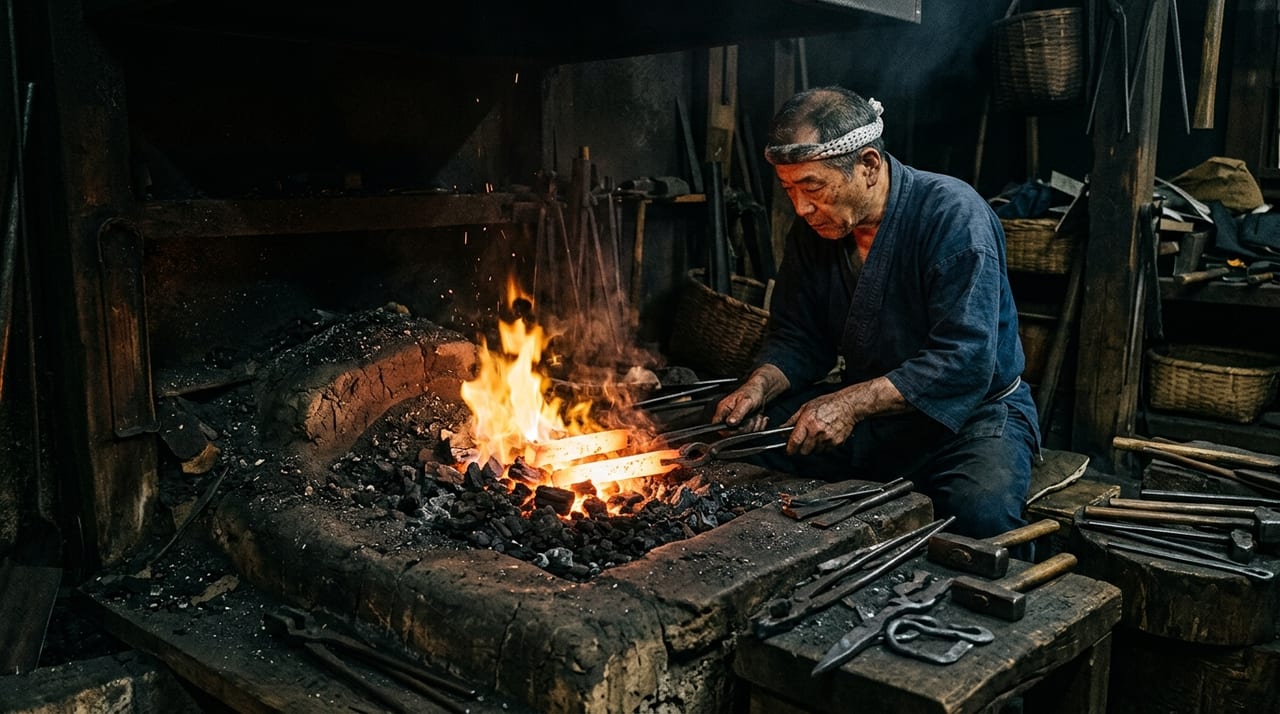 * Image is for illustrative purposes only.
Table of Contents
What Is Annealing (yakinamashi / shodonshi)?
The most well-known heat treatment step in nihontō manufacture is yaki-ire (quenching). This process, which produces the hamon and hardens the cutting edge, is described as a dramatic moment directly tied to the sword's completion.
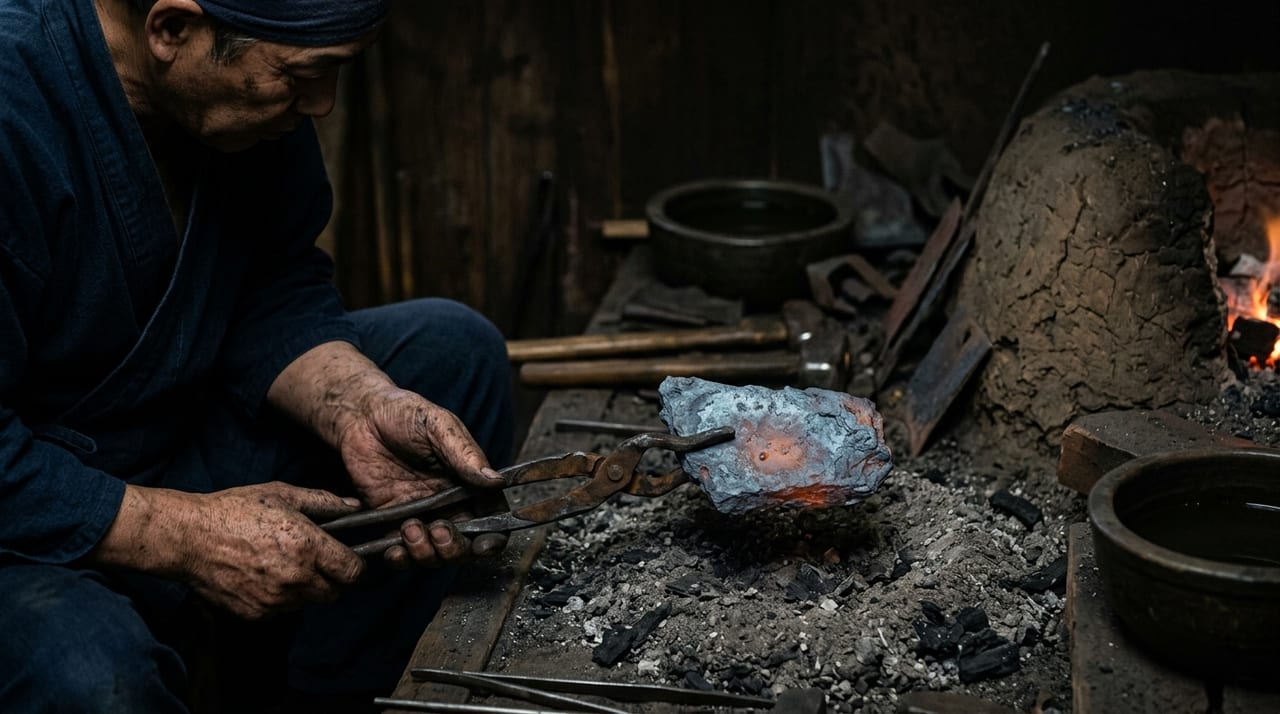
However, the "yakinamashi (shodonshi)" performed several steps before that is an important pre-treatment process in nihontō manufacture that is not widely known.
Annealing refers to the heat treatment operation of heating steel (or iron) to a certain temperature and then cooling it gradually and slowly, thereby removing internal stress from the steel and homogenizing and softening its microstructure. In English it is called "Annealing."
In nihontō manufacture, annealing is performed at multiple stages, but the most important is the annealing at the material preparation stage before forging.
Why Is Annealing Necessary — The Problem of Internal Stress
Tamahagane produced by tatara (traditional smelting) carries complex residual stress and a non-uniform microstructure inside due to rapid cooling and thermal history during the smelting process. Forging (the process of heating and hammering) performed without annealing is prone to cracks, fissures, and poor forge-welding (incomplete fusion).
Specific problems include:
① Uneven Hardness Tamahagane varies in carbon content by location (approximately 0.6–1.5%), and this difference produces uneven hardness. High-carbon areas are hard and brittle, while low-carbon areas are soft. Hammering in this uneven state makes cracks (microfractures) more likely to form in the hard portions.
② Internal Residual Stress Because the surface and interior of rapidly cooled steel cool at different rates, internal stress accumulates from differential contraction. This stress becomes a cause of unexpected cracking and deformation during the heating and hammering process.
③ The Problem of Martensite Microstructure Martensite (an extremely hard and brittle iron microstructure) can form in rapidly cooled high-carbon steel. Because martensite has markedly poor workability, it must be eliminated before forging.
Annealing resolves these problems and is the process that brings the steel into a state that is easy to hammer.
The Actual Process of Annealing
Heating Temperature and Atmosphere
In annealing tamahagane, the steel is heated to approximately 700–900°C (varying by steel type and carbon content). This temperature range is near the Ac1 transformation point (the temperature at which the steel's microstructure begins to transform to austenite), a region where microstructural homogenization takes place.
The tōkō (swordsmith) judges the furnace color (hi-iro) visually. The appropriate annealing temperature is when the steel glows orange-red to yellow-orange (equivalent to 700–900°C). This judgment depends on experience and intuition — a craftsman's eye passed down from an era when accurate thermometers did not exist.
The atmosphere (surrounding gaseous environment) during heating is also important; to minimize oxidation, measures such as burying the steel in charcoal ash or heating in a carbon-rich furnace atmosphere are employed.
The Slow Cooling (jorei) Process
The most critical step in annealing is "jorei" (slow cooling) — cooling slowly over time.
Since rapid cooling (water quenching) would increase internal stress, annealing instead involves lowering the temperature gradually by burying the steel in charcoal ash or allowing it to cool naturally with the furnace door closed. The cooling rate typically takes anywhere from several hours to half a day or more to reach room temperature.
This slow cooling:
- Transforms the martensite microstructure into ferrite + pearlite (a softer, more workable microstructure)
- Relieves internal residual stress
- Homogenizes carbon distribution more evenly
- Reduces overall hardness of the steel, improving workability for the next forging stage
The "namashi-agari" the Tōkō Observes
The steel after annealing ("namashi-agari") has a thin oxide film formed on its surface. The color of this film (blue-tinted gray to black) serves as an indicator of heating temperature, atmosphere, and quality of slow cooling.
Skilled tōkō observe the color, hardness (the feel when pressed with a finger), and surface condition of the "namashi-agari" to determine whether they can proceed to the next forging stage. If annealing is insufficient, the steel is heated and annealed again.
The Role of Annealing at Each Stage of Forging
The main stages of nihontō manufacture at which annealing is performed are as follows.
① After Material Classification and kōwari (Splitting) Tatara steel (tamahagane) is classified by carbon content (high-carbon = for kawagane (jacket steel), low-carbon = for shingane (core steel)) and annealed after being split into small pieces. This homogenizes the workability of each portion.
② Before Initial tanren (tsumiwakashi) As a preparatory stage before stacking multiple steel pieces and performing "tsumiwakashi," annealing prepares the surface condition of each piece. Homogenizing the oxide film on the bonding surfaces promotes fusion during forge-welding.
③ Intermediate Stage of orikaeshi tanren (Folding) When work hardening has progressed during long orikaeshi tanren (folding), annealing is temporarily performed to soften the steel before continuing tanren (forging).
The Essential Difference Between Annealing and Yaki-ire (Quenching)
Both annealing and yaki-ire (quenching) are "heating → cooling" processes, but the cooling speed produces diametrically opposite properties.
| Annealing | Yaki-ire (Quenching) | |
|---|---|---|
| Cooling speed | Slow (gradual cooling) | Fast (rapid cooling) |
| Purpose | Softening and stress relief | Hardening and hamon formation |
| Timing | Before and during forging | After forging is complete |
| Microstructural change | Toward a soft microstructure | Toward hard martensite |
As this contrast shows, nihontō manufacture is sustained by a precise chain of heat treatments that deliberately alternates between "softening (annealing)" and "hardening (yaki-ire)."
Conclusion: The "Pre-Process" Determines the Quality of the Sword
Annealing is an inconspicuous, understated process. Compared with the processes that produce the hamon, jigane (steel of the blade surface), and sugata — the elements that appear directly in the sword's finished form — it has few opportunities to be discussed.
However, a sword made from insufficiently annealed material will develop cracks, irregularities, and forge-welding defects during forging, fundamentally compromising the final sword's quality. The more skilled the tōkō, the more deeply they understand the importance of this pre-process.
"A good sword begins with good material" — this adage applies not only to the selection of tamahagane, but also to the annealing technique that properly prepares that material. The outstanding quality of nihontō rests upon the accumulation of such invisible pre-processes.