Quench Water and Temperature in Sword Hardening: How Water Quality, Temperature, and Tank Shape Affect Hamon and Blade Hardness
 * Image is for illustrative purposes only.
Table of Contents
Quenching: What Is It—The Instant That Determines a Blade's Destiny
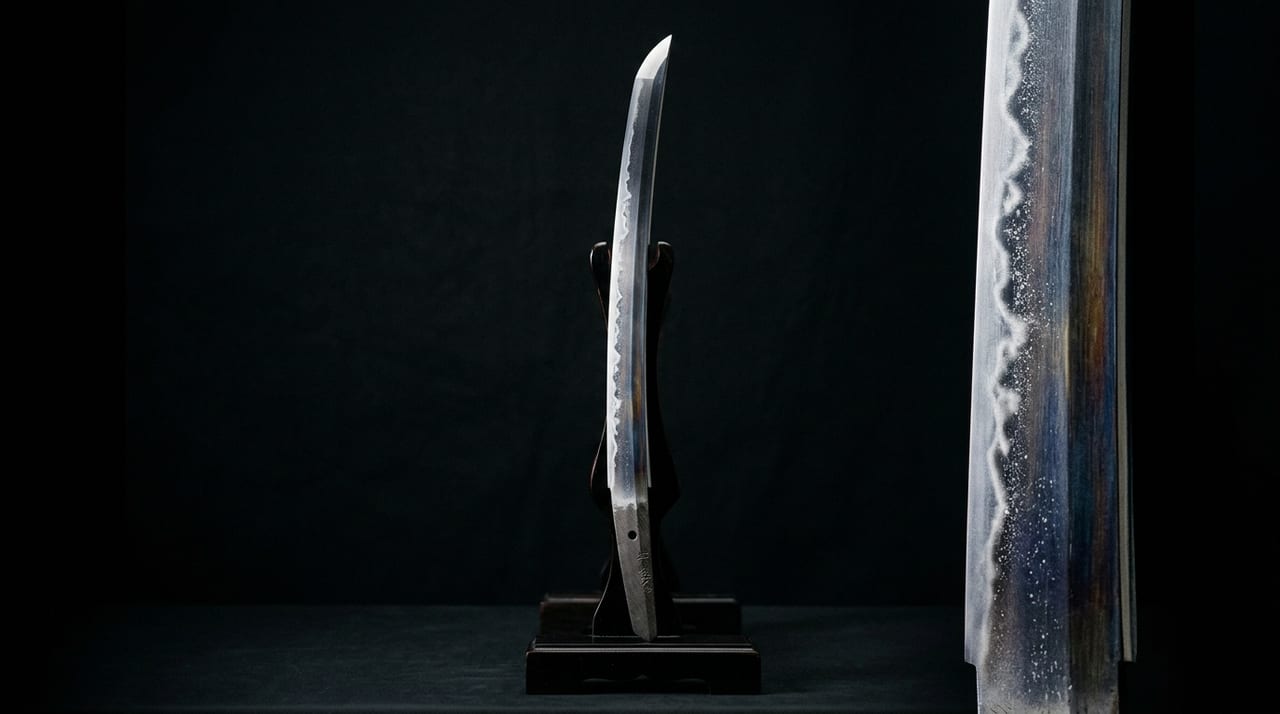
Quenching (yaki-ire) is the most dramatic and irreversible process in Japanese sword manufacturing. After coating the blade with clay and heating it to approximately 800-900°C (judged by the furnace color that swordsmiths call "fire color" or hi-iro), it is rapidly cooled (quenched) in water. This rapid cooling generates a hard metal structure called "martensite" on the cutting edge side of the blade, causing the hamon to appear and establishing the balance between hardness and toughness.
The success or failure of quenching decisively determines the quality of the sword. Success produces a work with a beautiful hamon and high hardness combined with appropriate toughness, but failure results in fatal defects such as the following:
- Hike (cracks in the blade): irreparable and must be discarded
- Hagire (discontinuities in the hamon)
- Warping of the curve
In this make-or-break process, one of the elements that swordsmiths pay the most attention to is "water." The choice of water quality, how water temperature is managed, and the shape of the water tank—these decisions directly affect the manifestation of the hamon and the finishing of the blade.
The Influence of Water Quality—Differences Between Hard Water, Soft Water, and Salt Water
The "water quality" used in quenching has long been valued among swordsmiths. In famous sword-making regions throughout Japan, unique quenching methods utilizing local water quality have been passed down, and the understanding that "the quality of water affects the outcome of the sword" was widely shared.
The difference between hard and soft water: Water hardness is determined by the concentration of calcium and magnesium ions in the water. The cooling curves differ subtly between hard water (with more minerals) and soft water (with less). Hard water has slightly lower surface tension, and changes in water adhesion to the blade affect cooling speed. In regions using soft water (common in western Japan and Kyushu), an empirical rule holds that hamon manifestation tends to be more uniform.
The use of salt water: Some swordsmiths use "salt water" (shio-mizu), which is fresh water with a small amount of salt added. Salt water has a higher boiling point than pure water, suppressing the formation of vapor bubbles on the blade surface, resulting in more uniform and rapid cooling. While this makes the hamon outline more likely to appear sharp, if the quenching is too rapid, the risk of hike (cracking) increases. Using salt water requires sophisticated judgment based on the smith's experience and blade material.
Groundwater and river water: Most swordsmiths during the Edo period used well water or clear streams near their forges. The smiths of Bizen Osafune are said to have used water from the Yoshii River, while smiths of Soshu (Kanagawa) used groundwater. The possibility that each region's water quality influenced the characteristics of each school's hamon continues to be debated among modern sword researchers.
Water Temperature Management—The Paradox of "Cold Water in Winter, Warm Water in Summer"
Water temperature management during quenching is an important technical variable for modern swordsmiths. Contrary to intuition, many swordsmiths practice paradoxical temperature management: "when quenching in summer, warm the water slightly, while in winter use it cold."
The reason for this lies in how water temperature affects cooling speed. The lower the water temperature, the faster the cooling; the higher it is, the slower it becomes. The balance among three factors—ambient temperature, blade temperature, and water temperature—determines the uniformity of cooling.
Summer quenching: In summer, the temperature in the forge is high, so there is little cooling loss as the blade is transferred from the heating furnace to the water tank. At the same time, water temperature tends to be high, creating a risk of non-uniform cooling. By intentionally warming the water slightly, uniform cooling speed is achieved, stabilizing hamon manifestation.
Winter quenching: In winter, ambient temperature is low, risking the heated blade cooling too much before reaching the water tank. However, because water temperature is low, if handled properly, uniform and rapid cooling can be achieved. Quenching that takes advantage of winter's cold water is also said to make hamon outlines appear sharp, and some swordsmiths prefer "winter striking" (fuyu-uchi).
Edo-period swordsmiths had no thermometers and judged water temperature by experience and feel. Sensory standards such as "warm enough when you put your hand in it" and "slightly cold when you breathe on it" have been passed down as tradition. Modern swordsmiths use thermometers for numerical management, with many maintaining a basic range around 15-25°C.
Water Tank Shape and Capacity—Control of Water Flow
The shape, capacity, and material of the water tank used in quenching are also important factors affecting the result.
Shape and capacity: If the tank is too small, water temperature will spike when the blade is inserted, causing non-uniform cooling. Also, in shapes where water does not circulate easily, localized problems occur where part of the blade remains surrounded by a vapor film, delaying cooling. Traditionally, large wooden barrels were used; adequate capacity combined with wood's insulating properties achieved appropriate cooling speed.
Presence or absence of water flow: Some swordsmiths create flow within the tank (such as by stirring the water by hand) to achieve uniform cooling. When there is water flow, the vapor film around the blade is more likely to break, allowing more uniform cooling. However, if the flow is too strong, cooling speed becomes too rapid and the risk of cracking increases, requiring experience to determine the appropriate flow strength.
The Science of Martensite Generation—The Mechanism of Hamon Clarified by Modern Chemistry
Modern metallurgy explains hamon manifestation through quenching as a physicochemical phenomenon called "martensitic transformation."
When steel (iron with carbon added) is held at high temperature (approximately 727°C or higher), carbon dissolves uniformly into the iron's crystal lattice, forming a structure called "austenite." When this is rapidly cooled, the crystal deforms without carbon being able to escape from the lattice, generating hard but brittle "martensite." Martensite is the brightly glowing portion of the hamon (the basis of the optical phenomenon called "hataraki"), and possesses high hardness around HRC 60.
Conversely, the spine side with thick clay coating has slow cooling speed, generating structures such as "pearlite" and "sorbite." These form the part of the "jigane" (body steel) where hamon does not appear, being softer than martensite and rich in toughness.
Water quality, water temperature, and water flow all influence the martensite generation pattern through "cooling speed." Modern chemistry's insights have clarified the physical mechanism underlying the "choice of water" that Edo-period swordsmiths empirically mastered.
The technology of quenching, understood from both traditional and scientific perspectives, remains even in 2026 a realm of profound craftsmanship where the smith's experience and intuition complement scientific numerical management. Understanding the tension inherent in this process underlying masterpieces will surely deepen sword appreciation.