Sword Aesthetics of the Azuchi-Momoyama Period: The Coexistence of Wabi-Cha Culture and Magnificent Sword Fittings
 * Image is for illustrative purposes only.
Table of Contents
The Azuchi-Momoyama Culture and Blades—An Era Where Contrasting Aesthetics Coexisted
The Azuchi-Momoyama period, which began in Tensho 1 (1573) and ended with the Summer Campaign of Osaka in Keicho 20 (1615), occupies a unique position in Japanese cultural history. While embers of the Warring States period still remained, the magnificent "Southern Barbarian taste" symbolized by gold and lapis lazuli painted sliding doors and the spirit of wabi tea perfected by Sen no Rikyu bloomed in parallel. This cultural bipolarity was directly reflected in the aesthetics of blades and blade fittings.
The three great unifiers—Nobunaga, Hideyoshi, and Ieyasu—each found unique meanings in blades.
| Figure | Relationship to Blades |
|---|---|
| Oda Nobunaga | Used blades as a tool of strategic patronage, stabilizing the supply system by protecting and organizing master smiths |
| Toyotomi Hideyoshi | Prohibited blade-wearing among non-samurai through the Sword Hunt Edict (1588), while personally favoring richly gilded blade fittings and actively using blades as gifts for diplomatic purposes |
| Tokugawa Ieyasu | Also known as a blade collector, visually demonstrated the legitimacy of his power through the collection and management of celebrated swords |
Wabi Tea and Blade Fittings—The Influence of Chanoyu on Blade Aesthetics
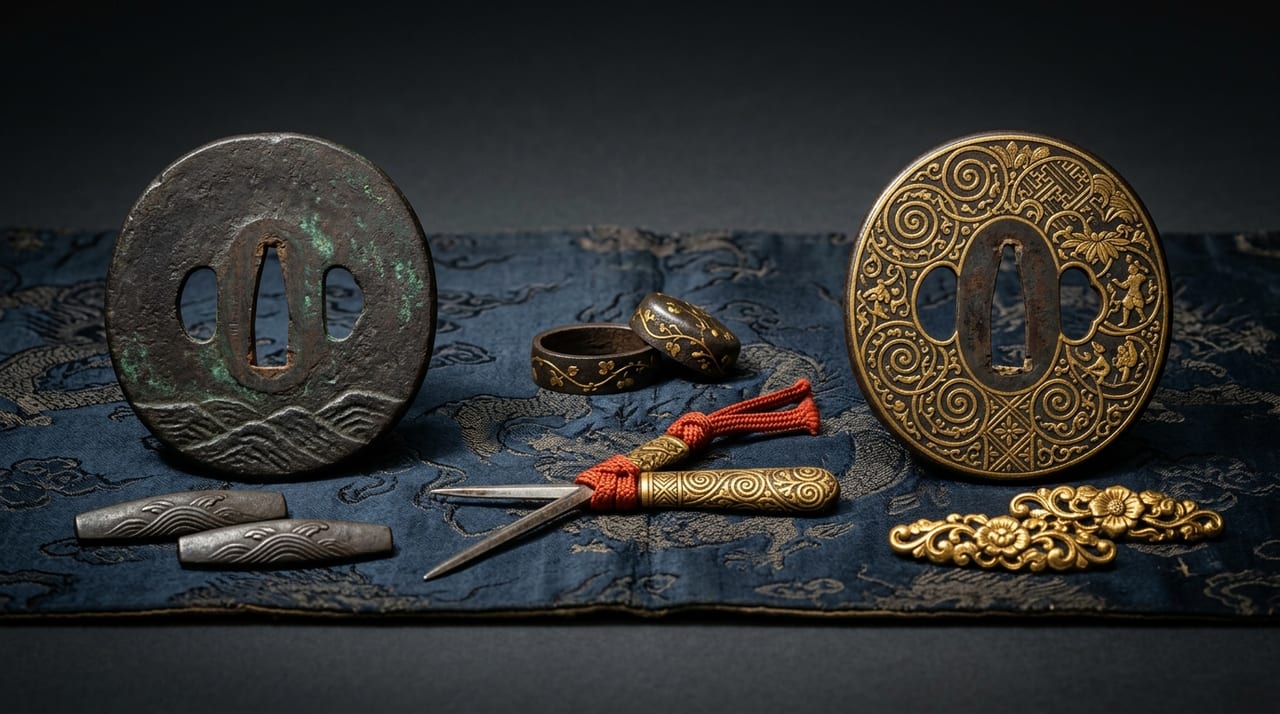
The spirit of "wabi tea" perfected by Sen no Rikyu (1522–1591) also spread to the world of blades. In chanoyu, the core sensibility is the wabi and sabi aesthetic, which rejects excessive decoration and finds beauty in the natural texture and unevenness of materials. This sensibility deeply permeated the design of blade fittings (tsuba, menuki, kozuka, kōgai, etc.).
Many of the blade fittings favored by tea masters during Rikyu's time valued material texture and patina more than meticulous metal carving techniques.
- Rough-finished iron tsuba
- Tsuba with deliberately asymmetrical contour lines in "mokkō" (four-lobed quince) shape
- Metal work bearing green patina (verdigris)
Umetada Myōju, a tsuba artisan of Kyoto, while influenced by tea culture, established his own refined design aesthetic and exerted great influence on later tsuba artistry.
On the other hand, the preference for "wabi-inspired" blade fittings existed in a different context from the practical world of blades. The blade fittings (chanoyu-to) brought into the tea room differed from robust battle use, favoring modest, dignified forms. This chanoyu-to culture became the foundation for the diversification of later "koshirae" (blade mounting) formality.
Magnificent Blade Fittings—The Visualization of Power and Southern Barbarian Taste
In contrast to the spirit of wabi tea, magnificent blade fittings employing gold, silver, and inlay (zougan) flourished at formal occasions of Hideyoshi and the great lords. Records of blade fittings in Hideyoshi's collection feature numerous exotic fittings utilizing pure gold saya lacquering and nanban-tetsu (Western iron imported via Portugal and Spain).
The Southern Barbarian taste (nanban taste) exerted unique influence on blade fittings of this era. Western artifacts introduced by Portuguese merchants and Jesuit missionaries—firearms with spiral patterns, metal decoration with scrolling arabesque patterns, designs of exotic beasts—were incorporated into blade fitting design, and exotic motifs called "nanban-jin-zu-tsuba" (Southern Barbarian figure tsuba) appeared on tsuba and menuki.
Hideyoshi's golden tea room was the ultimate expression of power display in chanoyu, and this same spirit was reflected in blade fittings. Celebrated swords gifted to foreign envoys as diplomatic presents served both as diplomatic tools conveying the essence of Japanese culture and as political messages demonstrating Hideyoshi's economic power and aesthetic judgment.
The Influence on Blade Smiths—The Dawn of the Shintō Era
The Azuchi-Momoyama period also marks the beginning of the "shintō" (new swords) era in the history of Japanese blade-forging technique. Smiths active during the Tensho, Bunroku, and Keicho years (1573–1615) began moving away from the practical demands of the Warring States period and pursued more aesthetic directions.
Kunihiro, a smith from Hyuga Province (present-day Miyazaki Prefecture), after the fall of the Ito clan, traveled through various provinces before settling in Kyoto during the Keicho years as "Horikawa Kunihiro," establishing a style of blades later called "Horikawa-mono." Horikawa-mono, pursuing the beauty of jihada and the richness of hamon variation, embodied a new blade aesthetic that departed from the unrefined practicality of old swords and aimed for artistic perfection worthy of appreciation.
During the same period, smiths also rose to prominence in regional centers such as Echizen (present-day Fukui Prefecture) and Hizen (present-day Saga Prefecture), and the foundation for later "Hizen-to" was formed. The origin of Hizen-to, which gained renown throughout the Edo period, lies in this diversification of production centers during the Azuchi-Momoyama period.
The Legacy of Azuchi-Momoyama Aesthetics—The Influence on Edo Blade Fitting Culture
The dual aesthetic of blade fittings established during the Azuchi-Momoyama period—the spirit of wabi and magnificent power expression—became the foundation of Edo-period blade fitting culture. The metalwork art of the Goto family, which reached its zenith during the Edo period, refined the magnificent direction of the Azuchi-Momoyama period, while the tsuba artistry of the Shoami school inherited the restrained beauty influenced by tea culture.
When samurai adopted the "ni-hon-zashi" (wearing two swords) as formal attire during the Edo period, blade fittings became systematized as a means of visualizing social status. The establishment of "koshirae formality" (distinctions in rank based on the material, design, and form of fittings) in formal occasions can be said to represent the institutionalization of the culture of "self-expression through blade fittings" that germinated during the Azuchi-Momoyama period.
Even in contemporary blade fitting collection, tsuba, menuki, and kogai from the Azuchi-Momoyama period receive the highest valuation. In particular, works by Umetada Myōju and Gotō Kōjō stand as testimony to the innovative role this era played in Japanese metalwork art.