Tsukamaki: Techniques and Materials — Protecting the Sword Grip
 * Image is for illustrative purposes only.
Table of Contents
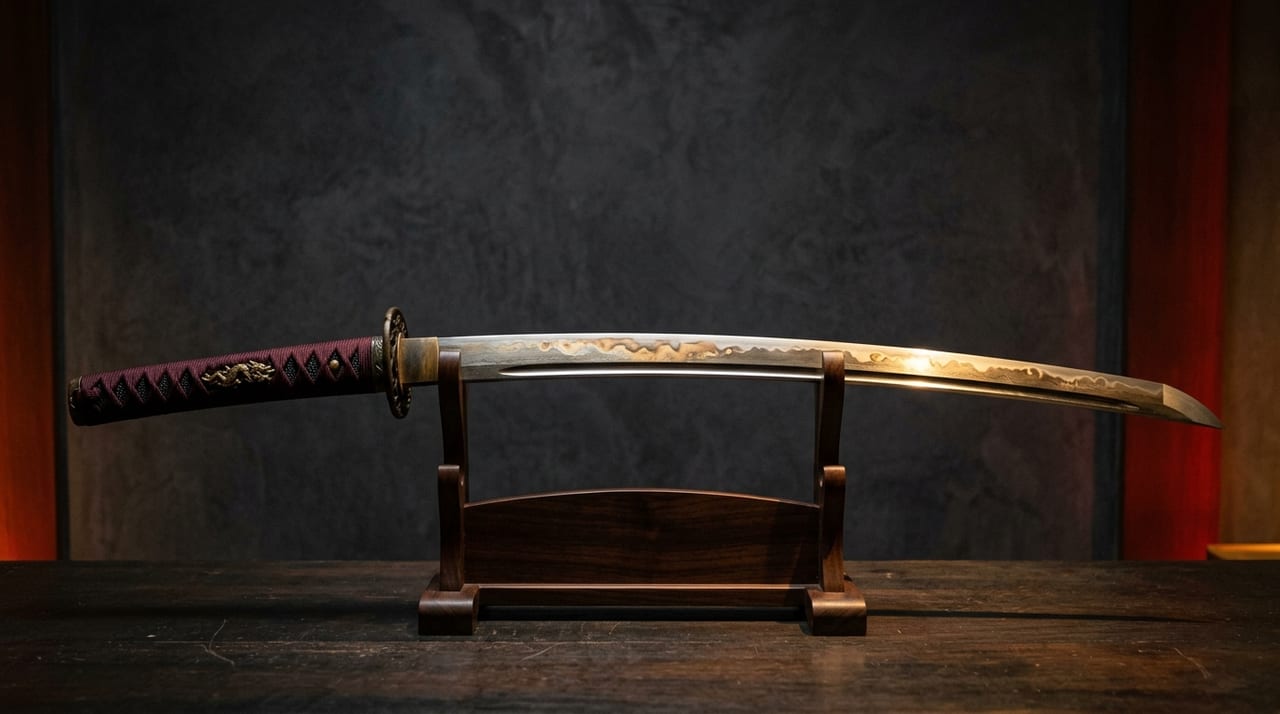
The handle (tsuka) of a Japanese sword is always wrapped with thread or leather. This work is called "handle wrapping" (tsukamaki) and serves not merely to improve appearance, but has a functional meaning—to allow safe gripping of the sword and to transmit force accurately. This time, we will focus on the techniques and materials of handle wrapping and explain this modest yet important process in detail.
Role and Structure of Handle Wrapping
Handle wrapping has three main roles.
- Non-slip grip: As the sword is swung downward, the hand experiences significant friction force. The wrapped thread or leather disperses this friction evenly and prevents the handle from rotating or slipping within the hand.
- Impact absorption: When the sword strikes a hard object, the elasticity of the handle wrapping absorbs the impact appropriately, reducing strain on the sword itself and the hand.
- Protection of handle wood: Inside the handle is a handle core made of magnolia wood (honoki), and the handle wrapping protects this wood from moisture, impact, and wear.
When viewing the cross-section of the handle, it is composed of the following layers from inside to outside.
- Nakago = the root of the blade
- Handle core wood
- Samegawa = ray skin
- Thread or leather (handle wrapping)
Ray skin has a fine granular surface with high friction coefficient and is important as a base to prevent thread slippage. Only through this multilayered structure as a whole is the function as a "grip" completed.
Types of Materials and Selection Criteria
Materials used for handle wrapping fall into three main categories: silk thread, cotton thread, and leather (primarily cattle leather and ray leather).
| Material | Characteristics | Primary Uses |
|---|---|---|
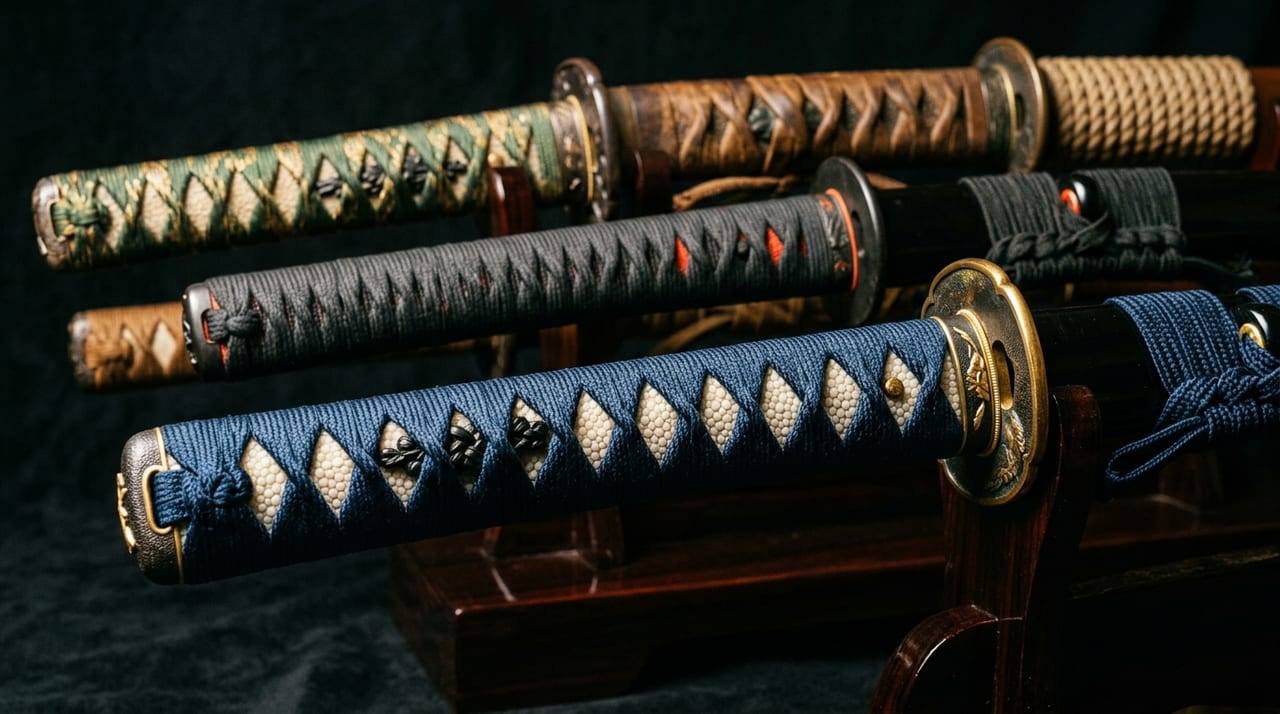
| Silk thread (kinuito) | Characterized by lustrous shine and soft feel. Fine and strong, thread does not break easily even when wound tightly. Wide range of color options available, allowing diverse color schemes including brown, navy, white, black, and vermillion. However, with prolonged use, the thread tends to unravel as it wears, requiring regular maintenance. | Formal ceremonial swords of samurai or modern iaido swords |
| Cotton thread (momenito) | Stronger than silk thread and more resistant to wear. Many surviving samurai swords from the Edo period feature cotton wrapping, representing a practicality-first choice intended for daily blade-carrying and use. | "Working swords" actually used by samurai, modern training wooden swords and iaido swords |
| Leather (kawa) | One of the oldest materials used. Made from thinly shaved cattle leather or ray skin wrapped as-is, offering the distinctive strength and durability inherent to leather. As time progressed, silk and cotton became mainstream. | Ancient sword fittings before the Edo period, modern restoration sword fittings |
Wrapping Methods and Techniques by School
There are multiple types of handle wrapping methods, each with different appearance and function.
| Wrapping Method | Characteristics |
|---|---|
| Morō-tsumami wrapping (morotsumamimaki) | The most common wrapping method. Thread is wrapped in a scale-like pattern while crossing, creating a "diamond" pattern across the entire handle. Force is dispersed evenly, and the appearance is well-balanced. Most modern iaido swords employ this wrapping method. |
| Kata-tsumami wrapping (katatsumamiまき) | A wrapping method where thread is pulled from only one side without crossing, resulting in a simpler finish than morō-tsumami wrapping. It has a more rustic appearance and may suit more practical, austere-looking swords. |
| Accordion wrapping (jabaramaki) | A technique where thread is folded accordion-style as it is wrapped. The appearance gains three-dimensionality, but requires skilled technique to execute and is known as a relatively rare wrapping method. |
Once the wrapping method is decided, achieving uniform tension becomes the greatest challenge in the actual work. From beginning to end, if thread tension is not uniform, distortion will appear in the finished product. Craftsmen manage this tension solely through the sensation in their hands, acquiring the skill through years of apprenticeship. Additionally, structural constraints exist at the handle tip (directly below the handle end, or kashira) and handle base (just above the ferrule, or fuchi), and each requires skilled technique in processing.
Transmission of Handle Wrapping in Modern Times
Handle wrapping is often undertaken by a specialized profession known as the "handle wrapper" (tsukamaкishi), separate from the swordsmith. Historically, the process of making a sword and the process of preparing it for use—the "fittings" (koshirae)—have been divided into separate specializations, and handle wrapping represents one area of specialization among craftsmen.
In modern times, the number of handle wrappers is hardly abundant, and with the growing demand accompanying the popularization of iaido, the absolute number of craftsmen cannot keep pace. Conversely, mass-production manufacturers of iaido swords have begun supplying products with machine wrapping, and quality differences compared to hand-wrapped craftwork are frequently discussed. Machine wrapping can achieve uniform appearance, but the "adaptability" of hand-wrapping craftsmen who adjust to the shape of each individual handle is difficult for machines to replicate.
For modern sword enthusiasts practicing iaido, kendo, and classical martial arts, handle wrapping is not mere decoration but a crucial element directly linked to the quality of practice and safety. A handle with loose thread or wrapping misalignment can lead to accidents during practice. Timely handle wrapping repair and re-wrapping represent basic maintenance for handling the sword safely.
In the world of the Japanese sword, a single blade is completed only when both the technique of creating the blade and the technique of preparing the sword for "use" are united. Handle wrapping is craftwork that fulfills the latter, and remains a traditional craft deserving careful transmission in modern times. Those interested in swords are encouraged to direct their attention not only to the beauty of the blade but also to the preparation of the grip. TOUKENZA's online catalog features various Japanese swords with different fittings, allowing you to compare handle wrappings in practice.