The Secret of Tamahagane — Understanding the Raw Material of Japanese Swords
 * Image is for illustrative purposes only.
Table of Contents
What is Tamahagane? — Steel That Exists Solely for Japanese Swords
When we speak of Japanese swords, our attention naturally turns to the beauty and sharpness of the blade, but when we ask the fundamental question of what a sword is made from, we arrive at a single answer: "tamahagane" (jeweled steel).
Tamahagane is a steel material exclusive to Japanese swords, produced from iron sand through Japan's ancient "tatara" ironworking method. It differs entirely in both manufacturing process and composition from industrial steel, and possesses unique properties that are difficult to intentionally reproduce with modern steelmaking technology. Today, tamahagane is legitimately produced at only one location: the Nihonto Hozon Tatara in Okuizumo Town, Nita District, Shimane Prefecture, operated by the public interest organization Japan Art Sword Preservation Society. Operations occur during winter months, and the produced tamahagane is distributed to swordsmiths throughout the nation. It represents an ironworking culture without parallel in the world—one preserved solely for the sake of Japanese swords.
The Mechanism of Tatara Ironworking — A Three-Day Dialogue with Fire
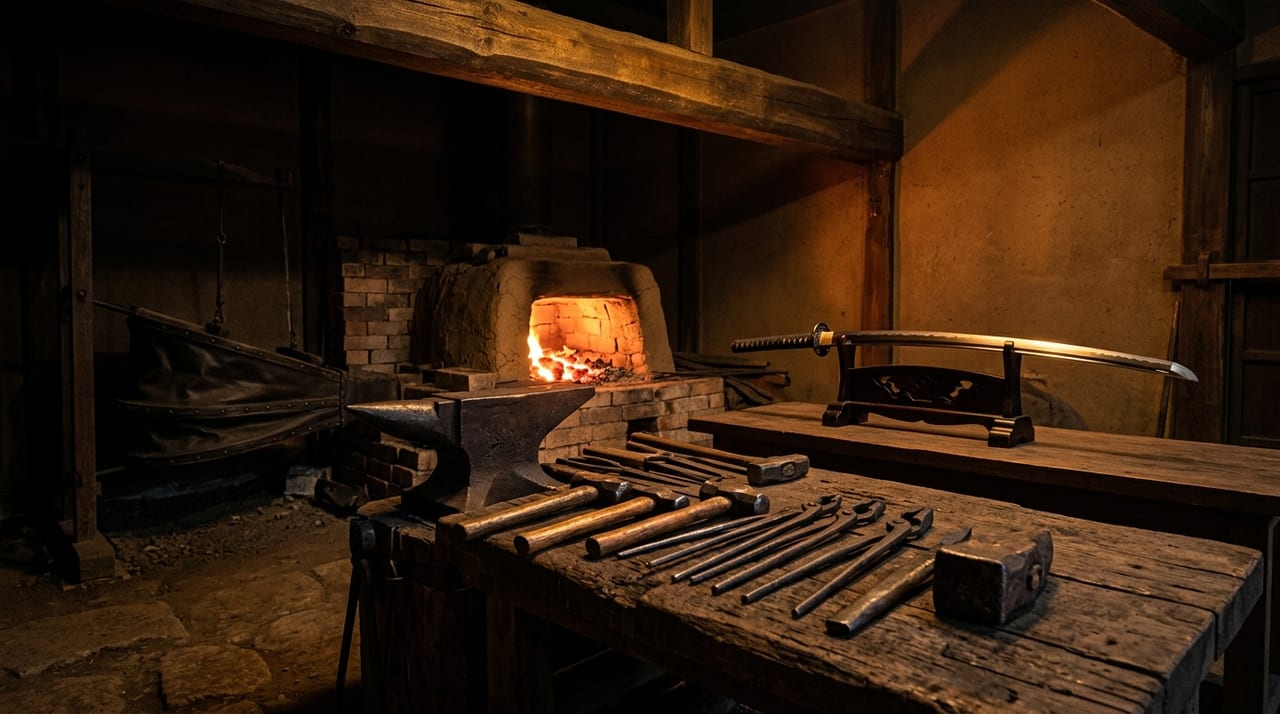
The heart of tatara ironworking lies in the "tatara furnace," a clay vessel. Operations typically continue for three days and nights—roughly 70 to 72 hours—during which craftsmen maintain constant vigilance over the furnace in rotating shifts.
When operations commence, charcoal is first layered across the furnace floor and ignited. Iron sand and charcoal are then fed alternately in small amounts. This process is called "pushing in," and decisions about the procedure are made by the master craftsman known as the "murage," who reads the furnace's state through all five senses. Every imperceptible change is measured against the murage's accumulated experience.
- The color of the flames
- The character of the smoke
- The sounds emanating from the furnace
Iron sand—whose primary component is iron oxide—undergoes reduction when reacting with charcoal and transforms into iron. Simultaneously, carbon dissolves into the iron, creating steel. After three days and nights, an enormous steel ingot called "kera" forms at the furnace bottom. Weighing 2 to 3 tons, this ingot is extracted during "kera removal," in which the furnace itself is destroyed—the final act of the operation.
Selection of Tamahagane — What Determines "Quality"?
The kera is not uniform steel. Carbon content varies significantly by location—regions near the furnace's top possess higher carbon content and are hard yet brittle, while sections near the bottom contain less carbon and are softer. The intermediate zone, which holds appropriate carbon content (approximately 0.6 to 1.5%), is selected as "tamahagane."
Selection is accomplished through the trained eye and experience of experts, guided by these criteria:
- The luster of the cross-section
- The fineness of the grain structure
- The presence or absence of air pockets
Superior tamahagane displays a finely-textured, luminous cross-section with minimal impurities and slag. Material rejected at this stage is repurposed as "tetsu" (iron) or "zuku" (pig iron) for agricultural implements and everyday goods—nothing is wasted.
The production volume of tamahagane is extremely limited. From all the steel produced in a single operation, only several hundred kilograms qualify as tamahagane. Compared to modern blast furnaces producing thousands of tons of steel daily, its rarity is beyond measure.
Compatibility with Folding and Forging — The Steel Structure Born from Tamahagane
The reason tamahagane has been continuously chosen as the material for Japanese swords is clear: its extraordinary compatibility with "folding and forging."
The swordsmith heats tamahagane in a furnace and strikes it with a hammer, driving out impurities. The steel is then folded and struck again. Repeating this process dozens of times causes carbon within the steel to distribute uniformly, creating a fibrous metal structure. As the number of folds increases, the resulting layers multiply exponentially—fifteen folds theoretically produce 32,768 layers.
This layered structure is the wellspring of Japanese swords' "resilience." Modern industrial steel, being homogeneous, tends to crack when strong impact concentrates on a single point. By contrast, a sword forged from folded tamahagane disperses impact through its fibrous structure, absorbing and deflecting blows with flexibility. The ideal of Japanese swords—"neither breaking nor bending, yet cutting excellently"—is realized only through the union of tamahagane's properties and the mastery of folding and forging.
Moreover, trace amounts of silicon and manganese present in tamahagane impart distinctive qualities to the sword's structure during forging. Reproducing such intricate interactions of trace elements is considered nearly impossible with industrially refined, uniform-composition steel.
The Mysteries of Tamahagane Revealed by Modern Science
In recent years, research has advanced in analyzing tamahagane through the lens of contemporary metallurgy and materials science.
- Electron microscopy and various spectroscopic analyses reveal that tamahagane's cross-section contains micro-scale structures absent in industrial steel. Some researchers propose that nano-scale carbide distribution particularly contributes to its resilience.
- Iron sand—primarily ilmenite and magnetite—exhibits subtle compositional variations by origin. Iron sand from Okuizumo is noted to have minimal impurities and properties ideal for sword-grade tamahagane.
- Charcoal used in ironmaking employs specific tree species (primarily pine and oak), with combustion temperature and ash composition influencing the furnace reactions.
- Evidence also suggests that clay walls of the tatara furnace dissolve minute quantities of silica compounds during operation.
It has become evident that tamahagane's composition is a complex product, not merely "iron sand plus carbon." Behind what long appeared to be "craftsman's intuition" lies precise chemical reaction.
What Tamahagane Protects — The Chain of Culture and Technique
The Nihonto Hozon Tatara continues in its present form following successful full-scale restoration in 1977. Prior to this, tatara ironworking had nearly disappeared, and during Japan's post-war reconstruction, dedicated practitioners rebuilt the technique through historical documents and testimony from those who had witnessed it. Without their efforts, Japanese sword culture itself might have faced extinction.
It is only through the supply of tamahagane that swordsmiths nationwide can continue to forge swords using traditional methods. Modern swordsmiths recognized by the Agency for Cultural Affairs number several hundred across Japan, and most eagerly await the year's distribution of tamahagane. The handwork of swordsmiths, the whetstones of polishers, the artisanship of sheath and hilt makers—every technique surrounding the Japanese sword depends upon tamahagane as its foundation.
Tamahagane is not merely a steel material. It is a living cultural treasure in which the iron sand nurtured by Japan's environment, charcoal, and the craft of artisans unite as one. Within that modest ingot of steel rests more than a thousand years of Japanese sword history and the accumulated wisdom of countless generations.