Structural Differences Between Tachi and Uchigatana — How Edge Orientation, Wearing Method, and Sori Position Reveal Function and Era
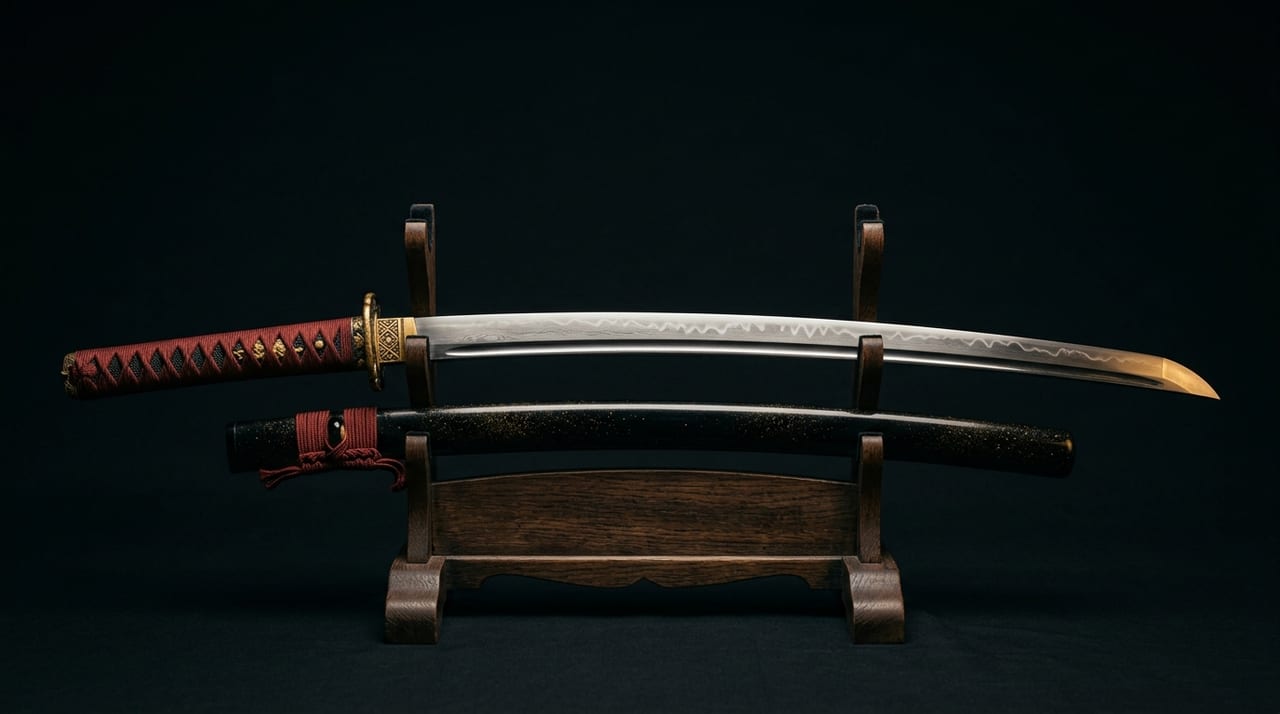 * Image is for illustrative purposes only.
Table of Contents
Tachi and Uchigatana — The Two Great Lineages of Nihonto
In the history of nihonto, tachi and uchigatana are defined not so much by lineage of construction as by differences in wearing method and use. It is not uncommon for the same toko to produce both types, and the manner of attachment and drawing — rather than blade shape — lies at the heart of the distinction.
Characteristics of the Tachi
Tachi are swords worn suspended from the hip by a hakio (suspension cord), with the edge facing downward.
- Edge orientation: edge-down (the mekugi hole is positioned upward)
- Wearing method: suspended (haku) — hung from the hip with leather cord or braided cord
- Sori: koshi-zori (the apex of the curvature near the base of the blade) is typical
- Nagasa: generally 2 shaku 4 sun (approximately 73 cm) or more in many cases
- Use and era: primarily used in mounted combat from the late Heian period to the mid-Muromachi period
In mounted archery and mounted grappling, the basic technique was either to dismount before drawing the suspended tachi, or to raise it with the left hand while still on horseback.
Koshi-zori is the sori form typical of tachi from the late Heian to the early Kamakura period; the apex of the curvature is near the base close to the nakago (tang), and the blade becomes more linear toward the kissaki (point). Koshi-zori excels in ease of handling on horseback and was designed to make it easier to raise the blade to the outside of the body while mounted.
Characteristics of the Uchigatana
Uchigatana are swords worn thrust through the waist belt, edge facing upward.
- Edge orientation: edge-up (the mekugi hole is positioned downward)
- Wearing method: thrust through (sasu) — inserted directly into the koshiobi (waist belt)
- Sori: middle sori to saki-zori is common
- Nagasa: 2 shaku (approximately 60 cm) to 2 shaku 8 sun (approximately 85 cm)
- Use and era: primarily used in infantry combat and street fighting from the late Muromachi period through the Edo period
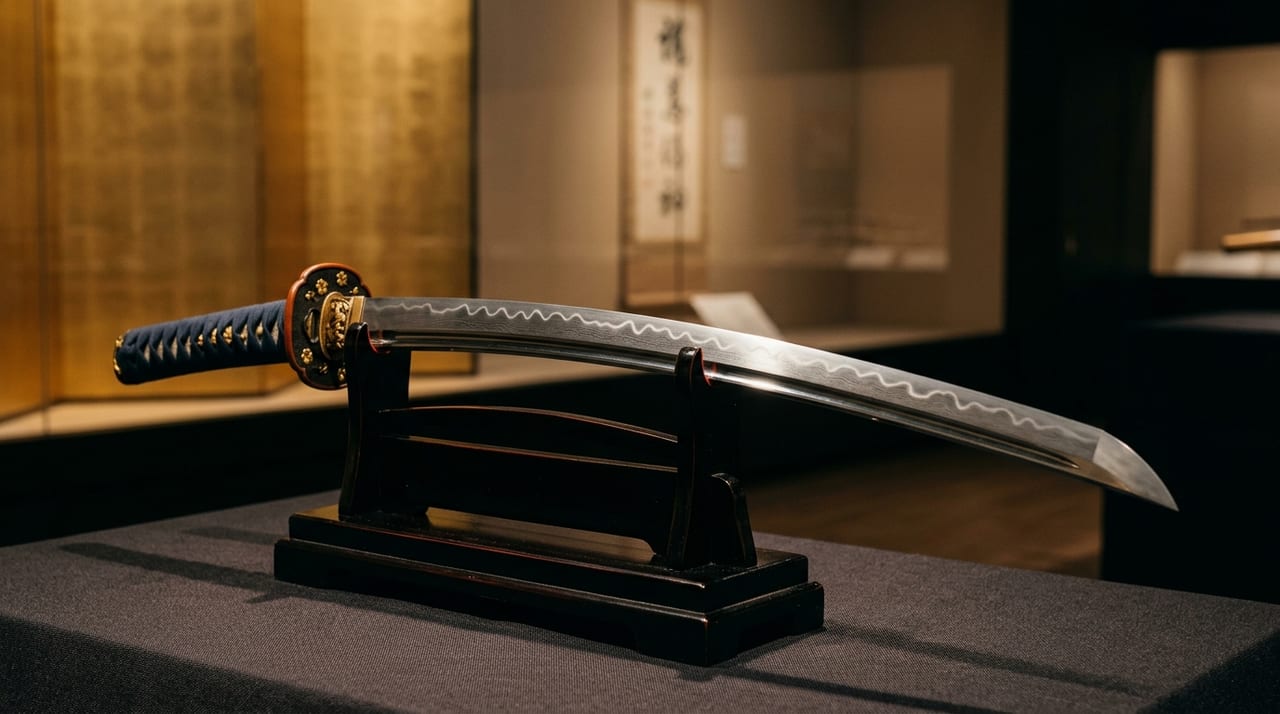
An uchigatana thrust through the belt can be drawn with the right hand and immediately transitioned into a cutting strike. The technique of iai developed from the rationalization of this draw-and-cut-in-one motion.
Middle sori (chuzori), also called "torii-zori," is a form in which the apex of the curvature is near the center of the blade; it was adopted from around the mid-Kamakura period onward. It offers high operability in infantry combat and is the predominant sori form for uchigatana.
The Mei and Its Sides — How to Tell Tachi from Uchigatana
In tachi and uchigatana, the face of the nakago (tang) on which the mei (signature) is engraved is reversed. This is one of the most reliable ways to distinguish between the two.
Mei on a tachi: The face that turns outward when the tachi is worn edge-down suspended at the hip is called the "hakiomote." The toko normally engraved the mei on the nakago on this hakiomote side. Accordingly, if a tachi is laid on a surface with the edge facing up (the display posture for uchigatana), the mei faces inward (downward).
Mei on an uchigatana: The face that turns outward when the uchigatana is thrust through the belt edge-up is called the "sashiomote." The mei of an uchigatana is engraved on the nakago on this sashiomote side. Accordingly, the mei can be read when the uchigatana is in its display posture.
Displaying a tachi with the edge facing downward is also done to show the mei in its "correct orientation." This is why the display orientation in museums and art galleries differs between tachi and uchigatana.
Sori of the Nakago (Nakago no Sori)
Differences can also be seen in the shape of the nakago (tang) between tachi and uchigatana. In general, the nakago of a tachi has sori (following the curvature of the blade — junzori), while the nakago of an uchigatana is relatively straight or has a gentle curve. The direction of the nakago's sori is also a functional difference arising from the distinction between the haku (suspension) and sasu (belt-insertion) wearing methods.
Relationship Between Sori Position and Combat Style
- Koshi-zori (tachi type): The center of gravity is close to the tsuba (hand guard), offering superior ease of handling on horseback. Typical of the late Heian to early Kamakura period.
- Middle sori (uchigatana type): Balance tends toward the center, offering high operability in infantry combat. Developed from the mid-Kamakura period onward.
- Saki-zori (a subset of blade types): The kissaki side curves strongly, enhancing the force of cutting strikes.
Historical Transition from Tachi to Uchigatana
Late Heian to Kamakura period: Mounted combat predominated. The tachi was the basic weapon of the warrior. Elegant tachi with koshi-zori were produced, and the various traditions of Yamato, Bizen, and Soshu were established.
Early to mid-Muromachi period: As the nature of battle changed, tachi blades became shorter and the kodachi also became widespread.
Late Muromachi to Sengoku period (15th–16th centuries): As warfare shifted to massed ashigaru (infantry) combat, uchigatana worn edge-up spread rapidly. Suited to close-quarters and chaotic fighting on the ground rather than on horseback, the uchigatana had the advantage of being drawable and ready to cut in an instant.
Edo period (17th century onward): The combination of daisho (uchigatana and wakizashi) as the everyday sidearm of warriors became established under the buke shohatto. Tachi came to be used for ceremonial and formal dress occasions, and continued to be produced as "kazaritachi" (decorative tachi) displayed at the head of daimyo processions. In warrior society, the tachi retained its status as a special sword signifying rank and prestige.
Points to Note in Display and Appraisal
When viewing nihonto in museums, tachi are generally displayed with the edge facing downward (in a posture that makes koshi-zori easy to observe), while uchigatana are displayed with the edge facing upward (in a form close to the inserted-in-belt position). Checking the orientation of the mei, the position of the sori, the nagasa (blade length), and the shape of the nakago in combination is the key to accurately distinguishing between tachi and uchigatana.