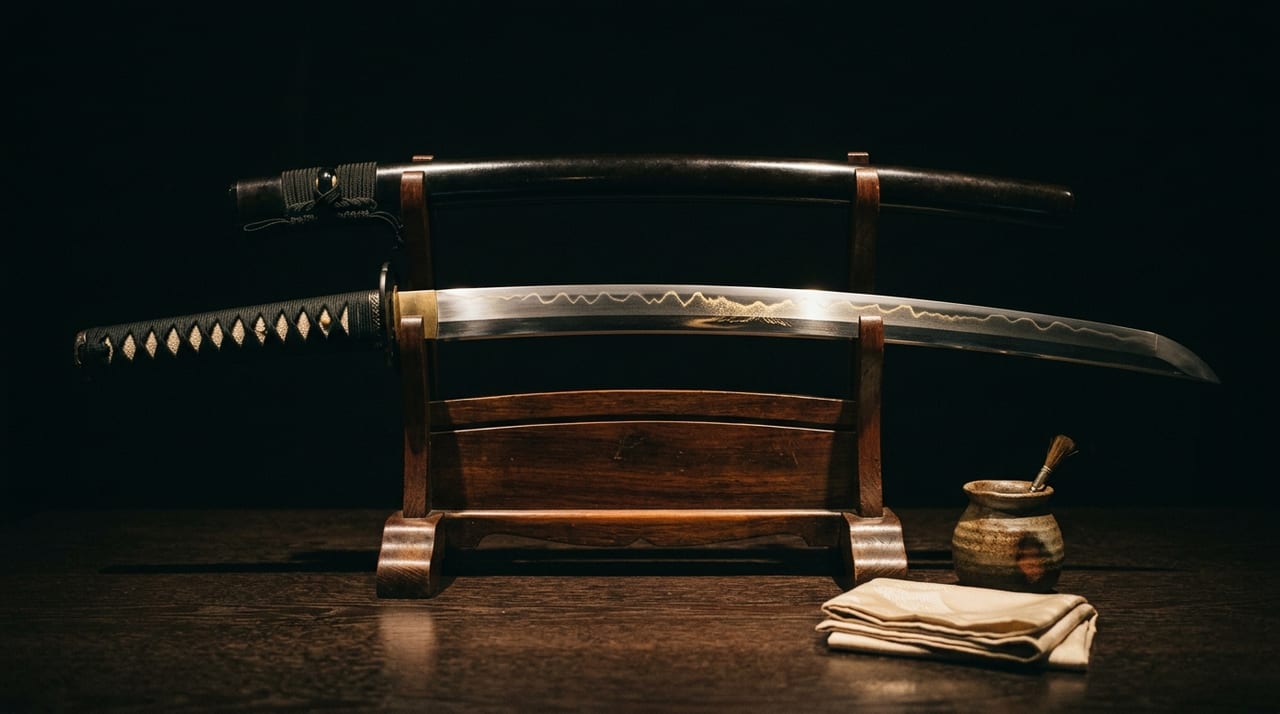
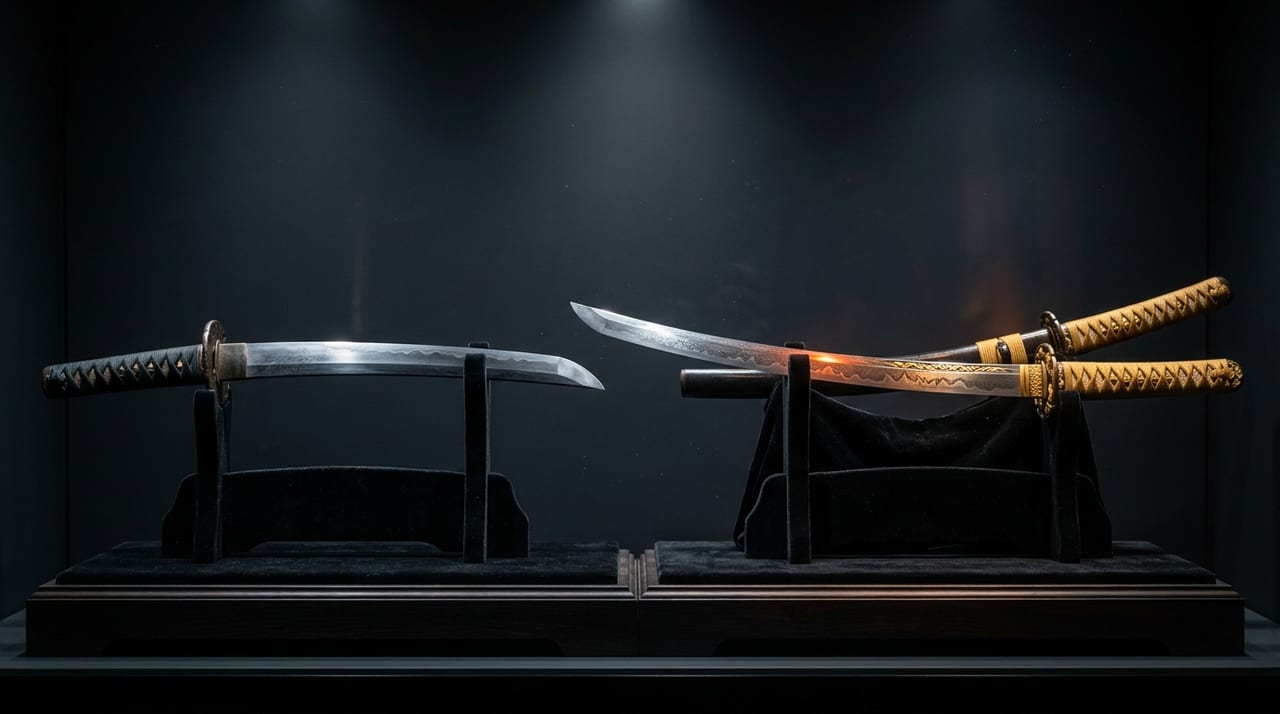
The Geometry of Shinogi — How Blade Structure Expresses Combat Performance and Aesthetics
 * Image is for illustrative purposes only.
Table of Contents
Among the elements that constitute a Japanese sword, the shinogi is an important structural element that influences the strength, cutting ability, and appearance of the blade. The shinogi is a ridge line that forms the boundary between the flat surface on both sides of the blade and the flat surface toward the spine, and the combination of the position, height, and width of this ridge line fundamentally determines the character of the sword. While attention often focuses on the beauty of the hamon and jihada, the shinogi is truly the structural-mechanical core of the Japanese sword—a crystallization of wisdom that unifies practical performance and aesthetic beauty.
The Basic Structure of Shinogi and Its Three Roles
Shinogi-zukuri (shinogi construction) is the representative blade form of the Japanese sword, a traditional style that has continued from the late Heian period to the present day. When viewed in cross-section, the flat surface from the spine (mune) to the shinogi is called the "shinogi-ji," and the sloping surface that tapers from the shinogi to the edge is called the "hira-ji." This three-dimensional cross-sectional shape creates the functional beauty unique to the Japanese sword.
The role of the shinogi can be organized into three main points.
- Enhanced structural strength: The ridge line strengthens the blade's axis, functioning as a core material that disperses impact during striking, thereby realizing a structure that is difficult to break while maintaining a thin edge.
- Optimized cutting ability: The angle of the hira-ji that descends smoothly from the shinogi to the edge reduces resistance during cutting and enhances penetration into the target. As the shinogi becomes higher, the angle of the hira-ji becomes steeper, giving unique characteristics to the blade's withdrawal.
- Expression of beauty: The balance of the shinogi's position, height, and width determines the overall impression of the blade and reflects the individuality of the era and school.
How Shinogi Height and Width Reveal Historical Change
Shinogi-taka (shinogi height) indicates how much the ridge line protrudes from the blade's surface, while shinogi-haba (shinogi width) is the distance from the ridge line to the spine. These measurements are important evidence for determining era and school.
Tachi from the Heian period have low shinogi height and wide shinogi width. The rounded cross-section gives an elegant impression and was suited to cutting downward from horseback in mounted combat. By the Kamakura period, accumulation of samurai combat experience led to a slight increase in shinogi height, adding strength. The sugata became more grand, and the shinogi line became more clearly defined.
During the Nanboku-cho period, large tachi and nodachi became popular, with the shinogi displaying a bold, expansive construction. In contrast, the uchi-gatana that became widespread after the Muromachi period required lightness and ease of handling to adapt to foot combat and indoor fighting, causing the blade to change to a shallow curve with uniform width, a silhouette resembling "Keicho shintou." With this, shinogi height settled lower, giving the overall impression a sharper appearance.
The Correlation with Grooves
The grooves "hi" carved into the blade are closely linked to the structure of the shinogi. Varieties include the rod groove, double groove, mantra groove, waist groove, and auxiliary groove, but the position where they are carved is invariably on the shinogi-ji. This is because the shinogi-ji has structural flexibility as a surface, and is the region where carving is possible without compromising strength.
By introducing grooves, the blade becomes lighter, and ease of handling improves even at the same length. This design of achieving lightness while maintaining rigidity is rational even from the perspective of modern structural engineering. However, if the depth or width of the groove is incorrect, blade strength decreases significantly, making advanced technique essential.
From an art appreciation perspective, the finishing of the groove's edges becomes an important point of appreciation. "Kaki-nagashi" is a technique where the groove naturally disappears at the spine, while "kaki-tooshi" means carving all the way to the kissaki, and these represent parts where the master smith's intent and skill are concentrated. The grooves of master smiths demonstrate unwavering precision in the straightness of the line, evenness of depth, and finish of the edges.
Individual Characteristics of Shinogi by School
Each school has distinct individuality in the treatment of shinogi.
| School | Characteristics of Shinogi |
|---|---|
| Yamashiro-den (Kyoto) | Slender with moderate shinogi height, an elegant construction with grace. Works by Sanjo Munetika and the Awata-guchi school possess delicate ridge lines reflecting court culture. |
| Bizen-den (Okayama) | Mild shinogi with stable blade thickness. The Osafune school creates an orderly and straightforward impression by clearly defining the shinogi line. |
| Yamato-den (Nara) | High shinogi height with somewhat narrow shinogi width, a practical construction. Reflects functionality directed at temple forces. |
| Soshu-den (Kamakura) | A shinogi line with strong, dynamic quality. The bold construction represented by Masamune exerted tremendous influence on later sword smiths. |
| Mino-den (Gifu) | Moderate shinogi height with stable balance. Within the mass production system of the Sengoku period, it achieves both practicality and beauty. |
Diversity of Cross-Sectional Shapes
Beyond shinogi-zukuri, multiple cross-sectional shapes of blades exist. "Hira-zukuri," without shinogi, is common in tanto and wakizashi, while "moroha-zukuri" with shinogi on both sides appears in straight swords and specialized blades. Even within shinogi-zukuri, variations such as "hiku-shinogi" with extremely low shinogi height or "kaki-otoshi" where the shinogi changes complexly near the ha-ma show variations concentrated in the individual smith's character.
Understanding these forms expands the clues for deciphering what purpose and aesthetic each individual blade pursued.
Reading a Sword from Its Shinogi
Specific points to observe when appreciating the shinogi are as follows:
- Whether the ridge line runs straight from the habaki base to the kissaki
- Whether the slope from the shinogi to the hira-ji is smooth or at a sharp angle
- Whether the shinogi width changes between near the nakago and near the kissaki
- How the shinogi converges at the kissaki
- When grooves are present, whether the edge finishing is clean
By comparing these elements across multiple blades, differences in era, school, and smith gradually become apparent.
Understanding the geometry of the shinogi is the key to elevating appreciation from "seeing" a sword to "reading" it. Before directing your attention to the glamorous hamon or deep jihada, first focus your awareness on the shinogi as the skeletal framework of the blade. There, quietly etched, are the traces of the wisdom and aesthetic sensibility that sword smiths have honed over centuries.