Forgery of Tōken Registration Certificates and the Front Lines of Authenticity Appraisal — The Problem of Counterfeit Distribution Facing the Industry
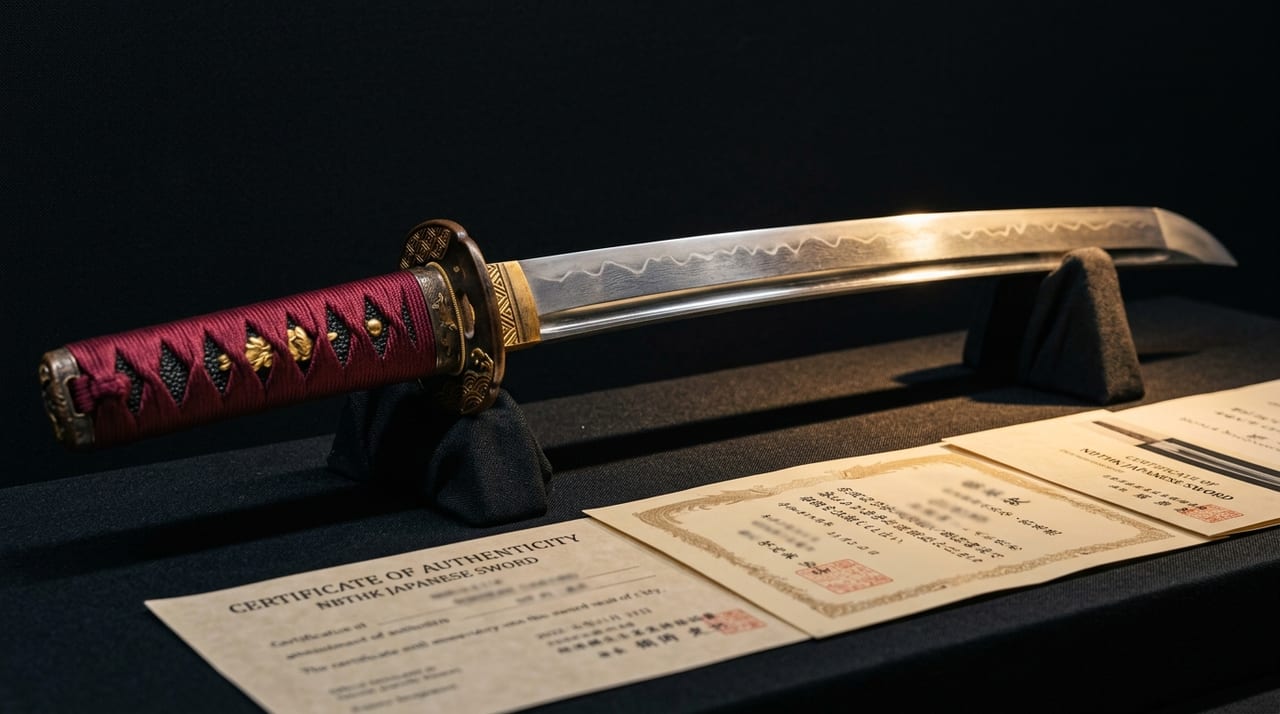 * Image is for illustrative purposes only.
Table of Contents
What Is a Tōken Registration Certificate — The Legal Basis Supporting Distribution
In Japan, under the "Act for Controlling the Possession of Firearms or Swords and Other Such Weapons (Jūtōhō)," possession of tōken (swords with a nagasa of 15 cm or more) requires a Firearms and Swords Registration Certificate (hereafter "registration certificate") issued by the prefectural Board of Education (Articles 2, 3, and 14; Act for Controlling the Possession of Firearms or Swords and Other Such Weapons (e-Gov Law Search)). The registration certificate is an official document proving the legality of a tōken, and this certificate must accompany all sales, transfers, and exhibitions of tōken.
The registration certificate records the registration number, type, nagasa, sori, number of mekugi holes, mei text, issuing prefecture, and date of registration. Tōken that have not been registered may not in principle be possessed (Article 3, Paragraph 1), and violations are subject to criminal penalties (Article 31-16).
The issuance of registration certificates is conducted through a "registration review board" organized by the prefectural Board of Education. When a tōken is newly discovered, the basic procedure is first to report it to the police, after which the review board determines whether it qualifies for registration as a tōken. When ownership changes through inheritance or sale, a change-of-owner notification must be submitted to the Board of Education that issued the certificate; if a registration certificate is lost, reissuance procedures can be handled through the same office. Since the specific requirements and forms for notifications and reissuance differ by prefecture, it is advisable to confirm the details directly with the issuing Board of Education.
The Reality of the Forgery Problem — Why Forgeries Are Made
Forgery of registration certificates is a serious problem the tōken industry has long faced. Several factors lie behind it.
Profit motive from high-value tōken: Tōken registered as the work of a noted tōkō and bearing an important kanteisho can be worth several million to tens of millions of yen. Forgeries are committed by swapping the registration certificate of a mumei or low-graded tōken onto a different sword, or by altering the recorded details to make it appear to be a high-value tōken.
Legalizing unregistered tōken: In some cases, counterfeit registration certificates bearing non-existent registration numbers are created in order to distribute legally unregistered tōken (swords buried during the postwar period of confusion, smuggled imports, etc.) through legitimate channels.
Vulnerability of paper documents: Registration certificates are paper official documents. Because formats differ by prefecture and are not standardized nationwide, appraisers and dealers face the weakness of being unable to keep track of all prefectural formats.
Limitations of the inquiry system: The basic method for verifying the authenticity of a registration certificate is to contact the issuing Board of Education, but in some regions the process centers on in-person inquiries or postal correspondence, and no nationally unified online database open to the public for instant verification exists. This inconvenience in inquiry creates room for forged documents to slip into the market.
Methods of Forgery and How to Detect Them
Substitution (swapping): A method in which a genuine registration certificate issued for one tōken is attached to a different sword, and details such as the nagasa and mei text are altered. By inquiring with the issuing prefecture based on the registration number, it may be possible to confirm the details of the tōken that was originally registered under that number.
Complete forgery: Forged documents bearing non-existent registration numbers and fictitious issuing information, including forgery of official seals (the official seal of the Board of Education). They are difficult to detect unless one is a specialist well versed in authentic formats.
Copy/scan forgery: Reproductions made with high-resolution scanners and printers. The print resolution, paper quality, and ink sheen differ from genuine certificates.
Points Anyone Can Check Before Purchasing
Even a non-specialist can use the following as an initial check before purchasing.
- Compare the nagasa, sori, and number of mekugi holes recorded on the registration certificate with the actual tōken.
- Confirm that the registration number and issuing prefecture match the recorded details.
- Visually check that the outlines of the seal and any blurring or bleeding of the characters are not unnatural.
- Check whether the paper quality and print color feel off, comparing with multiple registration certificates if possible.
- If there are any doubts, contact the issuing Board of Education or a trusted tōken dealer before purchasing.
Measures by the Industry and Appraisal Bodies
The role of NBTHK: The NBTHK (Society for the Preservation of Japanese Art Swords), a public interest incorporated foundation, is an authoritative appraisal body that examines the quality and authenticity of tōken. The Association's kanteisho (Hozon Tōken, Tokubetsu Hozon, Jūyō Tōken, Tokubetsu Jūyō Tōken) are value certifications independent of the registration certificate, and it has become industry practice in high-value transactions to confirm both.
Industry association self-regulation: Industry bodies such as the Zen Nihon Tōken Shōgyō Kyōdō Kumiai (Zentōshō) have established self-regulatory rules for member dealers covering the obligation to verify registration certificates and the procedures for inquiring about suspicious documents.
Cooperation with law enforcement: Forgery of registration certificates is a serious crime subject to charges of forgery of official documents (Penal Code Article 155) and use of forged official documents (Penal Code Article 158). The police and Public Safety Commission conduct periodic on-site inspections of tōken dealers to check for improper documents.
Maintaining transaction records: Many reputable tōken dealers maintain the voluntary practice of preserving copies of registration certificates and transaction records for each transaction. The fact that the history of a sale is kept as a record assists in any tracing investigation should forgery or misconduct be suspected.
The Front Lines of Authenticity Appraisal — Fusion of Technology and Traditional Knowledge
Authenticity appraisal of the tōken itself: High-value tōken bearing the mei of a master craftsman face the problem of false mei. In assessments by the Preservation Association, a comprehensive judgment is made based on observation of the jigane (the jihada, color, and utsuri specific to the tōkō and school), the characteristics of the hamon (pattern and working), and the condition of the mei text, yasurime, and patina on the nakago. A "nochi-mei" (a signature added later) differs in texture from a genuine mei.
Use of scientific appraisal: In recent years, research has advanced on using non-destructive X-ray fluorescence analysis to measure the metallic composition of tōken and apply this to estimating the period and place of origin. While this does not yet yield a definitive authenticity determination, it is effective as supplementary evidence.
Development of appraisal personnel: The appraiser's eye for evaluating jigane and hamon is cultivated through years of experience and transmission between master and apprentice. While scientific analysis is spreading as a supplementary method, the cultivation of personnel who can carry on such traditional appraisal techniques is considered an ongoing challenge for the industry.
The Difference Between a Registration Certificate and a Kanteisho — Two Documents Often Confused
The registration certificate and the Preservation Association's kanteisho are often confused, but their roles differ.
| Item | Registration Certificate | Preservation Association Kanteisho |
|---|---|---|
| Issuing body | Prefectural Board of Education | NBTHK (public interest incorporated foundation) |
| Nature | An official document showing that the tōken has been registered | An appraisal document examining the quality and authenticity of the tōken |
| Recorded content | Registration number, type, nagasa, sori, mei text, etc. | Appraisal grade (Hozon Tōken, Tokubetsu Hozon, Jūyō Tōken, Tokubetsu Jūyō Tōken, etc.) and appraisal rationale |
| If absent | A tōken that has not been registered may not in principle be possessed (Article 3, Paragraph 1). If only the certificate was lost, reissuance is available (Article 15, Paragraph 2) | Possession itself is not illegal without a kanteisho |
The registration certificate is the legal proof of "whether you are permitted to possess the tōken," while the kanteisho is an evaluation of "what level of value and quality the tōken possesses." Confirming both in high-value transactions is a basic industry practice.
The Impact of Counterfeit Distribution on the Industry
The circulation of forged registration certificates and tōken with false mei undermines the credibility of the tōken market as a whole. When a sword bearing a false mei circulates as the work of a master craftsman, it becomes difficult to assess the market value of genuine works, and in overseas markets the reputation of nihontō culture as a whole is damaged. Troubles in which novice collectors without specialist knowledge pay high prices for counterfeits show no sign of abating.
When purchasing or owning tōken, the three basic measures of self-protection are: verifying the registration certificate (whether inquiry to the prefecture is possible), confirming the presence of a Preservation Association kanteisho, and conducting transactions through a trusted tōken dealer. If there is any doubt, taking the time to stop before signing a contract and confirming with the issuing Board of Education or the Preservation Association is the most reliable way to avoid future problems. For the healthy transmission of nihontō culture, continued improvement of industry-wide compliance and the cultivation of successors in appraisal techniques remain important ongoing challenges.