Until the Blade Shines——The Process and Science of Japanese Sword Polishing
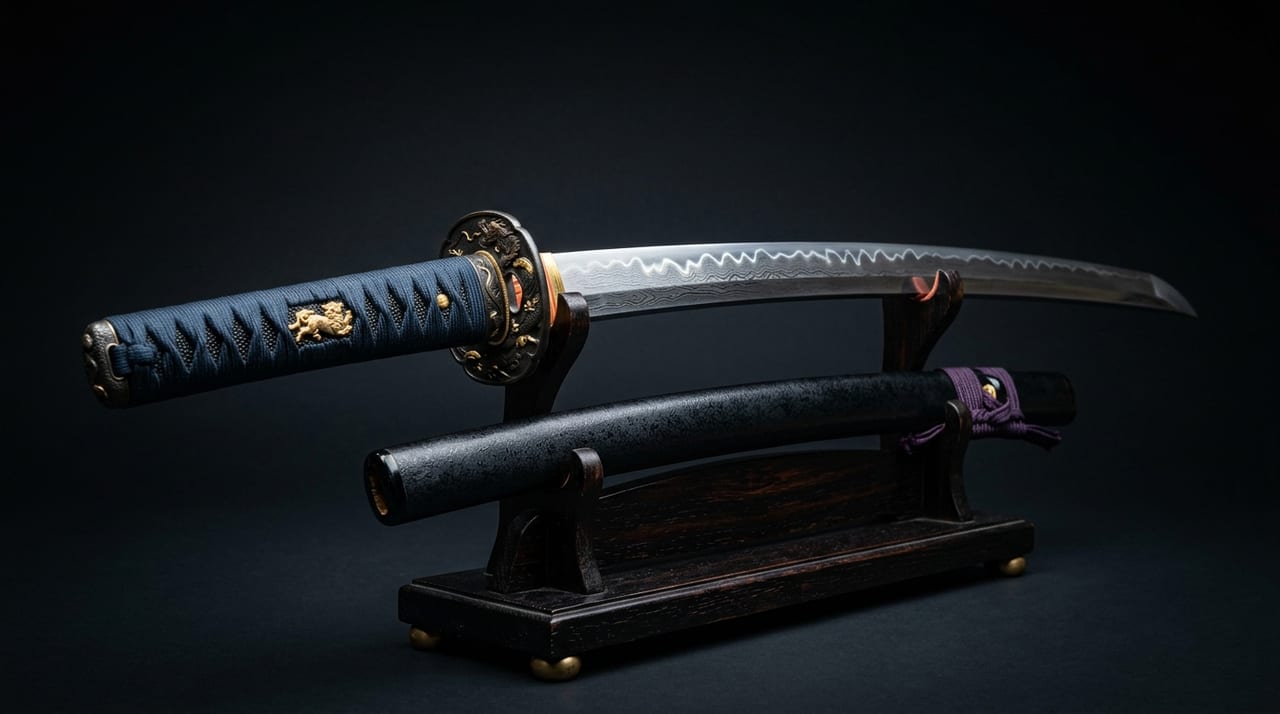 * Image is for illustrative purposes only.
Table of Contents
Polishing: "Completing" the Sword
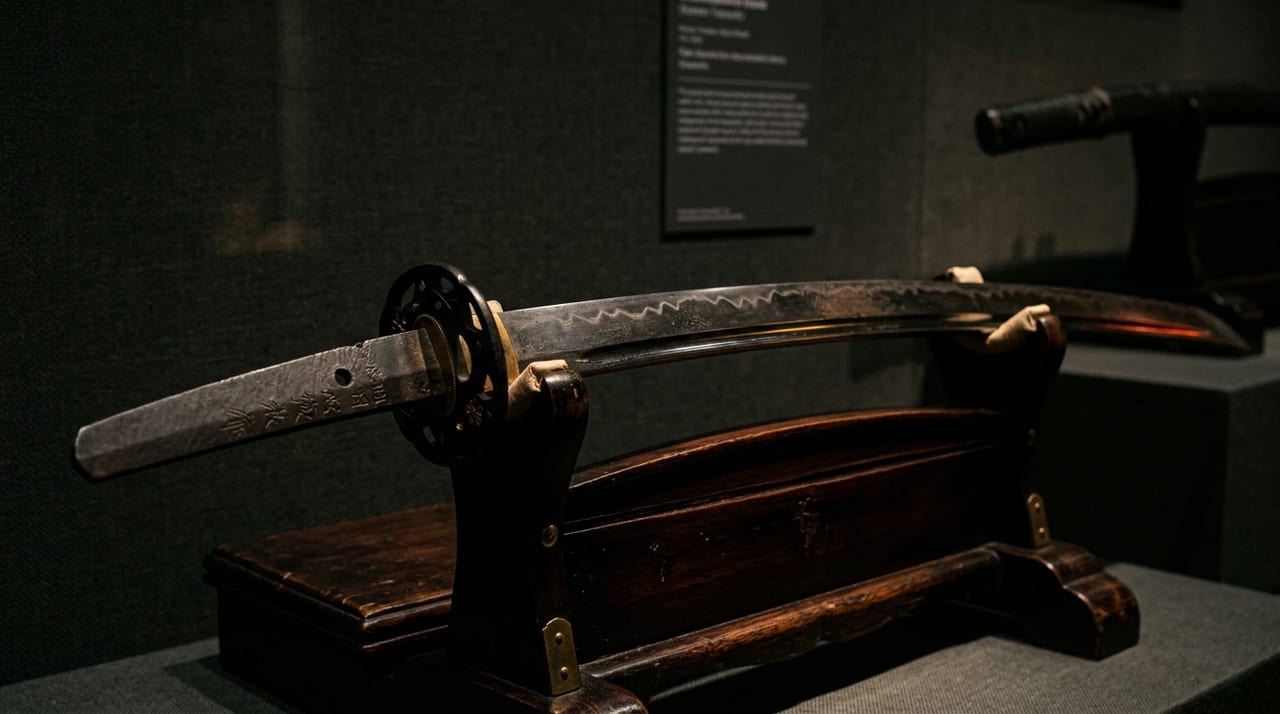
Japanese swords are given form by swordsmiths, but it is the work of the togishi (polisher) to draw out their latent beauty. Polishing is not merely a "polishing" operation, but a sophisticated technical system that scientifically and artistically reveals the jigata (surface texture), hamon (blade pattern), and kitaehada (forging texture) of the sword. Even experienced polishers require weeks to months to polish a single blade, and the cost often matches the sword's value.
The purpose of polishing has two aspects. One is functional—ensuring cutting ability and protecting the blade edge. The other is aesthetic—maximizing the sword's value for appreciation. To achieve both simultaneously, the polisher follows a staged and precise process.
Shitaji-togi: Revealing the Sword's True Face
The first stage of polishing, called shitaji-togi (foundational polishing), involves transitioning from coarse to fine whetstones in stages, straightening the blade's shape, and removing surface scratches and oxidation layers.
In shitaji-togi, the polisher uses multiple whetstones in stages as follows:
| Whetstone | Role |
|---|---|
| Aratsutsu or kaisei-to | Establishes the basic shape of the blade |
| Binsuito | Refines the blade's contour and hiraniku (the thickness of the blade's cross-section) |
| Nagura-to series (chuunagura, hosonagura, etc.) | Removes scratches from the previous step while finishing the surface evenly |
The technical points at this stage include maintaining the sword's sori (curve), balance of the blade width from hilt to tip, and clarity of the yokote (crossguard line) while polishing. Even slight polishing irregularities damage the sword's beautiful silhouette, so the polisher repeatedly checks with fingertip sensation and visual confirmation.
Whetstones and Science: The Role of Natural and Synthetic Stones
Whetstones used in polishing are divided into "natural whetstones" and "synthetic whetstones."
Natural whetstones are sandstones and mudstones quarried throughout Japan, with grain size and hardness varying significantly by region. The most important is the uchigumori-to (cloud stone). Currently, those quarried from specific locations in Kyoto Prefecture are considered highest quality and impart a distinctive semi-gloss finish called kasumi (haze) to the polished surface. This kasumi effect makes the surface texture and blade pattern visually stand out.
No two natural whetstones have identical properties; the polisher must discern each stone's individual character. High-quality uchigumori-to has become increasingly difficult to obtain in recent years, and among active polishers, the consensus is to "treat each stone as treasure."
Synthetic whetstones offer uniform grain size and stable polishing, but cannot fully replicate the random polishing effects created by the complex mineral composition of natural stone. Many modern polishers employ a division of labor: using synthetic whetstones for coarse foundational steps and natural whetstones for finishing.
Finish Polishing and Revealing the Blade Pattern
The true art of polishing lies in "finish polishing" (shiagetogi), also called "cosmetic polishing" (keshogi). At this stage, hadsuya (blade luster) and jidsuya (ground luster) are achieved using delicate techniques with thumbnail-sized fragments of whetstone affixed to the fingers.
In finish polishing, two techniques are employed:
- Blade Luster (hadsuya): Polishing only the cutting edge with fragments of uchigumori-to. This reveals the martensitic structure (hardened layer created by quenching), bringing out the white-gleaming hamon. The hamon forms along the boundary of the differential hardening clay applied before quenching and appears as characteristic patterns—suguha (straight), notare (undulating), gunome (interlocking crescents), choji (clove-shaped)—that reveal the swordsmith's individual character.
- Ground Luster (jidsuya): Polishing the "ground" (ji)—the main body of the blade apart from the edge—to reveal the forging texture patterns (itame, masame, mokume, etc.). Fine differences in whetstone angle, pressure, and movement direction directly affect the finish, and the "landscape" revealed by the polisher varies even with the same stone.
From a metallurgical perspective, hamon polishing exploits the difference in polishing rates between the martensitic structure (hardness HRC 60+) and the pearlite/ferrite-based ground iron structure. Structures with different hardness and Young's modulus reflect light differently even under identical polishing conditions, and this difference is visualized as the hamon.
Challenges Facing Contemporary Polishers
From the perspective of traditional craftsmanship, the number of polishers is not large. The Japan Art Sword Preservation Society (NBTHK) certifies several hundred polishers nationwide, but those with the highest-level techniques are even fewer.
The most significant structural challenge is the exhaustion of natural whetstones. Uchigumori-to quarrying sites are experiencing declining production, and obtaining high-quality stone becomes more difficult each year. Polishers devise methods to use every last fragment of a single whetstone, and many continue using stones passed down from their masters over decades.
Historic masterpieces also face a constraint: "polishing must not thin the blade edge." Because culturally valuable ancient swords gradually become slightly thinner with each polishing, contemporary polishers must possess the skill to achieve "maximum effect with minimum polishing." In authentication, original blade thickness is an evaluation criterion, so excessive polishing may be considered cultural property damage.
In recent years, research into using non-destructive inspection such as CT and 3D scanning for pre-polishing assessment is advancing. Approaches that assess internal flaws and rust conditions before designing the process are being tested.
Innovation and Tradition United: The Future of Polishing Technique
Contemporary polishers are beginning to employ digital technology as supplementary tools. Microscopic structure observation and surface roughness measurement using numerical evaluation are attracting attention as means to articulate and visualize the transmission of technique from master to apprentice. By complementing the tacit knowledge once learned purely through "feeling" with objective data, increased efficiency in developing the next generation is anticipated.
Research and development of ceramic-based synthetic whetstones and nanoparticle polishing materials is also advancing. However, many polishers note that "the random polishing effects created by the complex mineral composition of natural stone cannot be fully replicated by uniform synthetic stone."
Japanese sword polishing is a composite technology where metallurgical engineering, materials science, and traditional aesthetics intersect. Under the philosophy of "revealing the beauty the sword inherently possesses," polishers continue to face each blade by integrating scientific knowledge with practiced sensibility. This work continues to bridge the technology and spirit that swordsmiths embedded in iron centuries ago to the present day.