Reading the Sugata: A Guide to Japanese Sword Geometry Types and Their Historical Evolution
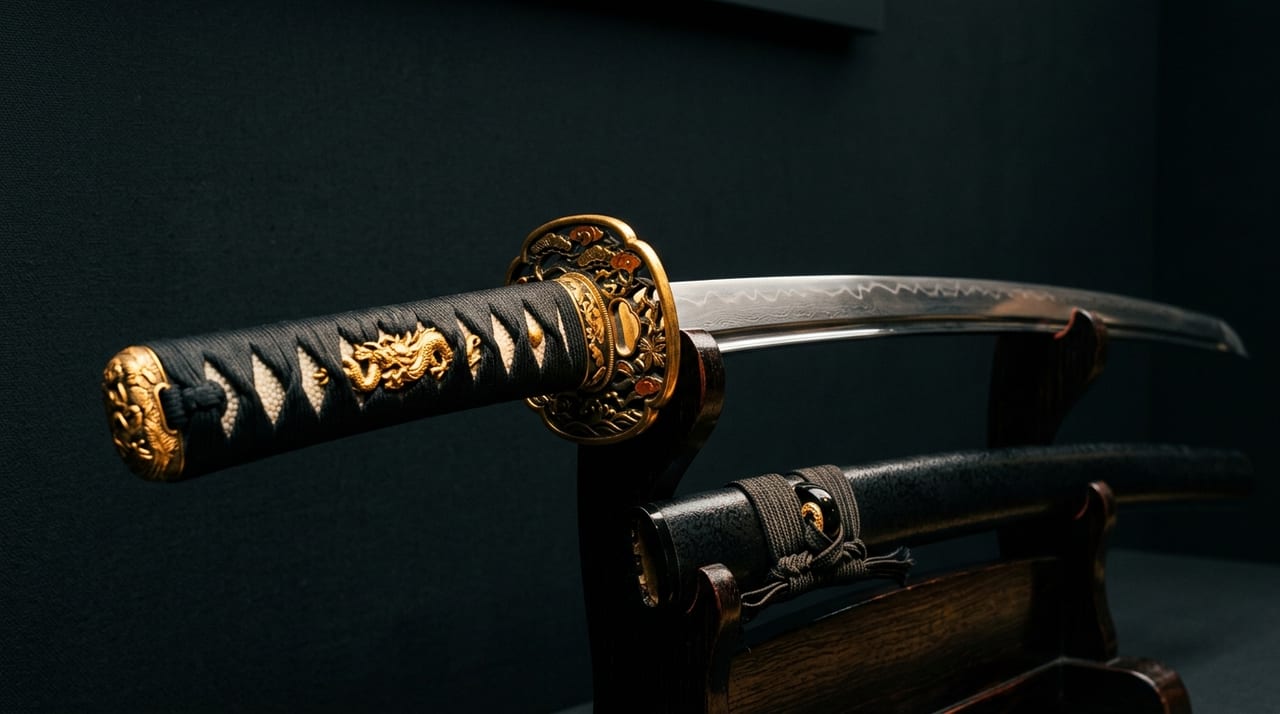 * Image is for illustrative purposes only.
Table of Contents
What is "Sugata"? — The First Step in Japanese Sword Appraisal
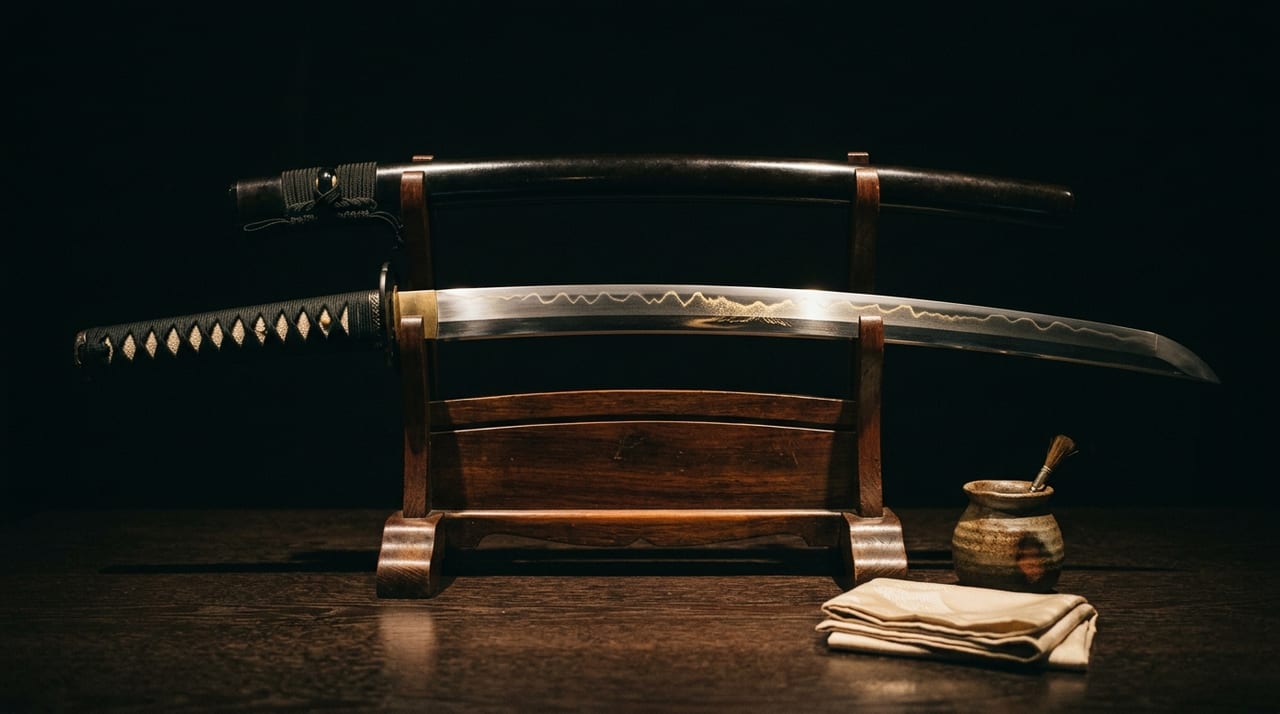
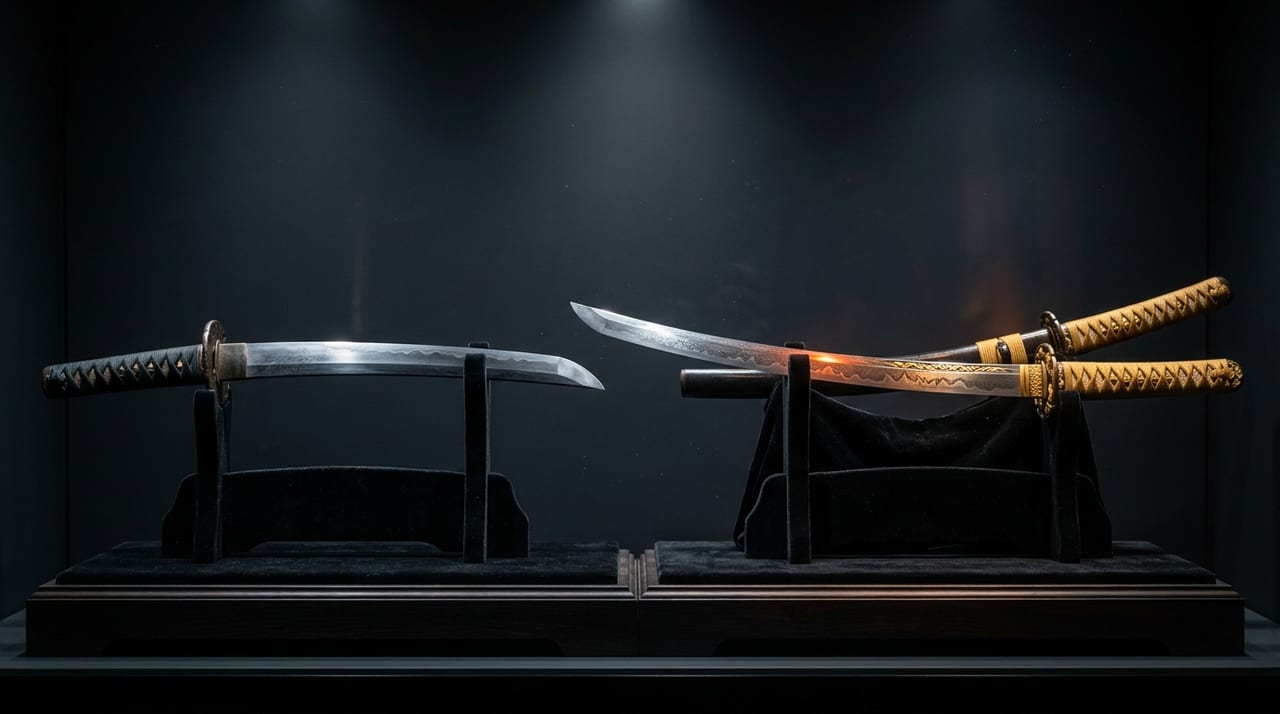
When appraising a Japanese sword, the first thing to focus on is "sugata" (form). Sugata refers to the overall "body" of the sword—a comprehensive view of the sword's entire exterior, including the depth and shape of the curve (sori), the ratio of blade length to thickness, the shape of the kissaki (point), and "tsukurikomi" (construction), which refers to the cross-sectional shape of the blade.
By observing sugata, an experienced appraiser can estimate the sword's "era," "region (place of origin)," and "purpose" to some degree. This is because the "ideal sword form of an era" changes across different time periods and regions, and this is inscribed in the sugata. The form sought by cavalry warriors of the Heian period and the form sought by infantry of the Sengoku period are fundamentally different. This difference is precisely the "testimony of the era" inscribed in sugata.
Types of Major Construction (Tsukurikomi)
Tsukurikomi (construction) refers to the cross-sectional shape of the blade. The shape of the cross-section creates a ridge line called "shinogi," which greatly influences the sword's strength, sharpness, and weight balance.
Shinogi-zukuri (Ridge Construction)
The most widely used construction, and when "Japanese sword" is mentioned today, this form is typically what is referred to. A ridge line called "shinogi-suji" runs along the blade slightly toward the spine, creating a cross-section where the edge side is thin and sharp, while the spine side is thick and strong. With excellent balance of sharpness, strength, and weight, it was widely adopted for both tachi and uchigatana. From the late Heian period to the present, it has been passed down as the standard construction of Japanese swords.
Hira-zukuri (Flat Construction)
This construction has no shinogi-suji, with a flat surface continuing from spine to edge in its cross-section. It is especially common on tanto and wakizashi. Because it can be made thinner and lighter than shinogi-zukuri, it is well-suited for thrusting. The hira-zukuri tanto crafted by the renowned Kamakura period masters Awataguchi Yoshimitsu and Rai Kunitsugu are still highly valued today as "Awataguchi tanto."
Ko-kirikiba-zukuri, Shobu-zukuri, and Kirikiba-zukuri
Ko-kirikiba-zukuri is an asymmetrical construction where one side is hira-zukuri (or shinogi-zukuri) and the other side is kirikiba-zukuri, commonly found on tanto and kaiken. Shobu-zukuri is a construction with no yokote-suji (cross-line), with the shinogi-suji running from the habaki to the kissaki. Its name derives from the fact that the blade's form resembles the leaf of a water iris (shobu), and it imparts a unique elegance to long wakizashi. Kirikiba-zukuri is a construction with a steep angle between the edge-side shinogi and the spine, found on waist swords from the Kamakura to Muromachi periods.
Blade Curve (Sori) Forms and Era Classification
Sori (blade curve) is one of the most distinctive elements of Japanese swords, and its shape and depth are the most important clues for dating.
- Koshi-zori (waist curve): The apex of the curve is located near the waist (base) of the blade. This is typical of tachi from the late Heian to Kamakura periods, designed for wielding from horseback with a downward swing. It often appears alongside a body configuration of "hosomi-chosun" (narrow, long-bladed form) with thin blade width and shallow thickness.
- Naka-zori (mid curve): The apex of the curve is near the center of the blade. Common on uchigatana from the Muromachi to Sengoku periods, it is a practical form suited for use on foot. Most uchigatana that have survived to the present day have this form.
- Saki-zori (point curve): The apex of the curve is near the kissaki. A bold curve seen on odachi (large tachi) of the Nanboku-Cho period, it embodies the turbulent spirit of the age when combined with long length and large kissaki.
- Uchi-zori (inward curve): A special form where the curve reverses direction. Found on tanto and kaiken from the ko-to (old sword) period, it is also a characteristic of "Kikuchi-yari"-type tanto. It is constructed with emphasis on portability and self-defense purposes.
Kissaki (Blade Tip) Forms and Historical Context
The shape of the kissaki is also an important element in period determination.
Ko-kissaki (small point) is a form where the kissaki is small and rounded, typical of slender tachi from the early to mid-Kamakura period. It possesses an elegant curved beauty and was treasured among nobility and upper-class samurai as an "elegant sword." It is frequently seen in masterworks of the Yamashiro and Yamato schools.
Oo-kissaki (large point) is a form where the kissaki is large and pointed, typical of odachi and nodachi (large swords) from the Nanboku-Cho period. Following the Genko Incident, during an era of prolonged large-scale warfare, it came into being as a result of demand for a more aggressive and robust form.
Inokubi-kissaki (boar's neck point) is a special form with a short, thick kissaki, seen from the Nanboku-Cho to Muromachi periods. It is considered a technique to increase the strength of the blade's edge to deliver effective blows against heavy armor.
Variations in Sugata by Regional School (Den)
To properly read sugata, understanding differences due to "regional schools (den)" is essential, not just era.
Yamashiro school is centered on workshops in Kyoto, with Awataguchi and Rai schools as representative. It is characterized by elegant sugata with slender form, small kissaki, and koshi-zori, strongly influenced by courtier culture.
Bizen school is a group of sword makers rooted in the Osafune area of present-day Okayama Prefecture. Schools such as Fukuoka Ichimonji and Osafune produced high-quality works in large quantities. Many swords have a robust sugata with wide blade width and thick profile.
Soshu school is a group of workshops centered in Kamakura, with Masamune and Sadamune as representatives. It is characterized by a bold sugata with shallow sori, moderately wide blade width, and thick profile. The works of Masamune had great influence on later generations as the "perfected form of the Soshu school."
These regional schools influenced each other, and from the late Muromachi through the early Edo period, many swords with eclectic sugata appeared.
Reading Sugata in Appraisal and Making Comprehensive Judgments
In sword appraisal, the basic principle is to view three elements—sugata, jigane (grain), and hamon (blade pattern)—comprehensively. A sword that is "deep koshi-zori with small ko-kissaki and slender long form" evokes the Yamashiro school of the late Heian to early Kamakura periods. One that is "naka-zori with large oo-kissaki" evokes Bizen or Yamato schools of the Nanboku-Cho period, while one that is "shallow sori with moderately wide blade width and thick profile" evokes the Soshu school.
However, many swords have had their sugata altered by later modifications (polishing down or cutting), so making definitive judgments based on sugata alone is risky. The practice of reshaping tachi into uchigatana configuration was common, and cases where the original sugata has been lost are not rare. A comprehensive judgment that also considers jigane, hamon, signatures on the nakago (tang), and the number of mekugi holes is essential.
Conclusion—Sugata is a Sword's "Resume"
The ability to read a sword's sugata is the foundation of Japanese sword appraisal. Understanding the story of era and region told by sori, tsukurikomi, and kissaki shape—cultivating the eye to decipher this narrative—is one of the true pleasures of sword appreciation.
Sugata is not merely appearance. It is a "resume" in which the martial philosophy, battle methods, and aesthetic sensibility of the sword maker from the era in which the sword lived are condensed. When appreciating the sword, I encourage you to observe its sugata while reflecting on the era in which it was made. The testimony of different eras in each sword will surely speak to you of new attractions of the blade.