The Succession Problem for Japanese Sword Dealers — The Existential Crisis Facing Long-Established Specialty Shops and a Path Forward
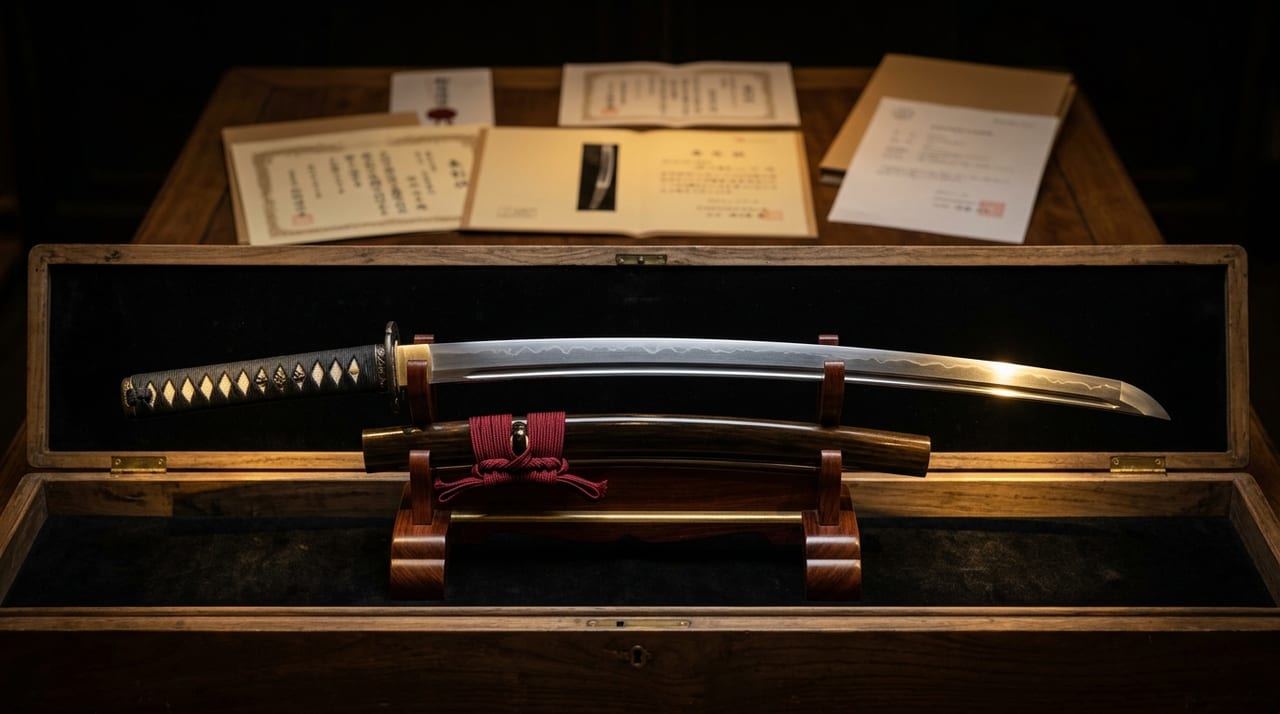 * Image is for illustrative purposes only.
Table of Contents
Long-Established Sword Dealers Are Disappearing — The State of the Industry
According to Agency for Cultural Affairs data on registered dealer numbers, the number of Japanese sword dealers (firearms and sword dealers) across the country has declined sharply compared to the early 2000s. Even in major cities such as Tokyo, Osaka, and Kyoto, only a handful of specialist sword dealers remain, and in regional cities the situation has already reached the point of near "endangered species" status. Most active proprietors are in their late 60s to 70s, and it is widely held that the majority are likely to close their businesses within ten years.
The problem is not simply a matter of "shops closing." The specialist knowledge held by sword dealers — the discerning eye for appraising blades from each period and each school, the experience to distinguish authentic pieces from forgeries, the long-cultivated trust relationships with customers, and the networks with associated craftspeople such as togishi, saya craftsmen, and metalworkers — is tacit knowledge built up through decades of practice. The loss of such knowledge and connections without successors means the collapse of the very ecosystem of Japanese sword culture. The appraiser's eye that can intuitively sense the differences among the Gokaden traditions — such as Bizen-den, Sōshū-den, and Yamato-den — is not something that can be acquired by reading books; it is cultivated only through the accumulated experience of handling thousands of blades.
The Structural Reasons Why Successors Are Not Emerging
Why are successors not being nurtured? The reasons are complex and deeply rooted.
- The high economic barriers to entry can be cited. To become a sword dealer, one must apply for a firearms and sword dealer license, and the initial costs of securing premises and investing in inventory are considerable. The nihontō that comprise inventory are expensive, ranging from several hundred thousand yen to several million yen or more per blade, and pieces designated as Jūyō Tōken or celebrated swords can reach tens of millions of yen, which is not uncommon. For the younger generation to establish a business on their own, substantial capital and determination are required.
- The long apprenticeship period and unstable income present further obstacles. Developing the discerning eye for authenticating swords is said to require at minimum over ten years of hands-on experience, and income during that period is not guaranteed. The apprenticeship-like structure of learning while working under a master remains firmly entrenched even today, and it can be said that it is only natural for the younger generation to choose other paths in search of stable careers.
- The shrinking market size and dramatic changes in the competitive environment are also at play. With the spread of the internet, auction and flea-market platforms such as Yahoo Auctions and Mercari have risen to prominence, and blades of uncertain authenticity have come to circulate at bargain prices. Brick-and-mortar shops caught in price competition struggle to attract customers, and profit margins continue to decline. In such an environment, the financial capacity to nurture the next generation is difficult to generate.
- Low social recognition cannot be overlooked either. While nihontō are recognized among young people in certain contexts such as Touken Ranbu, understanding of "sword dealing as a profession" remains low. At present, almost no young people consider the sword industry as a potential career path.
Cases of Successful Business Succession and New Market Entry
Even so, there are young business owners who are undoubtedly taking on the challenge of industry transformation.
Specialty shops taking an online-meets-physical hybrid strategy are actively communicating the appeal of nihontō through Instagram and YouTube. By showing the appraisal process on video and publishing macro photographs of the details of celebrated blades, they acquire fans from a wide range of demographics, creating a cycle in which some of them convert into actual customers.
The shift toward experience-based businesses centered on sword culture is also drawing attention. An increasing number of shops are building a "business model not dependent on sales alone" by combining sword appreciation events, sword-forging observation tours, iai experiences, and sword-polishing experiences. There are also cases achieving results by capturing inbound foreign visitor demand and developing overseas collectors through English and Chinese language support.
A new trend of entry from other industries is also emerging. Cases have been reported of individuals from IT companies and consulting backgrounds transitioning to become sword dealers, overhauling traditional management through digitalization of inventory management, construction of e-commerce sales systems, and analysis of customer data. By combining such cross-industry knowledge with traditional appraisal techniques, new business models are beginning to take shape.
Efforts by Industry Associations and Government
Industry associations including the National Japanese Sword Dealers Cooperative Association (Zentosho) have also begun seriously exploring responses to the succession problem. Work is advancing on initiatives such as the development of young talent training programs, the creation of qualification acquisition support systems, and business succession matching within the industry, and moves toward the standardization and documentation of appraisal techniques have also emerged.
The Agency for Cultural Affairs also has an interest in improving the distribution environment for nihontō from the perspective of "cultural property protection," and revisions to the registration system and expanded disclosure of distribution information are under consideration. The understanding that nihontō are both weapons and state-recognized works of art and craft, and that the survival of private dealers is indispensable to their preservation, is coming to be shared on the government side as well.
Knowledge Transmission and Business Model Transformation — Two Axes for the Future
Solving the succession problem for sword dealers requires two approaches to be pursued in parallel.
The first is the systematization and documentation of knowledge and techniques. There is an urgent need for efforts to digitize and document the appraisal know-how passed down through oral tradition and hand it on to future generations. In recent years, the development of support tools that combine AI image recognition with the expert appraiser's eye has begun, and work is advancing on accumulating appraisal elements such as hamon, jigane, and bōshi as data. This is expected not only to contribute to more efficient successor education but also to help curb the circulation of forgeries.
The second is diversification of the business model. By expanding a variety of value-added services that leverage the specialist knowledge of sword dealers — including kanteisho issuance, restoration coordination, insurance valuation, collection management support, and educational content production — rather than relying solely on sales revenue, a sustainable business foundation can be built. A shift in thinking toward monetizing specialist knowledge itself holds the key to the survival of the industry.
The survival of sword dealers is not merely a commercial problem. It is a matter of the ecosystem that supports the distribution, preservation, and dissemination of nihontō as cultural property, and is a challenge that the industry, government, and society must tackle together. Concrete action is needed now in order to reliably pass on to the next generation the craftsman's skill and the weight of history embodied in each blade. Precisely because the online distribution and dissemination of information is expanding today, the importance of an environment in which nihontō authenticated and traded appropriately can be found with confidence is only growing.