Detecting Fakes — An Introduction to Authenticating Nihontō
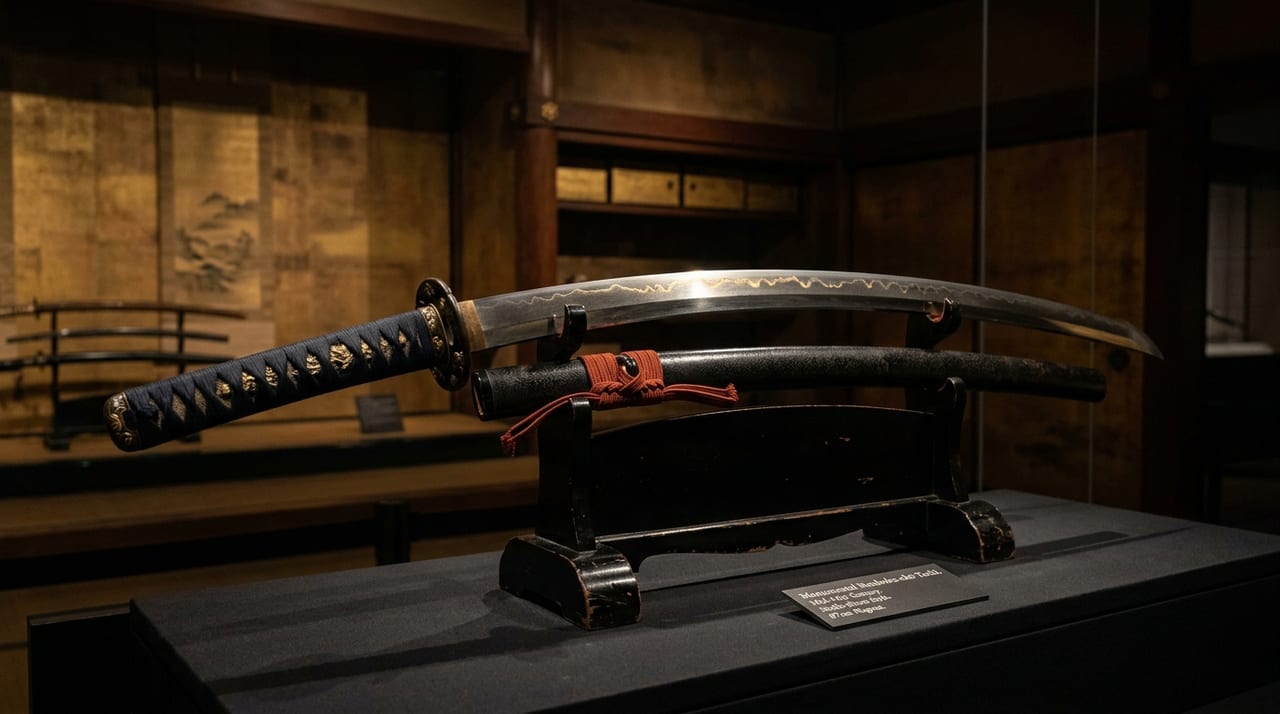 * Image is for illustrative purposes only.
Table of Contents
The Existence of Fakes — The Greatest Risk Collectors Face
Unfortunately, fakes do exist in the world of nihontō. The sword market has a history spanning more than a century, and running parallel to that history is an equally long history of forgeries. The methods of fakery are wide-ranging: gimei blades bearing forged signatures of master tōkō, atomei blades on which a signature has been added after the fact to an originally mumei sword, and awasemei blades in which a nakago from one period has been spliced onto a blade body from another.
The motivation to produce sophisticated fakes is particularly strong for works by celebrated tōkō and for pieces designated as Jūyō Tōken, precisely because such pieces command high prices. In a market where transactions of several million to tens of millions of yen are not uncommon, authentication is literally a matter that determines a collector's financial wellbeing. A foundational knowledge of authentication is an indispensable means of self-protection for the modern collector.
Gimei — The Most Widely Circulated Type of Forgery
Gimei refers to a famous tōkō's signature carved onto a blade after the fact. It is the most commonly encountered form of forgery in the sword market, a practice that has continued uninterrupted since the Edo period. Because a blade bearing the signature of a renowned tōkō commands a dramatically higher market value, the temptation to add a signature to raise a blade's worth — regardless of the blade's quality — has always been present.
Detecting a sophisticated gimei requires a composite examination not only of the calligraphic style and letterforms of the mei, but also of the type and fine expression of the yasurime on the nakago, along with the position, depth, and balance of the signature. It is also essential to verify whether the period of activity of the tōkō named in the mei is consistent with the technique and form of the blade itself. If the signature of a Kamakura-period tōkō appears on an Edo-period blade, the mismatch in technique and period emerges as a clear contradiction.
Atomei — Inserting a Signature onto a Mumei Sword
Atomei refers to a signature carved into a sword that was originally mumei, by someone in a later era. The fundamental motivation for this act of falsification is the simple reality that a signed blade commands a higher market value than a mumei one.
The most typical way to identify atomei is through unnaturalness in the color and condition of the nakago. Normally, a nakago forms a deep rust patina known as ko-sabi through centuries of exposure to air. Where atomei is present, the freshly carved area of the signature may show a coloration visibly different from the surrounding ko-sabi. However, sophisticated forgers conceal this inconsistency by artificially coloring the entire nakago or mimicking rust through acid treatment. Detecting such falsification requires observation under multi-directional lighting and a trained specialist's eye.
O-suriage Mumei and Awasemei
O-suriage mumei refers to a sword whose original mei has been lost as a result of the nakago being substantially shortened. This is not strictly a forgery, but the absence of a signature makes identifying the tōkō difficult. It is most commonly seen in cases where a tachi was shortened for use as an uchigatana.
Awasemei refers to a sword assembled from a blade body and a nakago that were not originally part of the same sword, presented as though they were. This is harder to detect than gimei, and requires a comprehensive assessment of whether multiple elements — the period character of the nakago and the blade, the nature of the steel, and the degree of wear — are mutually consistent.
A Practical Checklist to Review Before Purchase
Even when relying on a specialist for authentication, there are practical points a buyer should confirm at a minimum before purchasing. The following are checklist items useful in actual transaction settings.
- Verify the issuing body and date of issue of the kanteisho, and cross-check whether the recorded details (tōkō name, period, form) are consistent with the characteristics of the actual sword.
- Request photographs of the nakago taken from multiple angles and under multiple lighting conditions, and confirm that there are no unnatural discrepancies in the yasurime or rust coloration.
- If there are accompanying hakogaki, saya inscriptions, or documentation relating to provenance, verify the consistency of their contents.
- Ask the seller whether it is possible to handle and examine the actual sword in person before purchase, or whether a viewing by a trusted third party can be arranged.
- Confirm the seller's terms for returns and refunds in writing before the transaction.
Not neglecting these checks is the most practical way to avoid disputes over authenticity after the fact.
Quick-Reference Table: Types of Forgery and How to Identify Them
Organizing the types of forgery discussed above yields the following summary.
| Type | Characteristics | Primary Identification Method |
|---|---|---|
| Gimei | A famous tōkō's signature carved on after the fact | Verify consistency of the mei's calligraphic style, yasurime, period, and technique |
| Atomei | A signature added after the fact to a mumei sword | Check uniformity of the nakago's rust color and color differences around the signature area |
| Awasemei | A blade body combined with a non-original nakago | Assess consistency of the nakago and blade in period character, steel nature, and degree of wear |
| O-suriage mumei | A sword whose signature has been lost through shortening (not strictly a forgery) | Specialists estimate the period and school from the sugata, forging, and hamon |
This table is intended only as a guide for grasping the overall picture; a specialist's trained eye is indispensable for actual authentication.
Four Perspectives for Authenticating a Sword
The following four perspectives are cited as fundamental viewpoints for authentication. First, confirm whether the jigane and hamon are technically consistent with the period and school of the tōkō named in the mei. Second, verify that the rust color of the nakago exhibits the ko-sabi that reflects centuries of natural aging. Third, examine in detail whether the type and expression of the yasurime carved into the nakago conform to that tōkō's characteristic style. Fourth, confirm whether the sword's overall sugata, kasane, sori, and mihaba possess a natural beauty appropriate to its period. Only by examining these four perspectives in combination does one begin to approach a judgment of authenticity.
The Reliable Assurance Provided by an NBTHK Kanteisho
Self-assessed authentication is extremely dangerous, even for experienced collectors. Even professional appraisers well versed in nihontō may find it impossible to fully detect a sophisticated forgery. For this reason, purchasing only swords that come with a kanteisho from the NBTHK (Society for the Preservation of Japanese Art Swords) is the most reliable means of self-protection available to a collector. NBTHK appraisal is issued through a deliberative review by multiple specialists and is recognized worldwide as the highest authority in nihontō appraisal today.
NBTHK kanteisho exist in four tiers — Hozon Tōken, Tokubetsu Hozon Tōken, Jūyō Tōken, and Tokubetsu Jūyō Tōken — with higher-tier designations requiring more rigorous examination and commanding higher market value. It is also important to cross-check the contents of the kanteisho (the recorded tōkō name, period, form, and other details) against the actual sword before purchase to confirm that they are consistent. Purchasing from a trustworthy specialist sword dealer is ultimately the greatest defense.
Choosing a Reliable Place to Purchase
It is no exaggeration to say that detecting fakes ultimately comes down to choosing the right seller. Shops with a long track record of dealing exclusively in swords, or specialist dealers whose inventory centers on swords accompanied by NBTHK kanteisho, substantially reduce the very risk of encountering a forgery. When considering a purchase, a dealer's track record, the care with which they provide explanations, and their attitude in responding to questions are also important criteria.
It is also important to ask the seller any questions you have before purchasing without hesitation, and to press for explanation until you are fully satisfied. Building a relationship with a trustworthy dealer while equipping yourself with knowledge of authentication is the most reliable way to enjoy collecting nihontō safely for the long term.