Physics of Sword Draw: Return and Catch Mechanics - Blade Design for Explosive Fast Draws
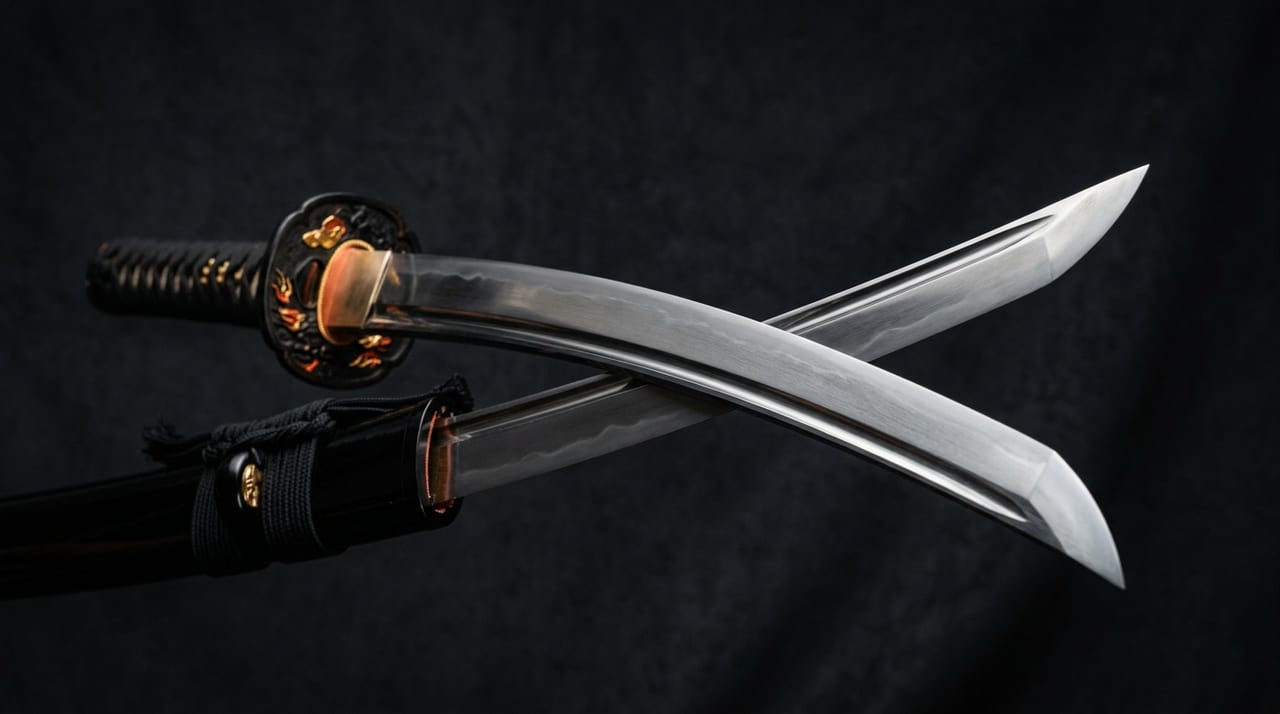 * Image is for illustrative purposes only.
Table of Contents
The Physics of Sword Drawing: The Mechanics Governing Scabbard Separation
The "speed" of drawing a Japanese sword is not merely a matter of arm strength or reflexes. When the blade separates from the scabbard, multiple physical forces act simultaneously, and controlling these through blade design is the foundation of fast sword drawing. In the world of iaido and sword-drawing techniques, a phenomenon called "kaeshi" refers to the acceleration effect created by the blade's curve and inertia at the moment of scabbard separation, while the opposite resistance phenomenon that hinders sword drawing is called "hikkari" (catch or sticking).
These two phenomena are inextricably linked—two sides of the same coin. Even minute differences in blade design determine which phenomenon dominates. Through years of experience and trial and error, sword makers have refined as a systematic technique the art of adjusting this delicate balance.
The True Nature of Kaeshi: The Acceleration Effect Generated by Curvature and Inertia
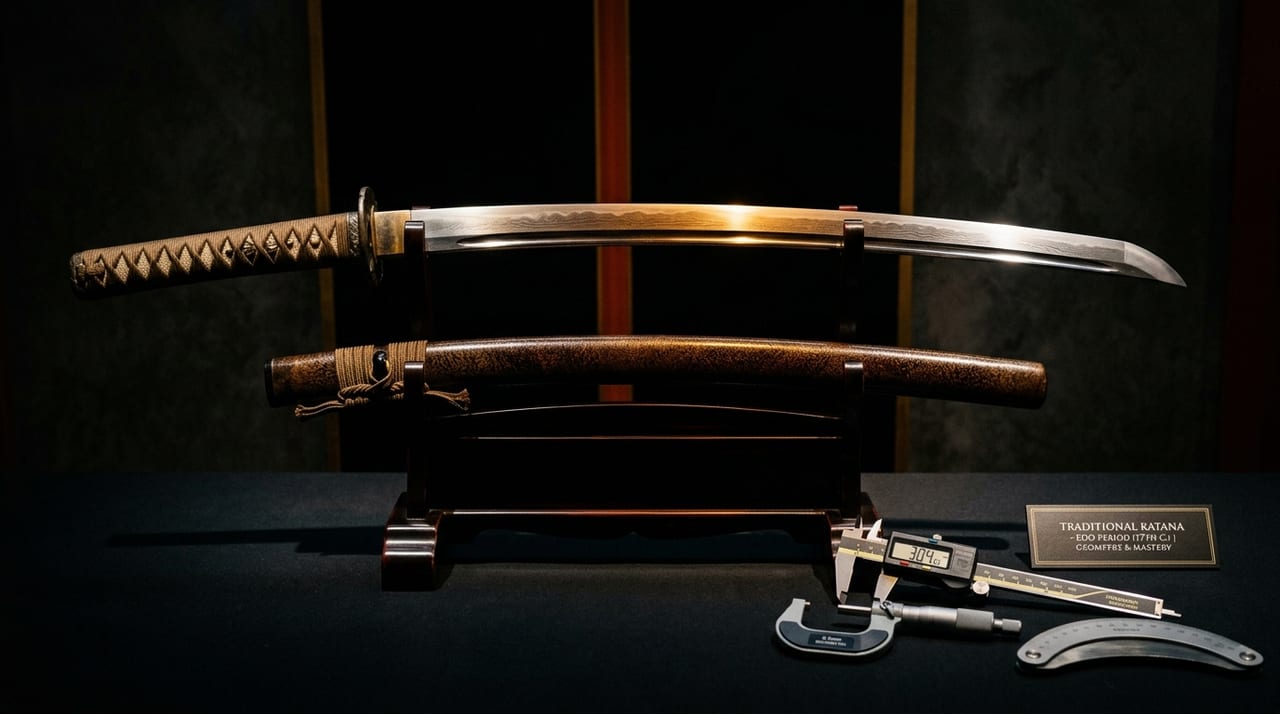
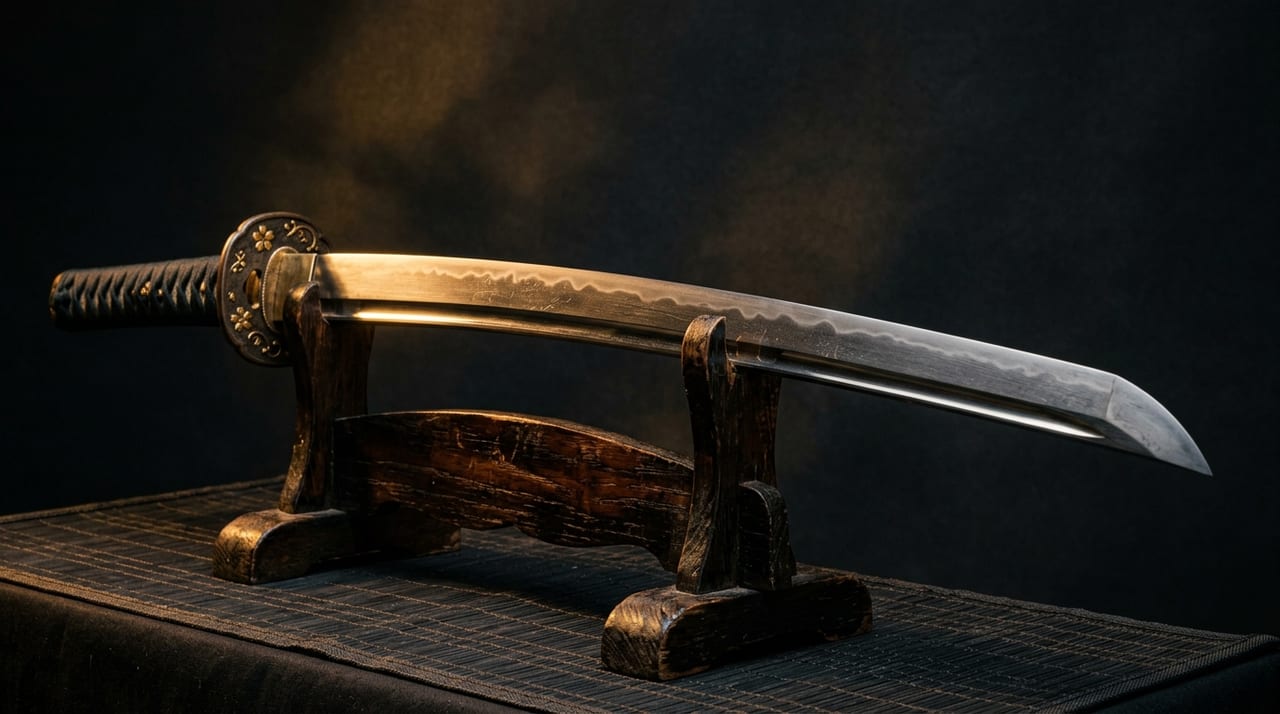
The "curvature" of the blade does not exist solely for aesthetic design or cutting performance. When functioning as an iaido sword, the curvature determines the physical angle of contact between the scabbard opening and the blade during separation, and this contact angle greatly influences the acceleration of the draw.
In kosozori—a form where the highest point of curvature is positioned near the tsuba—as the blade emerges from the scabbard opening, the blade's curvature rapidly reduces the contact surface area. This creates a moment when friction suddenly vanishes, causing the blade to accelerate as if "released" for an instant. This is the essence of kaeshi, and from this arises the sensation of acceleration that cannot be produced by arm strength alone.
To maximize this acceleration effect, the following conditions must align in combination:
- The highest point of curvature must fall within approximately 30 to 40 percent of the blade's total length from the tsuba
- The blade's center of gravity must be balanced, neither too far forward nor too far back
- The inner diameter of the scabbard opening must be properly designed relative to the blade's width, with neither excessive gaps nor excessive tightness
- Contact pressure with the scabbard must be evenly distributed on both the spine (mine) and cutting edge sides of the blade
When these conditions converge, the force required in the early stages of the draw rapidly diminishes near the scabbard opening, and acceleration close to "self-propulsion"—dominated by the blade's inertia and curvature rather than arm motion—occurs. The sensation experienced practitioners describe as "the sword runs by itself" is a felt expression of this physical phenomenon.
The Physical Mechanism of Hikkari
Hikkari is a phenomenon in which the blade encounters momentary resistance within the scabbard during drawing, and its cause involves multiple interacting physical factors, not merely simple surface friction.
First, there is the matter of air compression. When the blade moves at high speed, the air inside the scabbard is rapidly compressed, and this pressure creates resistance opposing the blade's direction of motion. When air trapped near the scabbard's base has no escape route, this air resistance reaches a non-negligible level. One reason scabbard makers (sayashi) take meticulous care in finishing the scabbard's interior is to control this air flow.
Next is the matter of the blade's cross-sectional shape and the contact distribution on the scabbard's inner wall. The prominent part of the shinogi (blade ridge) becomes a pressure concentration point within the scabbard. If this pressure concentration area makes non-uniform contact with the scabbard's inner wall during high-speed movement, fine vibrations and resistance develop, perceived as hikkari by the person drawing. Furthermore, if the contact pressure distribution along the blade's curvature becomes locally disrupted, high friction momentarily arises at specific points, manifesting as a "catching" sensation.
Principles of Blade Design for Achieving Maximum-Speed Drawing
Design elements for achieving maximum-speed drawing as an iaido sword can be organized as the optimization of multiple physical conditions. Since these conditions have trade-off relationships with one another, pursuing one often sacrifices another.
Center of Gravity Position and Moment of Inertia
A blade with its center of gravity closer to the tsuba requires less initial force for the draw. Conversely, when the center of gravity leans toward the kissaki (point), the initial force increases, but the cutting stroke benefits from centrifugal force. To maximize the balance between drawing speed and cutting power in an iaido sword, designs where the center of gravity is positioned at approximately one-third to one-third-plus of the blade's total length are often considered most appropriate.
Blade Tapering and Thickness Distribution
The distribution of blade width and thickness directly affects the smoothness of "slipping through" the scabbard opening. The following thickness distribution is said to enhance the kaeshi effect:
- Near the munematchi (base of the spine): Maximum thickness to ensure blade strength
- Central blade section: Gradually tapers while balancing inertia
- Toward the boushi (point shape): Gradually thins, optimizing air resistance at the tip and passage through the scabbard opening
Selection of Kissaki Shape
The kissaki's shape influences both the air resistance after the blade leaves the scabbard and the development of technique following the draw. If pursuing pure speed alone, a shape with minimal air resistance would be advantageous, but practical iaido swords require designs that account for the continuous motion from draw to cutting strike.
Where Traditional Craftsmanship Meets Modern Measurement
The "sensory knowledge" cultivated by sword makers in iaido sword design is increasingly becoming visualizable and verifiable through modern measurement techniques. With high-speed cameras, one can observe fine oscillations of the blade during drawing and contact changes at the scabbard opening at the level of individual frames. By incorporating force sensors into the handle, it is technically possible to record the temporal changes in pulling force during the draw as data.
One insight emerging from such measurements is that skilled practitioners sense kaeshi slightly before the moment the blade actually leaves the scabbard, meaning the practitioner adjusts their motion predictively. In other words, kaeshi is not a phenomenon transmitted one-way from blade to person, but an interactive phenomenon that is completed through the coordination of the practitioner's sensation and the blade's physical response.
It is also worth noting that the scabbard maker's work is directly tied to this mechanics. The finishing precision of the scabbard's interior and the shape and hardness of the scabbard opening are important variables that determine the friction coefficient and contact pressure distribution. The tradition of sword makers and scabbard makers working together to finish an iaido sword is nothing other than a cultural undertaking that has accumulated this kind of physical optimization as experiential knowledge.
What Kaeshi Teaches Us About Japanese Sword Design Philosophy
What emerges through these two phenomena of kaeshi and hikkari is the fact that the Japanese sword is a precise physical system far exceeding a simple blade. The blade's curvature, width, thickness, center of gravity—all these elements are organically integrated toward the single instant of drawing.
When practitioners of iaido approach training with conscious awareness of these physical principles, it is more than mere technical improvement. It is also an act of understanding through the body the design intent of the sword as a tool. When a sword maker minutely adjusts the blade's curvature, there is concentrated a deep insight into the entire physical chain of the drawing motion.
For those who wield the Japanese sword as a training tool or as a sword, the perspective of kaeshi and hikkari should bring new discovery. When one's eyes follow the blade's beautiful curve, there is quietly inscribed within it the mechanical dialogue of the drawing moment.