Forging Technology Comparison: Showa Industrial Swords vs. Traditional Nihonto — A Scientific Analysis of What Separates 'Authentic' from 'Industrial'
 * Image is for illustrative purposes only.
Table of Contents
Fundamental Differences Seen from Materials
To understand the differences between traditional Japanese swords and Showa-era blades (industrial manufacture), we must first begin with the differences in raw materials. These material choices are decisive factors that fundamentally determine the ultimate characteristics of the sword blade.
| Item | tamahagane | Industrial steel materials (for Showa blades) |
|---|---|---|
| Raw materials and manufacturing methods | Japanese iron produced by reducing iron ore in a tatara furnace over three days and nights | Industrial products such as gun steel, spring steel, chromium steel, uniformly managed in modern blast furnaces and electric furnaces |
| Carbon content and composition | Heterogeneous steel material with widely distributed carbon content of 0.6–1.5% | Homogeneous material where compositional variation is eliminated as quality defects |
| Representative steel materials | High-quality tamahagane derived from "kera" with high carbon content, selected from iron chunks accumulated at the furnace bottom | "Gun barrel steel," "SKS3 equivalent" and others |
| Impact on sword characteristics | Heterogeneity becomes uniform through repeated folding and forging, serving as the source for creating unique jihada and toughness unlike any other | Cannot serve as the foundation for creating the complex internal structure that Japanese swords should inherently possess |
The Science of jihada Created by Repeated Folding and Forging
jihada, one of the greatest features of traditional Japanese swords, is born from repeated folding and forging. It is a technique where tamahagane is heated to approximately 1200°C or higher, thinly hammered out, folded in half, and then forged again, with this process repeated. As impurities (slag) are expelled, the carbon concentration becomes uniform and the steel composition stabilizes.
With 15 folds, 2^15 = approximately 32,768 layers are formed; with 17 folds, approximately 131,072 layers are created. The pattern of jihada is what emerges on the surface after polishing due to this multi-layered structure. Patterns such as itame, mokume, and masame appear as a result of the complex interplay of folding direction, number of forgings, and the carbon distribution in the tamahagane. Even if the same swordsmith forges using the same procedure, the appearance of jihada subtly differs depending on furnace temperature and the source of iron ore, so jihada can be called the "annual rings of steel" that simultaneously reflects the swordsmith's skill and the quality of materials.
Because industrial steel is homogeneous, no jihada pattern appears no matter how carefully it is polished. This is the most intuitive visual criterion that can distinguish Showa blades from traditional blades.
Tempering Technology—The Scientific Background of hamon
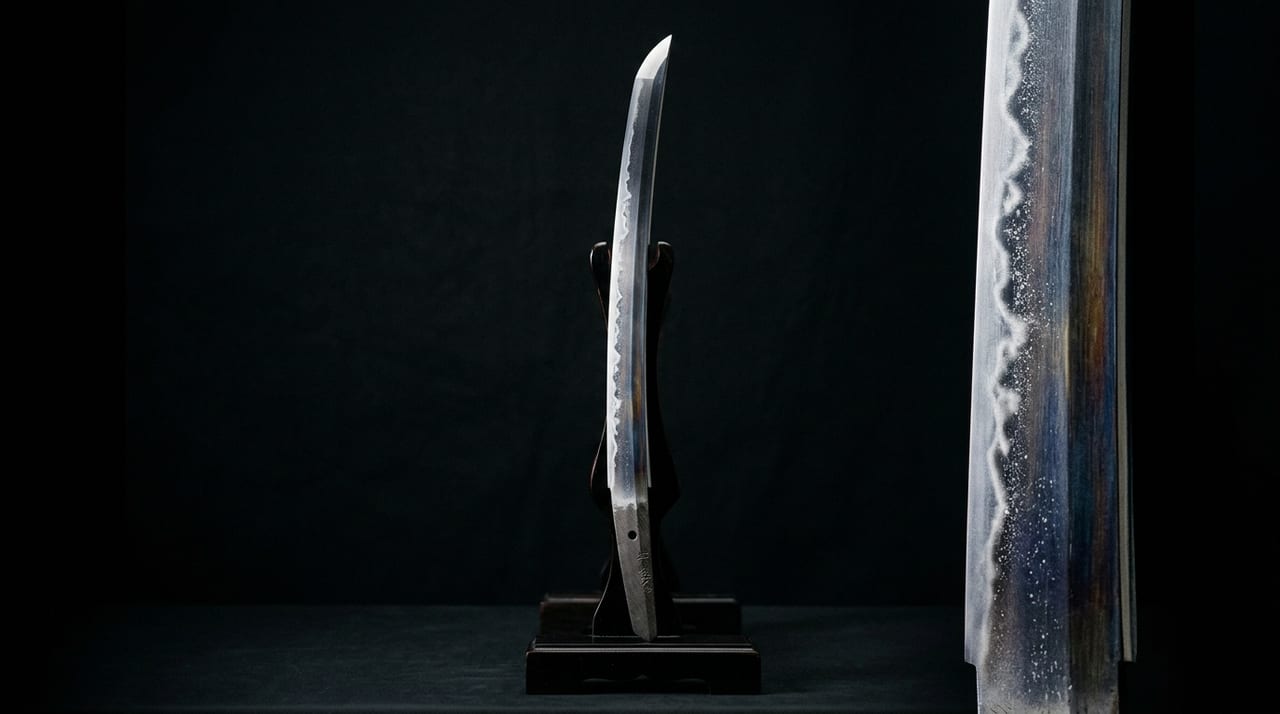
The hamon of traditional Japanese swords is created through selective hardening via clay coating. This technique involves thinly coating the blade portion with a mixture of clay, whetstone powder, and charcoal, while thickly coating the spine portion. During hardening, the thinly coated blade portion is rapidly cooled, causing martensitic transformation and hardening. Meanwhile, the thickly coated spine side is protected from rapid cooling, pearlite structure is maintained, and toughness is preserved. This boundary line of rapid cooling is what appears as "hamon" on the polished surface.
Crystallographic difference between nie and nioi: The nie in hamon is an aggregation of coarsely formed martensitic crystals during hardening, visible to the naked eye as granular particles. Nioi is finely distributed martensitic particles in a misty pattern. Because each swordsmith has different clay composition, concentration, and application techniques, hamon patterns serve as the basis for individual identification like fingerprints, and hamon types such as gonomeme-midare, choji-midare, and suguha are important information that reveals the swordsmith's school and historical context.
Most Showa blades (industrial manufacture) do not use clay coating and instead harden the entire blade uniformly, so no hamon appears even after polishing. Some have finished patterns resembling hamon in the polishing process, creating "forged hamon," but because the crystal structure is fundamentally different from genuine hamon, it can be easily identified by specialist polishers.
Cross-sectional Structure—Functional Design of shingan and kawagane
Another technical core of traditional Japanese swords is the composite laminated structure combining shingan (core iron) and kawagane (outer iron). Shingan is soft iron with low carbon content, high toughness and flexibility, while kawagane is hard steel with high carbon content, high hardness and wear resistance. By wrapping the shingan with kawagane, contradictory properties of "hard on the outside, soft inside" are simultaneously achieved in a single blade.
There are also three-layer and four-layer blades that use even higher-carbon steel in the edge, functionally realizing the ideal of Japanese swords: not breaking, not bending, and cutting well. Showa industrial blades are made from homogeneous single steel material and therefore fundamentally lack this functional composite structure. While attempts are made to compensate for the hardness-toughness tradeoff through fine adjustments in heat treatment, it falls far short of the tenacious flexibility of traditional composite lamination.
Application to Modern Authentication—The Fusion of Science and Connoisseurship
In modern Japanese sword authentication, in addition to traditional "connoisseurship" based on visual inspection and tactile examination, scientific analytical methods are used as complementary approaches.
- X-ray fluorescence (XRF): Non-destructively analyzes the elemental composition of steel and determines whether trace alloy elements unique to modern industrial steel (chromium, nickel, vanadium, molybdenum, etc.) are present. Since tamahagane contains virtually none of these alloying elements, their detection immediately confirms industrial steel.
- Metallic structure observation (microstructure): Microscopic observation of polished cross-section samples confirms the presence or absence of layered structures from repeated folding and forging, the distribution pattern of martensitic particles, and the boundary between shingan and kawagane. This typically involves destructive examination limited to broken blades.
- Magnetic measurement: Selective hardening and uniform hardening can produce differences in magnetic properties, and research into applying this as a non-destructive primary screening method is advancing.
These scientific methods are employed in advanced authentication and objectively reinforce the distinction between Showa and traditional blades, which is difficult to judge through visual examination alone. However, final authentication achieves reliability only when combined with the knowledge of polishers and sword scholars who have accumulated decades of experience.
Conclusion—The Technical Depth Revealed by "Authenticity"
The difference between Showa blades and traditional Japanese swords is not merely a difference in manufacturing method, but a difference in philosophy across all processes from materials and structure to hardening and polishing. While industrial blades have merit as products of an era prioritizing cost and mass production, traditional sword forging beginning with tamahagane can be said to represent the pinnacle of rare composite material engineering from a scientific perspective. The three elements of jihada, hamon, and composite lamination are an art of iron refined over more than a thousand years, and even with modern metallurgical technology, they are difficult to reproduce completely. To truly "see" a Japanese sword, first understanding this scientific background is the first step in discerning authenticity.