The Craft and Materials of the Sayashi: The World of Artisans Who Protect the Blade
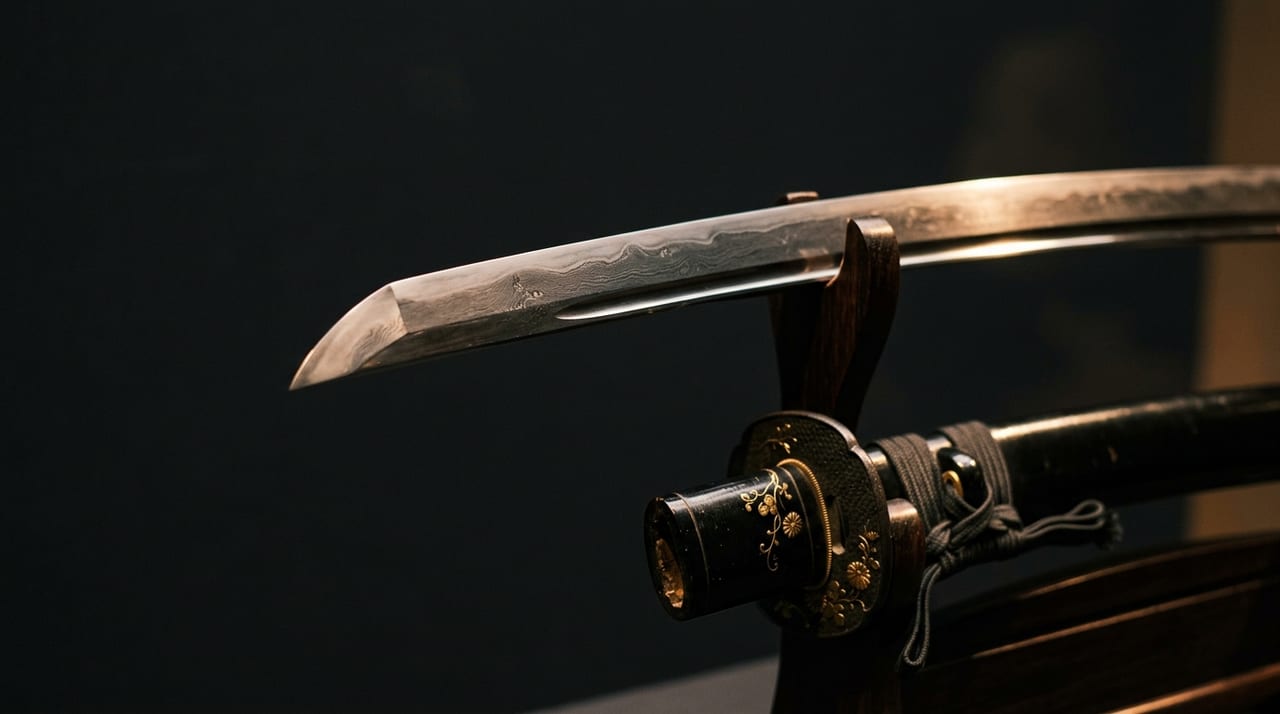 * Image is for illustrative purposes only.
Table of Contents
The World of the Sayashi: The Craft of Giving the Blade a "Home"
A nihontō does not function as a "weapon" merely because the blade is finished. Only when the togishi has polished the edge, the tsukamakishi (hilt-wrapper) has breathed life into the tsuka, the kinkōshi (metalsmith) has forged the fittings, and the sayashi has made a "home" to house the blade does a nihontō become complete.
The sayashi is an artisan who specializes exclusively in making saya. The division of labor among sword-related crafts is thorough, and the sayashi handles everything pertaining to the saya — from material selection and wood cutting to shaping, koiguchi adjustment, and lacquer ground preparation.
The role of the saya extends beyond merely housing the blade. It ensures safety during drawing and sheathing, protects the blade from moisture, rust, and impact, and also functions as a decorative object that makes visible the status and aesthetic sensibility of the samurai. During the Edo period there were retained sayashi who served the shogunal house and various daimyo, and their skills were passed down through the generations under the master-apprentice system. Even after the Meiji era, when demand plummeted due to the Sword Abolishment Edict (Haitōrei), the craft maintained its vital thread in the context of the preservation and restoration of art swords, continuing to the present day.
Choice of Materials: Hō Wood, Lacquer, and Ray Skin
Hō wood (hōnoki), the primary material for saya, is a broadleaf tree native to Japan, relatively soft and lightweight. Why has hō wood been chosen over countless other timbers? The answer comes down to two properties: it does not scratch the blade, and it maintains a stable humidity inside.
The cellular structure of hō wood contains appropriate oils and elasticity, making it unlikely to induce rust even in direct contact with a steel blade. It also has the function of naturally regulating the environment inside the saya by repeatedly absorbing and releasing moisture. Sayashi generally use wood that has been naturally dried for several years to over ten years, carefully selecting portions with uniform moisture content. This is because using insufficiently dried wood leads to warping and cracking after completion, causing the shape of the saya to change.
Lacquer (urushi) is the finishing material applied to the outside of the saya, serving three functions: waterproofing, moisture resistance, and impact resistance. For the shirasaya (plain storage scabbard) made for preservation purposes, no lacquer is applied — the principle being to leave the white natural surface of the hō wood as-is, which makes it easier to visually check the condition of the blade and also ensures breathability. The saya of koshirae (mounting) are finished with a variety of techniques such as black lacquer, red lacquer, and kawari-nuri (novelty lacquer finishes). Among the kawari-nuri are refined decorative techniques that developed in the Edo period, including nashiji (pear-skin), ishime (stone-texture), and sabi-nuri (rust-finish).
Same-gawa (ray skin) is primarily made from dried hides of the red stingray or spotted eagle ray, and has a distinctive granular surface. While widely known as a wrapping material for the tsuka (hilt), it is also sometimes used on the exterior of the saya in a form called same-maki (ray-skin wrapping). It is becoming increasingly difficult to obtain in modern times, and no substitute material that matches genuine same-gawa has yet been found.
The Fully Custom Manufacturing Process
Saya production is entirely bespoke. Because every single sword differs in blade length, motohaba, sakihaba, kasane (blade thickness), sori curvature, and nakago (tang) shape, mass production is in principle impossible, and in the world of art swords and honkatō (original antique swords) generic products are entirely unsuitable.
- Measuring and wood selection: The blade is measured and all dimensions recorded on a paper template. In wood selection, the direction of the grain affects strength and future shrinkage, so experienced sayashi read the "character" of the wood at this stage. The decisions made here determine everything in subsequent processes.
- Rough shaping and carving the tōdō: The hō wood is split lengthwise into two pieces, and a groove following the contour of the blade — the tōdō (blade channel) — is carved into the inner face of each. The precision of this groove is the core process that determines the overall quality of the saya. The two pieces are then joined by hagi-awase (edge-gluing) and the exterior shape is refined.
- Finish shaping and koiguchi adjustment: The outer surface is finished thinly and evenly, and the weight balance is refined. The final adjustment of the koiguchi (described below) is carried out at this stage, and it is the moment that tests the sayashi's skill most severely.
- Lacquer ground preparation: For a shirasaya, the process is essentially complete with the application of a thin lacquer to consolidate the wood base, but for a saya finished as koshirae, multiple rounds of applying and polishing — ground lacquer, intermediate coats, and top coat — are repeated. After each application the lacquer must be dried in a high-humidity muro (drying room), and this process alone can take anywhere from several weeks to several months.
As a rule, a shirasaya takes approximately one week per sword, while a saya finished as koshirae including lacquer work typically extends to several months.
The Precision of the Koiguchi: The Ultimate Measure of a Saya's Quality
"Judge the saya by the koiguchi" — this saying, often heard in the sword world, is no exaggeration. The koiguchi is the opening of the saya, and its precision directly affects function, safety, and aesthetics alike.
The inner diameter of the koiguchi is designed with a tolerance of just tens of micrometers (μm) relative to the thickness of the blade's mune (back of the blade) and ha (edge). If the gap is too large, the blade rattles inside the saya when sheathed and damages the interior walls. Conversely, if it is too narrow, strong friction arises when drawing, and in the worst case the wooden part of the koiguchi can split.
The ideal that a skilled sayashi aims for is a state in which the blade "will not fall under its own weight, yet can be drawn silently with a light pull." It has enough holding power that the blade will not fall out naturally when the saya is held upside down, while during drawing it is released smoothly with the first pull — such an exquisite coefficient of friction is achieved through shaving work on a sub-millimeter scale.
To achieve this precision, the sayashi at the final adjustment stage repeatedly inserts the blade into the saya while shaving the inner wall of the koiguchi in extremely small increments. It is an entirely one-shot process from which there is no going back once material has been removed; a failure means the entire saya must be remade.
Modern Sayashi and the Succession Problem
At present, it is estimated that only a few dozen artisans nationwide make their living exclusively as sayashi. On the demand side, the growing population of iai practitioners provides a stable source of orders for repair and new commissions of iai saya, and requests for restoration and new saya from overseas nihontō collectors and museums are also on the rise. However, income stability is low, and even a sayashi regarded as top-class often produces only a few dozen new pieces per year.
The succession problem is serious. Reaching the level of independent competence after apprenticing requires a minimum of five to ten years of training, with no income guarantee during that period. The difficulty for young people today in enduring this apprenticeship period while managing living expenses is a structural challenge shared with other traditional crafts such as ceramics, dyeing and weaving, and lacquerwork. Some sayashi are working to raise awareness and secure successors through collaboration with the Japanese Sword Museum and through sharing their techniques via video and social media.
The Qualities of a Fine Saya That Top Sayashi Pursue
The qualities of a "fine saya" that top sayashi consistently describe can be summed up in three points.
- Complete dialogue with the blade. A fine saya accurately receives the individual character of the blade. The length, sori, and position of the center of gravity are all reflected in the shape of the saya, giving it a natural fit as though the blade is "breathing" within.
- Resistance to aging. Wood is alive. It repeatedly expands and contracts with the seasons, and sori may change during long-term storage. A fine saya, through wood selection and drying processes that anticipate this change, possesses a stability that can withstand decades of use. The saying "not just a fine saya for today, but a fine saya a hundred years from now" is itself the guiding principle passed down among craftspeople.
- Respect for the user. The faint sound when sheathing the sword, the sensation in the hand at the instant of drawing, the weight balance when worn at the hip — all of it is designed to accompany the movements of the user.