What Is Sayagaki? The History and Meaning of Inscriptions on a Sword's Shirasaya
 * Image is for illustrative purposes only.
Table of Contents
What is Saya-gaki?
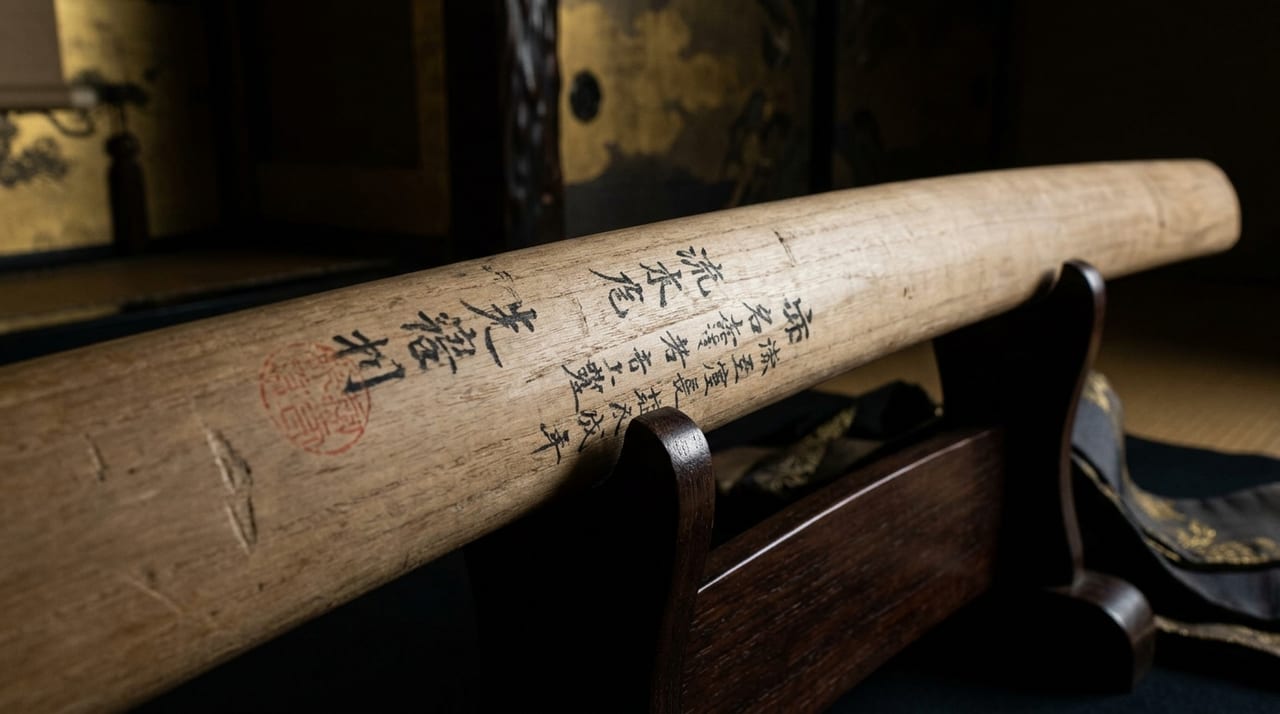
Japanese swords preserved in shirasaya (white scabbards) often have characters written in ink on the flat surface of the scabbard. This is called saya-gaki (scabbard inscription). Distinct from the mei (signature) carved into the nakago (tang) of the blade itself, there is a custom of recording the name of the swordsmith, blade length, and the signature of the appraiser on the outside of the shirasaya. This practice has served to transmit information about the sword's provenance and authentication to future generations. For Japanese swords, which are often handled with the blade still in the scabbard, the information written on the scabbard's surface also serves as an important clue for identifying the blade without needing to unsheathe it. When handling Japanese swords in sword shops and museums, checking the presence and contents of saya-gaki by removing the shirasaya has become one of the basic procedures in authentication practice.
The Origins of Saya-gaki: A Custom Born from the Organization of Daimyo Sword Collections
The origin of saya-gaki is thought to lie in the practice of daimyo (feudal lords) who possessed large numbers of swords writing the names of swordsmiths and blade lengths on the scabbards to organize the information of the swords stored in their collections. Samurai collections often contained dozens to hundreds of swords, and it was difficult to distinguish individual blades by shirasaya alone. By recording information on the surface of the scabbard, the management of these collections became significantly easier. It is thought that this practical innovation gradually took on an authenticating significance—a guarantee of authenticity—as time passed. What began as a practical inventory note eventually transformed into a document that vouched for the value of the sword itself once it passed through the hands of an authoritative appraiser.
The Role of the Honami Family and Other Appraisers
Essential to any discussion of the history of saya-gaki is the Honami family, who made a profession of authenticating Japanese swords from ancient times. Saya-gaki written by Honami family appraisers such as Honami Chouji, Honami Shinshin, and Honami Ringa remain on many swords today. The Honami family authenticated swords at the request of the shogunate and various daimyo, returning the results to the sword's owner in the form of documents called orishie (authentication papers) or as saya-gaki. By attaching saya-gaki to swords they had authenticated, the Honami family created a system that made authoritative assessments of the sword's maker and period visible. In modern times, not only the Honami family but also members of sword preservation societies and other sword experts write saya-gaki, and who wrote it has become an important factor in determining the value of the saya-gaki.
Information Recorded in Saya-gaki and How to Read It
While the content recorded in saya-gaki varies depending on the writer and period, the typical items are as follows.
- Swordsmith's name: the name of the swordsmith presumed to be the maker
- Blade length (measurements): the length of the blade expressed in shaku and sun
- Appraiser's signature and kao (seal): the signature indicating who authenticated and recorded the information
- Date of recording: when the saya-gaki was written
- Notes on provenance and transmission: some records include detailed information about previous owners and transmission history
Not all items are always present; many saya-gaki contain only the swordsmith's name and the appraiser's name. On the other hand, some saya-gaki are written in great detail, including highlights of the blade and its transmission history, and these have the value of a kind of appraisal essay. It is sometimes possible to infer the approximate date of recording from the handwriting style, vocabulary used, and the very format of writing in ink directly on the wood instead of on paper. However, it should be noted that saya-gaki are often written in skilled, cursive script that is difficult to read without specialized training.
The Relationship with Authentication Certificates: Differences in Their Respective Roles
In modern sword commerce, authentication certificates issued by public appraisal organizations such as the Japan Art Sword Preservation Society (NBTHK) are the primary basis for determining whether a sword is genuine and its period. Saya-gaki differ from these official authentication certificates in both their origin and character. While authentication certificates are issued by organizations following unified standards, saya-gaki are written by individual appraisers based on their own knowledge and are essentially personal, signed opinions. The two may sometimes contradict each other, or they may reinforce each other. A proper understanding requires comparing both without favoring either one exclusively, to understand the background of the sword. Swords with old saya-gaki are proof that they have been carefully preserved for a long time and have value as records that tell the story of their provenance.
The Significance and Cautions Regarding Saya-gaki in Modern Times
Saya-gaki is information recorded on the shirasaya, an accessory, and is not the mei signature struck into the blade itself. Therefore, it is essential to compare the content of saya-gaki with the mei cut into the nakago of the blade and the information in authentication certificates issued by public appraisal organizations, and make a comprehensive judgment. Shirasaya can be remade if they become damaged over time, and in such cases, only the saya-gaki carries the old information while the current shirasaya itself is new. There is also a custom of copying the text of saya-gaki from an old scabbard to a new one, and in such cases it is desirable to verify who and when copied it. Understanding the historical significance of saya-gaki and regarding it as a reference alongside authentication certificates and nakago mei is essential when engaging with Japanese swords.