Japanese Sword Storage Environment Management — Temperature and Humidity, Sword Cases, Pest Prevention, Correct Use of Uchiko, and Long-Term Storage Risks
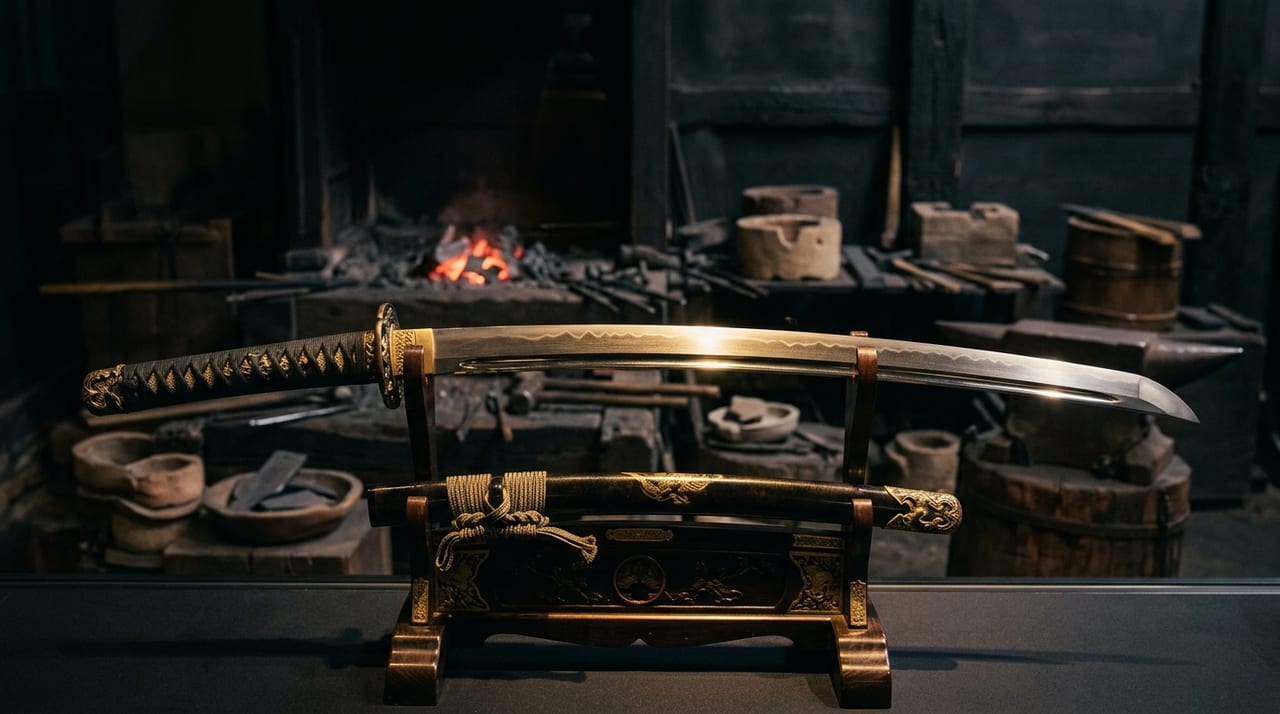 * Image is for illustrative purposes only.
Table of Contents
Factors That Cause Deterioration in Japanese Swords
The main causes of deterioration in Japanese swords are the following three.
- Oxidation (rust)
- Organic contamination (mold)
- Mechanical damage
These stem primarily from failures in storage-environment temperature and humidity management, and from improper oil application and maintenance methods.
Proper Temperature and Humidity Management
The recommended conditions for an ideal storage environment are a temperature of 15–25°C and a relative humidity of 50–60%.
| Humidity condition | Effect |
|---|---|
| Above 70% | Rust progresses rapidly |
| Below 50% | The wooden materials enclosing the blade (shirasaya, sword cases) dry and shrink, creating a risk of cracking |
Japanese summers are hot and humid, so combining an air conditioner with a dehumidifier is effective. During dry winter months, humidification may also become necessary. In old households with a traditional kura storehouse, it has long been customary to carry out "mushiboshi" (airing out) in spring and autumn to check the condition of swords and release accumulated moisture. This practice remains a valid maintenance habit today.
Choosing Sword Cases and Sword Bags
The main implements and materials used to store Japanese swords, along with their characteristics, are as follows.
| Implement / material | Characteristics and notes |
|---|---|
| Sword case (katanabako, made of paulownia wood) | Pest-repellent properties, moisture-absorbing and releasing capacity, and light weight make it suitable for Japanese sword storage |
| Shirasaya (honoki, Japanese magnolia wood) | Its lightness and moderate moisture-absorbing and releasing capacity protect the blade |
| Synthetic storage cases | Poor ventilation; risk of trapping moisture through airtight sealing |
| Sword bag (katanabukuro, cotton or silk) | Unlike synthetic fibers, these cause no adverse effects on the blade from static electricity or chemical components |
| Camphor / naphthalene | Their components can adhere to the blade and cause discoloration; avoid using them during storage |
Correct Use of Uchiko and Chōji Oil
Uchiko (polishing powder) is a silk bag filled with fine powder of uchigumori stone, used to remove old oil. Uchigumori stone is a natural whetstone also used in the final stage of Japanese sword polishing, and its fine powder works by absorbing and removing oil from the blade's surface. The method of use is as follows.
- Lightly tap the blade with the uchiko ball to deposit the powder
- Wipe it off with soft hōshogami (Japanese tissue paper)
An important caution: overuse must be avoided. Frequent use causes microscopic scratches to accumulate on the blade's surface, so for a well-polished, high-quality sword the frequency should be kept to an absolute minimum — approximately once or twice a month is the general guideline. Wiping away the old oil to some extent with hōshogami before using uchiko reduces the burden on the surface.
Chōji oil is applied thinly to the blade as a rust preventive. The application procedure is as follows.
- Apply a small amount to a tissue or hōshogami
- Spread it evenly and thinly across the blade
Applying too thick a coat is counterproductive, as it makes dust adhere more easily. Because chōji oil is a vegetable-based oil, it oxidizes readily over time, and old oxidized oil left on the blade produces the opposite effect by causing rust. For this reason, regular "oil changes" — wiping away the old oil and applying fresh oil — are necessary. In addition, chōji oil seeping into the saya can cause "sayazome" (saya staining), so care must be taken regarding the amount of oil used and the timing of sheathing the blade.
Long-Term Storage Risks and Inspection Frequency
The main cause of microscopic scratches (hike) on the blade surface that are invisible to the naked eye is friction from the blade shifting inside the sword case during storage. This can be prevented by securing the blade inside the case and by storing it in an appropriate sword bag.
Leaving a sword without maintenance for several years or more can lead to irreversible rust. The appropriate response depends on the severity of the rust, as follows.
| Severity of rust | Response |
|---|---|
| Minor rust | Can be addressed by a togishi (polisher) through partial polishing |
| Deep rust | Full polishing is required, and the cost becomes substantial |
For extended absences (overseas assignments, etc.), consider entrusting the sword to a reliable sword dealer or a specialist in cultural property conservation.
Entrusting to Professional Services
When long-term storage or maintenance is difficult to manage independently, entrusting the sword to a sword dealer or a specialist fine-art storage provider is a practical option. For swords purchased through TOUKENZA, consultations are available via the inquiry form in the online catalog.
Timing and Cost of Polishing
Swords that have gone without maintenance for an extended period may require togi (re-polishing). Togi is carried out by specialists known as tōshō (swordsmiths) or togishi (polishers), and the cost varies considerably depending on the blade's condition, length, and depth of polishing required. The approximate cost guidelines are as follows.
| Type of polishing | Approximate cost |
|---|---|
| Standard polishing | Approximately 50,000–150,000 yen per shaku of nagasa |
| Full-scale complete polishing | May run to several hundred thousand yen |
After polishing the blade regains its brilliance, but it is also important to understand that polishing makes the blade thinner ("togi-beri," reduction by polishing). Excessive polishing can alter the blade's geometry and diminish its artistic value, so for minor rust it is important to monitor the condition using chōji oil and uchiko and to seek expert opinion before deciding on polishing.
Obtaining Maintenance Supplies
The three-piece set of uchiko, hōshogami, and chōji oil can be purchased from sword dealers and specialty sword-supply shops. As quality varies, it is advisable to choose products handled by a trustworthy sword dealer. The TOUKENZA inquiry form also accepts consultations about selecting maintenance supplies.
Note that when first using uchiko, chōji oil, and hōshogami, learning by watching an expert demonstration is ideal. To minimize the risk of damaging a precious blade through incorrect use, TOUKENZA can provide basic advice on maintenance — please feel free to submit your questions via the inquiry form.