Price Appraisal Standards for Nihontō — How Sword Dealers Evaluate Mei, Condition, and Period
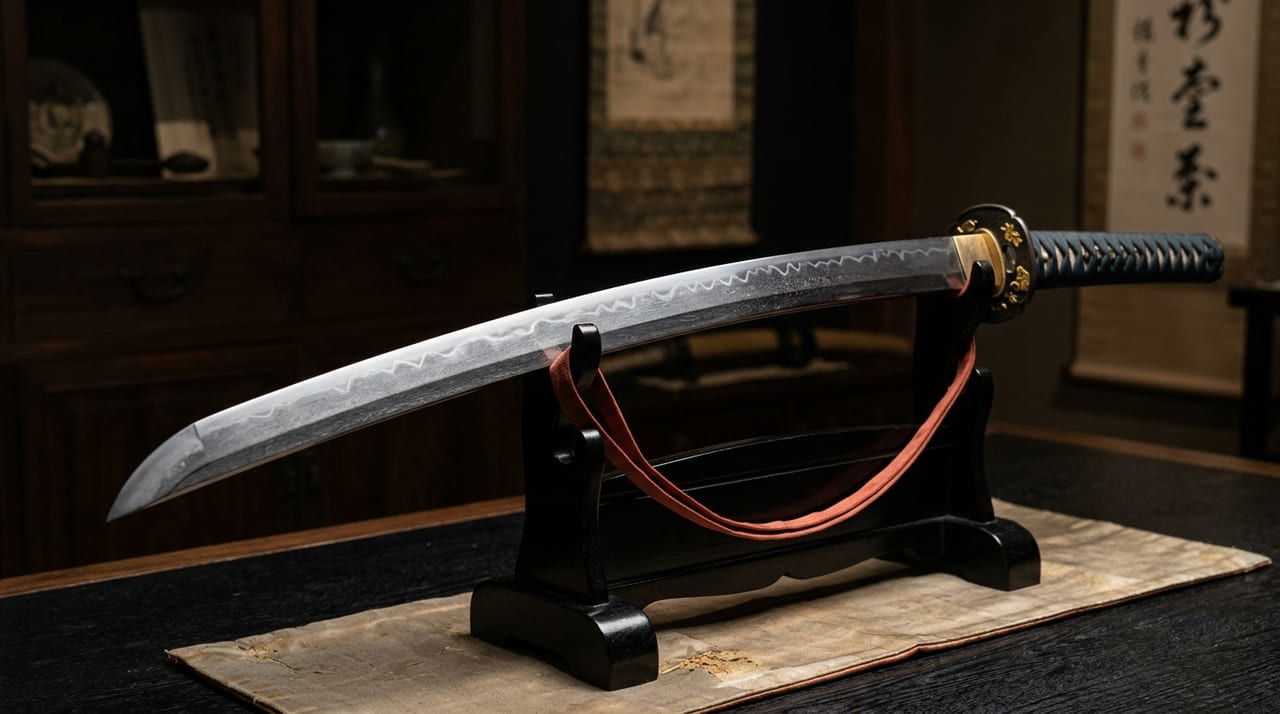 * Image is for illustrative purposes only.
Table of Contents
What Determines the Price of Nihontō
The price appraisal of nihontō is based on a composite evaluation system fundamentally different from the Western antique market. The final price is determined by a complex interplay of factors beyond simple "age" or "rarity": the level of forging technique, the reliability of the mei, the condition of preservation, the completeness of accompanying items, and historical context. Understanding the perspectives that sword dealers apply in actual appraisal settings is extremely important in any context — whether buying, selling, inheritance, or donation.
Those who request appraisals range widely: owners considering selling, bereaved families unsure how to handle swords inherited or being sorted out ahead of the owner's death, and collectors who continue acquiring swords as works of art. The "purchase price" offered by a buying dealer and the "appraisal value" issued by an appraisal institution are fundamentally different concepts; the purchase price incorporates the dealer's resale costs and inventory risk, so it is customarily offered below the appraisal value. Understanding this distinction is essential for correctly interpreting appraisal results.
Evaluation of Mei — Authenticity and Credibility
The evaluation of mei has the most direct influence on price. The name of the tōkō carved into the nakago of the blade serves as the sword's "proof of origin." However, throughout the history of nihontō, the forging of mei (mei-giri) was rampant, and many swords bearing the names of famous tōkō are later works or mei added after the fact to unsigned blades.
When sword dealers and appraisers evaluate mei, they first confirm whether an origami from an authoritative appraisal institution such as the Hon'ami family is present. They then refer to the grade of the NBTHK (Society for the Preservation of Japanese Art Swords) appraisal certificate — Tokubetsu Jūyō Tōken, Jūyō Tōken, Tokubetsu Hozon Tōken, or Hozon Tōken. It is not uncommon for a sword designated Tokubetsu Jūyō Tōken to command a price several times to more than ten times higher than an undesignated work by the same tōkō.
Even when mei is authentic, the evaluation differs depending on whether the work is from the tōkō's prime period or later years. In the case of Osafune Nagamitsu, the master tōkō of Bizen Osafune, works from the mid-to-late Kamakura period receive the highest evaluation, while works under the same mei from the Nanbokuchō period onward tend to be valued lower.
When appraisers determine the authenticity of mei, they compare the way the chisel (tagane) was applied, the idiosyncrasies of the characters, and their placement against other surviving works by the same tōkō. Even within the same tōkō, the position of the mei and the size of the characters change over time, making comparison with known zaimei works indispensable. Furthermore, even a mumei blade may be attributed (kiwame) to a particular school or tōkō based on the characteristics of the jigane and hamon; when the attribution is accurate, a mumei blade can still receive a commensurate evaluation. Conversely, even a zaimei blade may be valued lower than if it were unsigned if the mei is judged to be a later addition or a forgery.
Evaluation of Condition — Hamon, Jigane, and the Presence of Flaws
Next in importance is the physical condition of the blade. The following points are examined with precision during appraisal.
Completeness of hamon (temper line): The hamon produced by yaki-ire (quenching) is checked for loss through togi (polishing), blade cracks (hakire), and collapse of nie. If the hamon has partially disappeared, this constitutes "polishing loss" (togiberi) and becomes a significant factor in reducing value.
Quality of jigane (steel of the blade surface): The beauty and uniformity of the grain patterns — itame, masame, mokume — are evaluated. Mune (back of the blade) cracks, flaws (kizu), and forging cracks in the jigane are counted as irreparable defects and reduce the grade.
Preservation of sugata (form): How well the original sori (curvature), mihaba (blade width), and kasane (blade thickness) have been maintained is examined. Loss of koshi-zori or reduction in mihaba due to excessive togi strays from the original form and significantly lowers the evaluation.
Condition of nakago (tang): The state of rust is considered a certain gauge of age — "the rust speaks of the period" — but excessive corrosion is regarded as a functional defect. The clarity of the yasurime (file marks) is also confirmed.
The history of togi (polishing) is also a factor that cannot be ignored. Whether careful togi by a trusted togishi (polisher) has been applied, or whether repeated careless togi has damaged the original character of the jigane and hamon, is difficult to judge without specialist knowledge. In appraisal settings, the following points are frequently used as a checklist.
- Whether the hamon remains clearly as it was at the time of yaki-ire (quenching)
- Whether the jigane has no forging cracks or flaws
- How well the original sugata (sori, mihaba, kasane) is preserved
- Whether the rust and yasurime of the nakago have not been altered in later times
- Whether the bōshi (temper line in the point) returns cleanly without disturbance
Period and School — Historical Context Determines Price
The price of swords varies greatly by manufacturing period and school. In general, kotō (swords made before Keichō) tend to be valued higher than shintō (swords made from Keichō onward), but this is not absolute.
The finest works of the five traditions of the Kamakura period — Yamashiro-den, Yamato-den, Bizen-den, Sōshū-den, and Mino-den — command the highest prices even in today's market. Works by the "master tōkō of Sōshū-den" — particularly Masamune, Norishige, and Gō Yoshihiro — can reach tens of millions of yen to over one hundred million yen.
On the other hand, even within the shintō period, Hizen Tadayoshi, Nagasone Kotetsu, and Inoue Shinkai maintain high evaluations. Among gendaitō made since the late Edo period, works by Living National Treasure designees are especially highly valued.
Denrai — provenance, meaning from which families or persons the sword has been passed down — is also one of the factors that influences evaluation. When provenance through a daimyo family or a notable collection is supported by documentary evidence, the sword is often valued higher than a work of the same period and tōkō without such provenance. On the other hand, since kotō have passed through many years since their creation, the natural "age fatigue" that comes with the passage of time is not necessarily a factor in reducing evaluation; rather, it is received positively as an element demonstrating the sword's antiquity — a point that differs from the evaluation of shintō and gendaitō.
Accompanying Items and Koshirae — Axes of Added Value
The completeness of koshirae (mounting), not just the blade alone, is also reflected in the price. If an Edo-period daimyo koshirae or samurai koshirae is present in original condition, it may add approximately 10–50% of the blade price in added value.
The quality and fit of the shirasaya (plain storage scabbard) are also evaluated. A custom shirasaya made by a noted shirasaya craftsman enhances both the functional protection of the blade and its standing as a work of art. Whether accompanying documents such as a kanteisho (appraisal certificate), origami (appraisal certificate), and appraisal sword bag are present is also included in the appraisal.
Conversely, if part of the koshirae is missing, or if it clearly consists of mismatched components assembled in a later period, it is unlikely to be evaluated as adding value. Whether the period and style of the blade and koshirae match is also an important consideration in judging the authenticity of the koshirae. The presence of a sword box or paulownia box used for storage, accompanying letters attesting to provenance, and other peripheral documents are also confirmed as reference information during appraisal.
Market Trends and Price Benchmarks
The sword market is influenced by both domestic and overseas demand. With growing collector demand from Europe, North America, and East Asia, prices for particularly well-preserved kotō and works by noted tōkō are on an upward trend.
As a general price benchmark, mumei, undesignated, mass-produced wakizashi and tantō start from around tens of thousands to over a hundred thousand yen; NBTHK Hozon Tōken designated items are in the hundreds of thousands to around one million yen; Jūyō Tōken are several million to tens of millions of yen; and Tokubetsu Jūyō Tōken typically exceed ten million yen at standard market levels. However, these are only benchmarks, and actual figures vary greatly depending on the individual sword's condition, mei, and accompanying items.
Fluctuations in exchange rates and growing interest in Japanese art overseas also have an indirect effect on domestic prices. It should therefore be understood that even for the same sword, the offered price may vary depending on when the appraisal is requested.
For selling, purchasing, or inheritance, obtaining estimates from multiple specialist sword dealers and making decisions after going through the assessment of a public institution such as the NBTHK is the best strategy for avoiding disputes.
Points to Note When Requesting an Appraisal
When actually requesting an appraisal, there are several practical points to bear in mind.
First, since the appraisal amount offered tends to vary by dealer, it is advisable not to judge on the basis of a single dealer's figure alone, but to obtain estimates from multiple specialist sword dealers. Second, the figure offered in a rough appraisal by telephone or photographs and a formal appraisal after examining the actual item often differ, so the final decision should always be based on the appraisal amount after physical confirmation. Third, for a sword that already has an appraisal certificate from a public institution such as the NBTHK, it is advisable to prioritize the contents of that certificate over a dealer's individual assessment.
Not neglecting these basic checks leads to buying and selling at appropriate prices.