Modern Tōshō Apprenticeship — The Reality of Daily Life, Pay, and Years from Entry to Independence
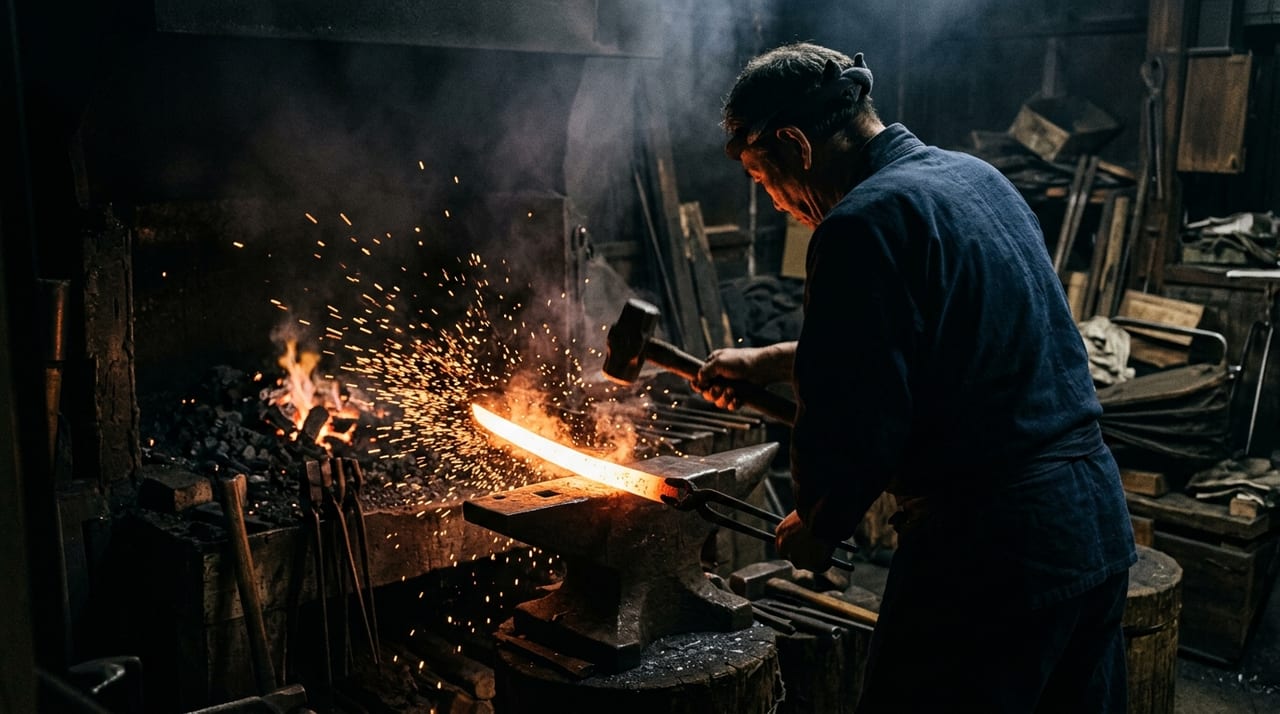 * Image is for illustrative purposes only.
Table of Contents
Becoming a Tōshō
The official path to becoming a tōshō in modern Japan is apprenticeship under a tōshō who has previously received sword-making authorization. No university or vocational school curriculum for this exists (at most, a handful of university craft programs offer basic kaji training), and everything rests on one-to-one technical transmission between master and apprentice.
No specific educational requirements exist for those who wish to become a tōshō, but since the work is primarily physical labor involving fire, physical strength and endurance are required, as is the resolve to endure a long period of financial instability.
Finding a Master
Finding a master is the first hurdle on the path to apprenticeship. The main approaches are as follows.
- Contacting the All-Japan Tōshō Association: They may provide information on tōshō who are accepting apprentices
- Attending sword exhibitions: Introduce yourself directly to tōshō at the New Sword Exhibition (held once a year) and convey your enthusiasm
- Through sword dealers and togi specialists: Introductions via personal connections in the sword industry
- Writing directly to a tōshō or paying a visit: A handwritten letter expressing your passion remains effective even today
Finding someone willing to take you on is difficult in itself, and many people spend several years before finally beginning an apprenticeship. Whether by introduction or by letter, it is considered advisable to first research the styles and teaching philosophies of multiple tōshō before seeking out a master whose style aligns with what you aim to achieve.
The Reality of Apprentice Life
Live-in Apprentices
In many traditional workshops, living in is the norm. Apprentices live in the master's home and begin with chores such as assisting with work, cleaning the workshop, and preparing charcoal.
Daily Schedule (Example)
- 6:00 – Cleaning the workshop, preparing the fire
- 7:00 – Work begins (operating the bellows, preparing tamahagane, assisting the master)
- 12:00 Lunch (usually eaten at the master's home)
- 13:00 – Afternoon work
- 17:00–18:00 Work ends, tidying up
- Evening: Independent practice and self-study of related books
Day Apprentices
In recent years, day apprentices have increased due to changing lifestyles. However, since time with the master is limited, skill development is said to take longer.
Customs of the Master-Apprentice Relationship
In the traditional master-apprentice relationship, etiquette beyond sword-making itself is also emphasized, including caring for tools, tidying up, and attending to guests. Learning basic manners such as proper greetings and polite speech is also considered an important part of the apprenticeship.
The Reality of Pay and Working Conditions
The pay during tōshō apprenticeship is in reality almost nothing to perhaps several tens of thousands of yen per month, which differs greatly from modern employment expectations.
| Apprenticeship Phase | Expected Compensation |
|---|---|
| First–second year | Unpaid or a few thousand yen/month (room and board provided in lieu of pay) |
| Third–fourth year | Approximately 10,000–30,000 yen/month (varies by master's policy) |
| Fifth year onward | Approximately 30,000–100,000 yen/month (rises with achievement) |
Many apprentices continue their training while relying on side work or family support. Even for live-in apprentices, the handling of social insurance such as health insurance and pension varies by master, and this is considered one of the matters to confirm before entering apprenticeship.
A 5–7 Year Apprenticeship Timeline
| Year | Main Content |
|---|---|
| First year | Workshop assistance, knowledge of charcoal, handling tamahagane |
| Second year | Assisting with tanren, observing orikaeshi tanren |
| Third year | Basic sword-making assistance, practice striking with a hammer |
| Fourth year | Trial production of small blades and tantō under the master's guidance |
| Fifth year | Full-scale independent sword-making |
| Sixth–seventh year | Undergoing training conducted by the Commissioner of the Agency for Cultural Affairs, working toward receiving first authorization for production |
The requirements for receiving sword-making authorization include having devoted oneself to honing one's skills for five or more years under a tōshō who has previously received authorization, and having undergone training conducted by the Commissioner of the Agency for Cultural Affairs (Fine Art Sword Manufacturing Authorization Rules (e-Gov Legal Search)).
Independence After Receiving Authorization
The following preparations are required to open an independent workshop after receiving one's first sword-making authorization.
- Securing a workshop: Because forging involves noise, vibration, and open fire, the search is primarily focused on suburban or rural properties
- Equipment investment: At least approximately 3,000,000–5,000,000 yen for a forging furnace, bellows, grinding stones, and various tools
- Securing tamahagane: The right to purchase tamahagane distributed from the tatara (traditional smelting) operation (Okuizumo, Shimane Prefecture) sometimes has a waiting list
When securing a workshop, prior explanation to neighboring residents to obtain their understanding and attention to safety measures for work involving open fire are also essential considerations.
The Reality of Income (Early Independence)
- Annual production volume: The Fine Art Sword Manufacturing Authorization Rules set no upper limit on annual production volume (Fine Art Sword Manufacturing Authorization Rules (e-Gov Legal Search)). However, prefectural examination standards stipulate the minimum number of tanren days per blade (15 days or more for tachi, katana, and naginata; 10 days or more for wakizashi, tantō, etc.), so the number that can actually be produced is effectively limited (Aomori Prefecture "Fine Art Sword Manufacturing Authorization" Examination Standards).
- Selling price of new swords by a tōshō: 200,000–500,000 yen per blade (early period when reputation is low)
- Since togi and koshirae costs are incurred separately, actual take-home pay is low
- As prize-winning achievements accumulate, the price of one's work rises
The reality is that many tōshō make their living while also pursuing side work (lectures, workshops, sword maintenance).
The Current Situation of Young Tōshō
In recent years, the number of young people aspiring to become tōshō is said to be on the rise, but many drop out partway through due to the high financial hurdles. At the same time, the sword boom and increased visibility of tōshō through the internet have been attracting the younger generation.
Young tōshō have begun using social media (Instagram, etc.) to share the sword-making process and take direct orders from overseas fans, and new business models that do not rely on traditional distribution channels (through sword dealers) are being explored.
Frequently Asked Questions
- Are academic qualifications or credentials required?: No specific academic background or credentials are required; the biggest barrier is whether a master agrees to accept you.
- Is there an age limit?: No clear age restriction is set, but since much of the work is physically demanding, entering apprenticeship at a relatively young age is considered the norm.
- Can women train as apprentices?: Female tōshō do exist, but this has traditionally been a male-dominated world, and whether women are accepted varies by master and workshop.
- Is it possible to quit partway through?: Since it is a master-apprentice relationship rather than contract-based employment, cases of leaving midway do occur, but the paths to sword-related work afterward are said to be limited.
Conclusion
Tōshō apprenticeship is financially harsh, and it is a demanding path on which a long training period before receiving authorization and a difficult business environment after independence await. Even so, young people with a sense of mission as guardians of tradition and a passion for making swords continue to exist, supporting the continuation of nihontō culture.