Nakago Finishing Forging Techniques — The Practice of Shaping, Mekugi Hole Drilling, and Yasurime Cutting Performed After Yaki-ire
 * Image is for illustrative purposes only.
Table of Contents
What is the nakago? — The technical significance of the blade's "root"
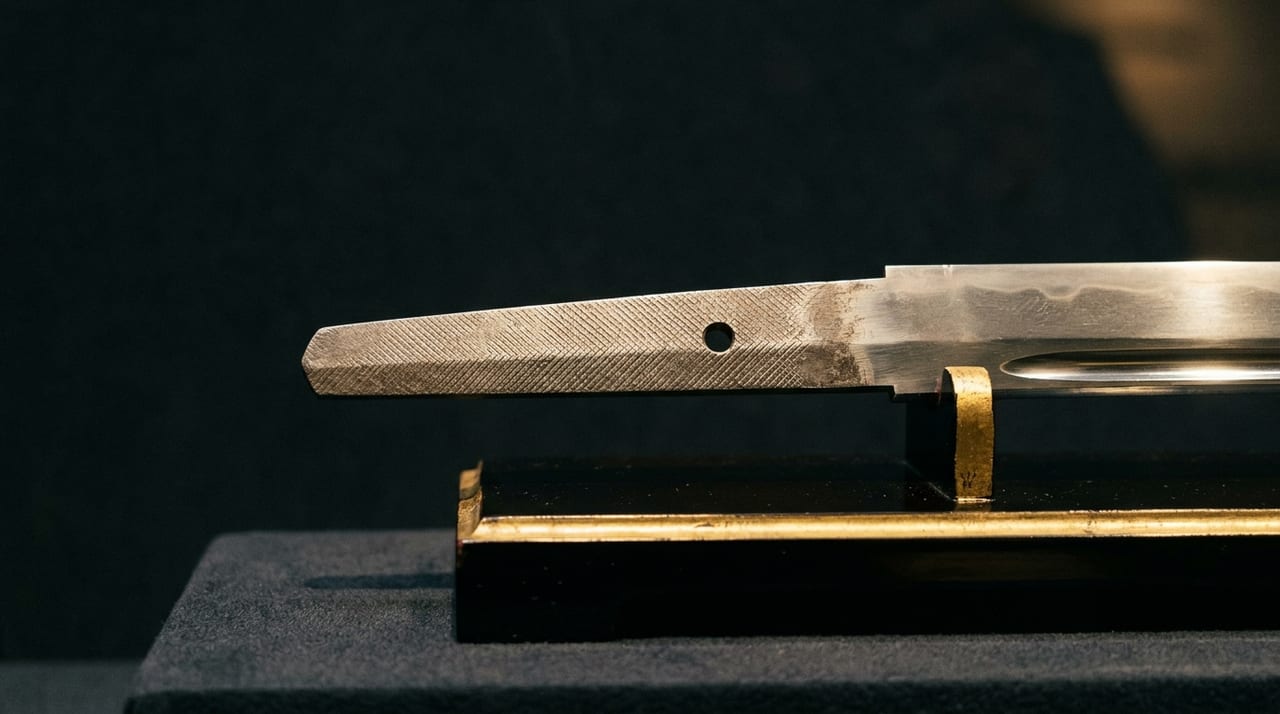
The nakago is the base of the blade inserted into the tsuka (hilt), and it functions as an "invisible foundation" within the Japanese sword as a whole. While hamon, jigane, and sugata attract attention in appreciation and appraisal, the nakago carries information such as the tōkō's mei, yasurime, and mekugi holes, making it one of the most important parts for determining a sword's authenticity, period, and school.
From a forging technology perspective, the nakago is not merely "the part that goes into the hilt" but a precise structure that receives careful finishing work after the yaki-ire process. Proper nakago shape and finish directly affect the fit with the tsuka, stability during drawing, and stress distribution on the mekugi, so the tōkō's skill is partly revealed here as well.
In appraisal contexts too, the nakago is an important part; alongside the hamon and jigane, the shape of the nakago, its yasurime, and the position and number of mekugi holes are treated as clues for estimating period and school. The rust that forms on the nakago surface is the result of long years of aging, and its color and texture also serve as appraisal judgment materials, so one must be careful in handling it, avoiding direct contact with the nakago with bare hands that would deposit skin oils.
The flow of nakago processing before and after yaki-ire
At the "hi-zukuri" stage where the basic shape of the blade is formed, the outer shape of the nakago is largely determined. At this stage, the position of the machi, the nakago length, and the basic width and thickness are established, and the nakago portion is formed as a bar-shaped piece of iron.
At the tsuchioki stage carried out before yaki-ire, refractory clay is applied to the blade for hamon formation, but the nakago portion is left with bare metal exposed as it enters the furnace. After yaki-ire, the nakago does not harden from the furnace heat and remains in a tempered state, possessing moderate toughness (resilience). This is a deliberate design consideration so that the nakago does not crack during mekugi hole processing and assembly/disassembly.
While the blade portion transforms into a hard and brittle structure, the nakago maintaining a soft state means that cracking and chipping are less likely to occur in subsequent yasurime work and mekugi hole drilling. If the nakago were to harden in the same way as the blade portion, cracks would easily form when drilling the mekugi hole, making it difficult to stably support the blade within the tsuka. For this reason, the decision not to apply refractory clay to the nakago portion at the tsuchioki stage is itself an important step that governs the entire subsequent finishing process.
Nakago shaping — finishing by shape type and tools
After yaki-ire, nakago shaping begins. First, a file and hammer are used to flatten the nakago surface, and the boundary lines of the ha-machi and mune-machi — collectively called "machi" — are clearly formed. The finishing of this machi relates to the overall "sense of balance" of the sword; if the corners of the machi are too sharp, the boundary with the tsuka becomes visually unnatural, and if too rounded, blade strength decreases, requiring delicate judgment to shape it appropriately.
There are multiple styles for the contour shape of the nakago, chosen according to period, school, and the tōkō's individuality.
- Funazoko-gata (boat-bottom shape)
- Kurijiri-gata (chestnut-base shape)
- Ken-gata (sword shape)
- Ha-nobori mune-sagari-gata (rising-ha, descending-mune shape)
Kotō from before the Muromachi period tend to have relatively long nakago with rounded shapes, while shintō from the Edo period onward shows a tendency toward shorter, more parallel shapes.
In the shaping process, even slight irregularities on both sides of the nakago (the mune-side and ha-side surfaces) are carefully smoothed out so that they fit snugly against the inner shape of the tsuka. Since the tsuka is made by hollowing out the inside to match the shape of the nakago, if the nakago finishing is rough, gaps will form between them, potentially causing rattling and damage during use. Conversely, if shaping proceeds too far, it can compromise the strength and weight balance of the nakago itself, so maintaining the necessary and sufficient smoothness without over-cutting is an area left to the experience and intuition of the tōkō.
Mekugi hole processing — precise management of position, diameter, and angle
The mekugi hole is a hole for passing the mekugi that fixes the tsuka and blade together, and its position, diameter, and angle determine the precision of fit with the tsuka. Traditionally, punching with a "chisel and hammer" method is used, and many tōkō today maintain the same approach.
| Item | Details |
|---|---|
| Position | Determined based on calculations considering the center of gravity balance, decided by the ratio of the nakago's length and width |
| Diameter | Generally around 4–6 mm, adjusted to match the cross-sectional diameter of the mekugi material (bamboo is traditional) |
| Angle | Rather than perpendicular to the nakago surface, it is often tilted slightly toward the ha side, which has the effect of allowing the mechanical load during drawing to be absorbed more readily by the mekugi as a whole |
Care is also required regarding the position of the hole; if a hole is drilled too close to the edge of the nakago (near the mune or ha end), force tends to concentrate there, making it prone to becoming the starting point of cracks. Therefore, tōkō take care to drill holes in positions leaving sufficient margin relative to the width of the nakago. Even when viewing or purchasing existing swords, whether cracks radiate from the edge of the mekugi hole is considered one of the basic points to check when assessing condition.
When an old sword has multiple mekugi holes, it is evidence that the nakago has been shortened through suriage (shortening), and the number and position of holes become important appraisal judgment materials. When creating new swords, tōkō drill only one mekugi hole and may select a position with future suriage in mind.
Yasurime cutting — engraving the tōkō's "fingerprint" into the nakago
The final step in nakago finishing is the application of yasurime (file marks), a process of engraving regular grooves into the nakago surface using flat files, cross files, and medium-finish files. There are many patterns of yasurime, and the preferred styles differ by school.
- Osuji-chigai (large diagonal)
- Ko-suji-chigai (small diagonal)
- Yoko (horizontal)
- Takanoha (hawk feather)
- Higaki (cypress fence)
Yasurime are not merely decorative but have the practical function of "improving friction" when the nakago is inserted into the tsuka. Having appropriate yasurime increases adhesion at the contact surface between the tsuka wood (tsuka-gi) and the nakago, preventing the tsuka from loosening during use. At the same time, yasurime are also "the part where a tōkō's individuality appears most clearly," and when comparing works by the same tōkō across pieces, consistent patterns are often recognized in the way the yasurime are cut. This is why, even for swords whose mei is unknown, the style of yasurime serves as a supplementary clue in appraisal.
It should be noted that for swords that have undergone suriage, the yasurime may be re-applied to the shortened nakago, and this is called "yasurime no kake-naoshi." The re-applied yasurime may differ subtly in groove direction and spacing from the yasurime applied by the original tōkō, and in appraisal, this difference is also treated as a clue for reading the provenance of the nakago. In this way, nakago finishing forging techniques are not mere post-processing but a process that engraves indispensable information for discussing a sword's authenticity, period, and school.