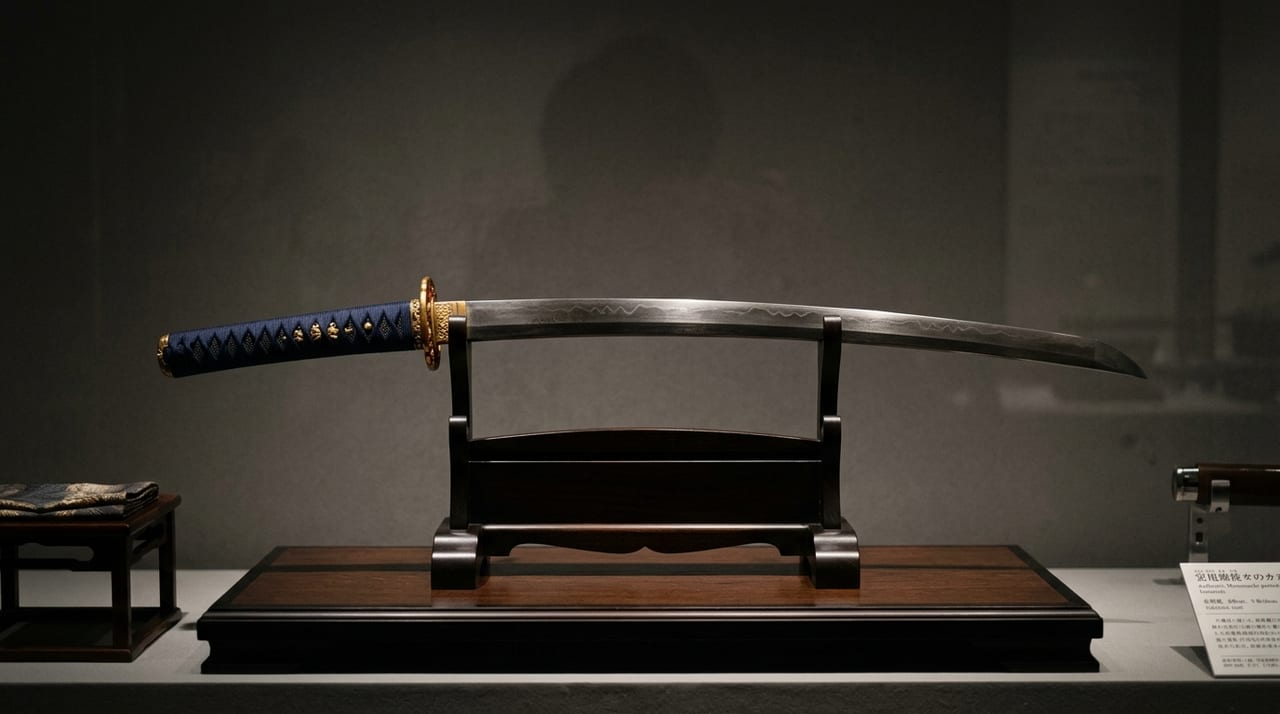
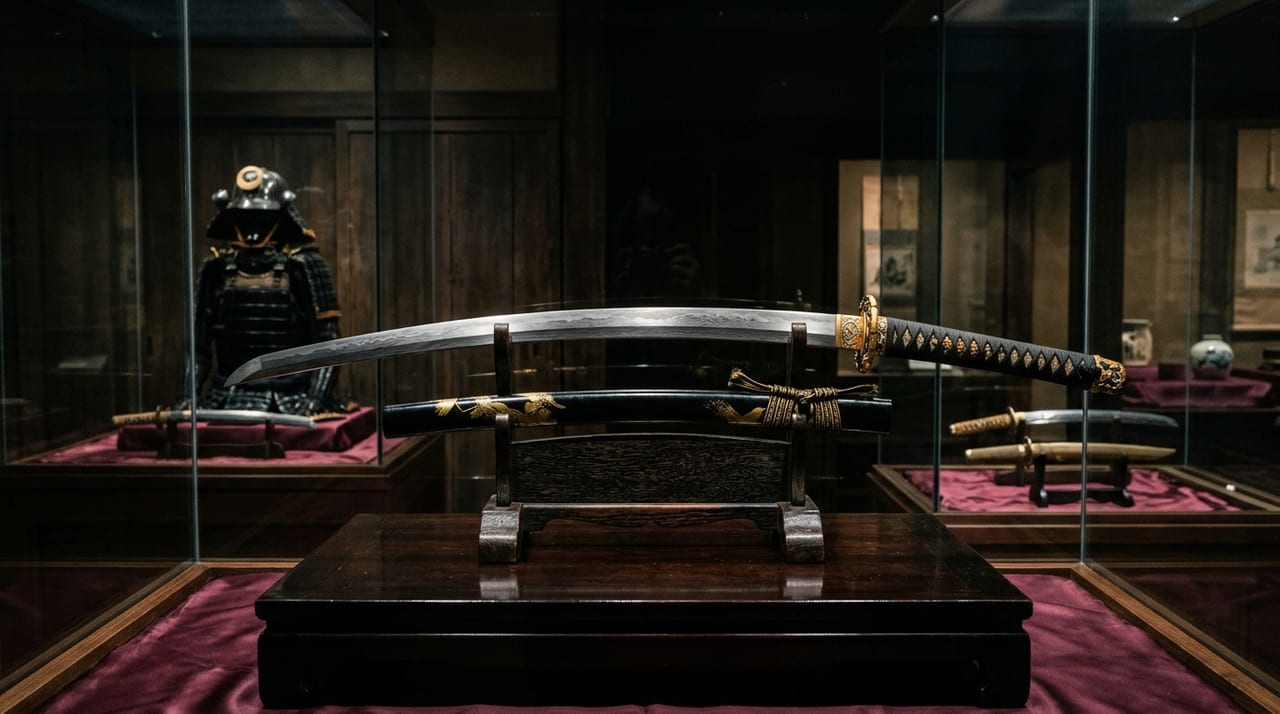
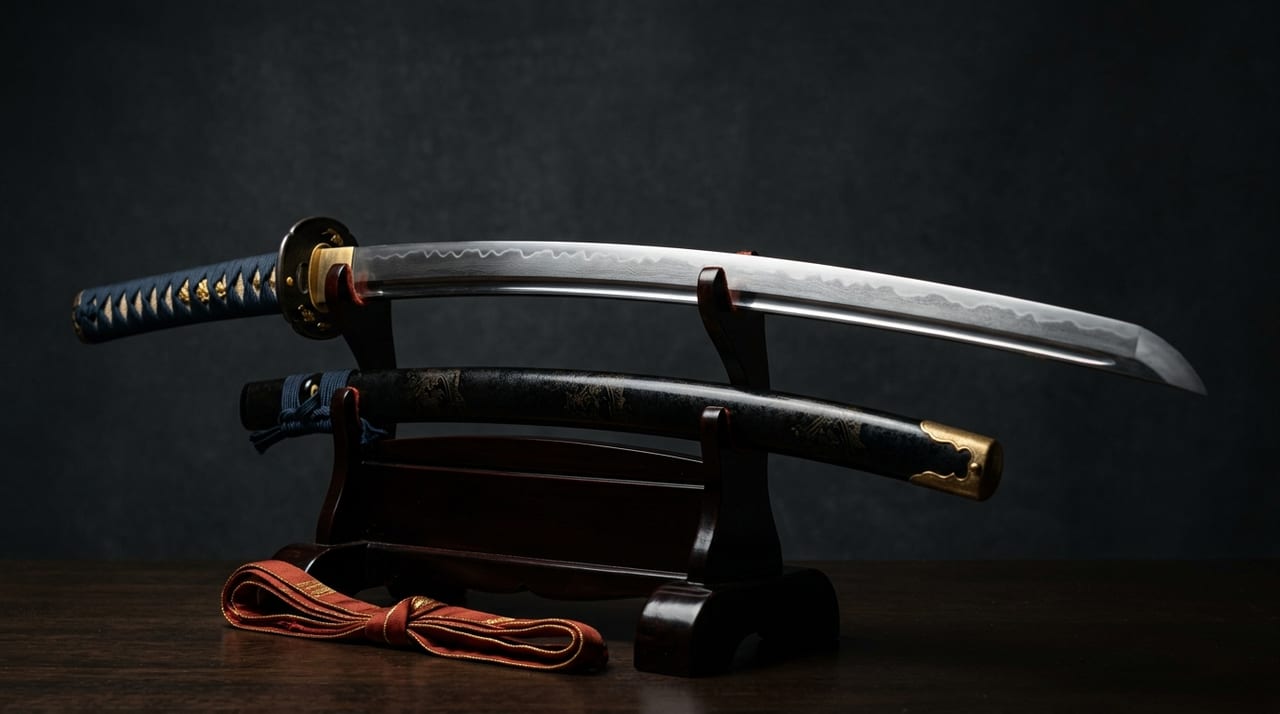
The Goban Kaji System of Go-Toba In — The System of Monthly Rotation Summons of Master Smiths from Across the Country, Established in the Early Kamakura Period, and Its Operational Reality
 * Image is for illustrative purposes only.
Table of Contents
What Kind of System Was the Goban Kaji?
Goban kaji refers to the system established by Go-Toba In (the retired Emperor Go-Toba) in the early Kamakura period, whereby skilled tōkō from across the country were summoned on a monthly rotation to the Minase Detached Palace to produce swords in turn. "Ban" refers to rotational duty shifts, and it is traditionally held that twelve master smiths from various provinces — including the Bizen Ichimonji, Awataguchi, and Aoe schools — were organized into rotation groups (the theory of twenty-four is considered a later embellishment). Goban kaji is a term used as a proper noun referring exclusively to Go-Toba In's own institution, which differs from the system of swordsmiths retained by the Muromachi shogunate's shogunal house in both origin and character.
This system served multiple purposes.
- First, Go-Toba In was so devoted to swords that he forged them himself within the imperial palace, and he wished to gather the finest tōkō in the country around him in order to oversee and direct their work in person.
- Second, by imposing the rotation system, to bring tōkō from across the provinces under the institutional control of the retired emperor's authority.
- Third, to convey the retired emperor's personal preferences directly to the smiths and to create a setting where the techniques of Bizen-den and Yamashiro-den could intersect.
In terms of actual operation, it is said that the summoned tōkō served their rotation on a monthly basis, and that during their period of service they were stationed at a smithy established near the imperial palace to devote themselves to sword-making. During the periods of service, it is said that Go-Toba In himself would sit beside the forge to observe the fire management and forging techniques; the fact that this created a rare arrangement in which the retired emperor and the smiths refined their craft together in the same space, transcending the ordinary relationship of patron and artisan, may be considered the most distinctive feature of the goban kaji.
The Origins and Reality of the System
The goban kaji was conducted during the period of Go-Toba In's cloistered rule (early 13th century), prior to the Jōkyū War (1221), at a time when the retired emperor held substantial power. Go-Toba In was known not merely as a patron but as someone who participated in forging swords himself, and his imperially made swords (gosei-tō) were permitted to bear the chrysanthemum crest.
The home provinces of the summoned tōkō spanned a wide range, including Bizen Province (the Fukuoka Ichimonji, Yoshioka Ichimonji, and others), Yamashiro Province (Awataguchi Norikuni and others), and Bitchū Province (Aoe Tsunetsugu and others). Each rotation group is said to have traveled to the capital in turn and stayed for a fixed period to produce swords, but no detailed documentary records survive, and the reality of the system is inferred from later oral traditions and the analysis of zaimei swords.
The style that emerged under Go-Toba In's guidance became distinguished in later ages as the "goban kaji of Go-Toba In," coinciding with the mature period of the Bizen Ichimonji, characterized by bold sori (curvature) and fine chōji-midare.
Since almost no contemporary primary sources on the goban kaji survive, when judging today whether a given sword is a work of Go-Toba In's goban kaji, the approach taken is to estimate the period, province, and maker based on the overall quality of workmanship — the density of the jigane (steel of the blade surface), the activity of the hamon (temper line), and the finishing of the nakago (tang) — rather than on the mei (signature) itself. There are many cases in which swords are attributed as "Bizen Ichimonji" or "Awataguchi" while remaining mumei (unsigned), and whether an individual maker's name can be identified depends on the sword's state of preservation and how well its distinguishing features have been retained.
Differences from the Swordsmiths Retained by the Muromachi Shogunate's Shogunal House
The Muromachi shogunate also had a custom of the shogunal house retaining tōkō and having them produce swords in Kyoto. However, this was not called goban kaji; it took the form of retained tōkō and tōkō presenting swords to the shogunal palace. Documentary evidence that the shogunate managed tōkō from across the provinces through a rotation system is scarce, and the understanding of goban kaji as a "system of the Muromachi shogunate" is not accurate.
It is true that many swords made in the capital by tōkō who traveled from various producing regions during the mid-Muromachi period (the era of Ashikaga Yoshimochi through Ashikaga Yoshinori, the first half of the 15th century) survive — bearing inscriptions such as "Oite Kyōto" or "Oite Raku" — but these are treated as swords produced in the capital in response to individual summons or commissions, not within the framework of goban kaji. The two differ in their historical formation: one is "a rotation-based system organized by the retired emperor," the other "individual commissions to produce swords in the capital at the shogunate's invitation"; and even though both result in "swords made in Kyoto," it is important for understanding sword history not to confuse their origins.
The Summoned Tōshō and Their Home Provinces
The principal home provinces of tōkō summoned to Go-Toba In's goban kaji were as follows.
Bizen Province (Osafune, Ichimonji): With the Fukuoka Ichimonji and Yoshioka Ichimonji at the fore, the tōkō of Bizen Province are said to have served in the greatest numbers. The period of Go-Toba In's goban kaji coincided with the peak of the Bizen Ichimonji, and bold chōji-midare developed.
Yamashiro Province (Kyoto environs): Awataguchi Norikuni, Kunitomo, Kuniyasu, and others of the Awataguchi school are said to have participated. It is inferred that the tōkō of Yamashiro Province, being geographically close, were summoned frequently.
Bitchū Province (Aoe): Aoe Tsunetsugu, Tsugunao, and others of the Aoe school are said to have participated, and Bitchū Province's gentle chōji-midare was refined under Go-Toba In's guidance.
Each of these schools sometimes used the same name across multiple generations as a workshop tradition, and whether the member who served in the goban kaji was the first generation or a later one must be examined from the workmanship and date inscriptions of individual swords. Comparing the stylistic differences between home provinces is also a useful perspective for appreciating how the goban kaji functioned as a venue for technical exchange across various regions.
What the Goban Kaji Left to Sword Culture
Go-Toba In's goban kaji is regarded as one of the turning points at which the nihontō was elevated from a weapon to a work of art and cultural symbol. The imperially made swords, in which the retired emperor himself participated in the forging and which were permitted to bear the chrysanthemum crest, carried exceptional authority as "swords viewed by the emperor," and deeply influenced the cultural ranking of swords in later ages.
The fact that the Bizen Ichimonji and Awataguchi — the two great pillars of the Kamakura period — competed in their craft under the goban kaji system is one of the reasons why swords of this era continue to receive the highest esteem today. The term "goban kaji" refers as a proper noun to Go-Toba In's institution precisely because of this historical weight, and understanding it as clearly distinct from the swordsmiths retained by shogunal houses from the Muromachi period onward constitutes foundational knowledge for appreciating nihontō.
What to Know When Selecting Works Associated with the Goban Kaji
Among the zaimei works that can be reliably identified as having served in the goban kaji itself, the great majority have already come into the possession of museums, shrines and temples, and public institutions, making opportunities for them to circulate in general trade extremely rare. The great majority of swords for which a connection to "Go-Toba In's goban kaji" is claimed in the market are, in most cases, works of closely contemporary schools that share the same lineage and transmission — such as the Bizen Ichimonji, Awataguchi, and Aoe that produced goban kaji smiths — and one must be aware that they do not directly prove that the individual sword itself served in the goban kaji rotation.
Therefore, when examining swords of such lineages, it is essential to maintain a stance of determining the extent to which information is substantiated — relying on the period, province, and attribution recorded in kanteisho (appraisal certificates) issued by appraisal bodies such as NBTHK (Society for the Preservation of Japanese Art Swords), in addition to provenance and transmission records. Kanteisho vary between those that attribute down to an individual tōkō's name and those that confine attribution to the range of a school or period; understanding that distinction before appraising a work's standing leads to collecting and appreciation that properly reflects the historical significance of the goban kaji system.