The Kozuchi and Ōzuchi and Their Respective Uses — The Roles and Selection of Hammers Wielded by the Tōshō and Uchiko in Forging
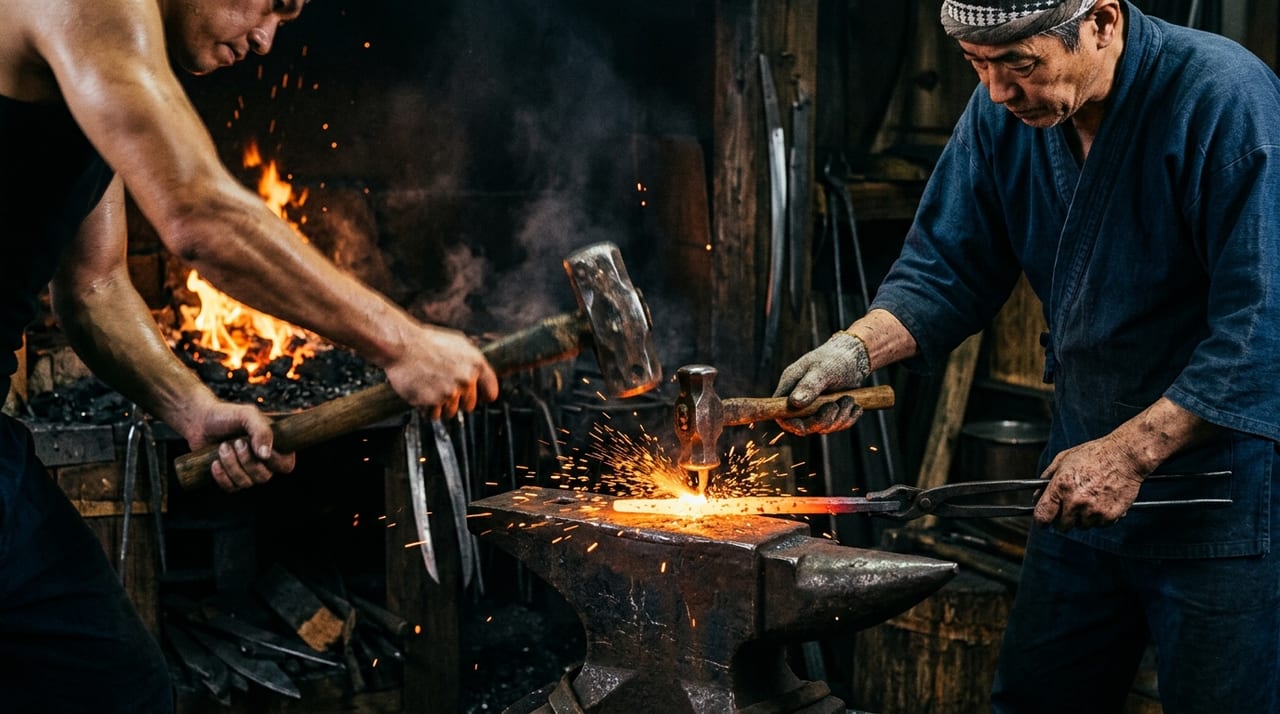 * Image is for illustrative purposes only.
Table of Contents
Basic Role of Hammers in Forging
In the tanzō (forging) process of Japanese swords, the hammer (tsuchi) is the most fundamental tool for striking and drawing out steel, introducing forging grain, and forming the shape of the blade. Unlike modern machining, the tōshō's forging is performed entirely by human-powered striking. Therefore, the selection of hammer and striking method are technical decisions that directly influence the quality of the jigane, the fineness of its grain, and the pattern of residual stress in the finished sword.
In a Japanese sword forging workshop, two types of hammers are generally used: the kozuchi, operated by the tōshō himself, and the ōzuchi, swung by the uchiko (apprentice or assistant). By striking in concert, it becomes possible to continue quickly and uniformly striking the high-temperature steel removed from the furnace (approximately 1,200°C or higher) before it cools.
Characteristics of the Kozuchi and the Tōshō's Role
The kozuchi is the hammer that the tōshō grips and operates directly; its weight is generally in the range of approximately 800 grams to 1.5 kilograms. The shape of the head varies according to each tōshō's style, but flat striking faces and those with a slight convex curve are common. The handle (e) is around 30 to 40 centimeters long and is designed to allow precise control through movement from the elbow down through the arm.
The main roles of the kozuchi can be divided into two categories.
- Shiji-uchi (directive striking): The tōshō lightly strikes a specific spot on the steel with the kozuchi to send the uchiko a signal meaning "strike here next." It functions, so to speak, as a conductor's baton.
- Shiage-uchi (finishing strikes): In the precision-striking process of fine-tuning the shape of the blade and introducing fine forging grain, this handles the delicate control that is impossible with the ōzuchi.
Characteristics of the Ōzuchi and the Uchiko's Role
The ōzuchi is a large hammer that the uchiko (apprentice) swings with both hands; its weight is approximately 2 to 4 kilograms, and in the case of large types it may exceed 5 kilograms. Its striking force is several times to more than ten times that of the kozuchi, and it is used in the ara-uchi (rough striking) and nobashi (drawing out) processes, which quickly draw out and flatten the steel to an even thickness throughout.
The differences between the kozuchi and the ōzuchi are summarized as follows.
| Item | Kozuchi | Ōzuchi |
|---|---|---|
| Operator | Tōshō | Uchiko (apprentice) |
| Weight | Approximately 800 grams to 1.5 kilograms | Approximately 2 to 4 kilograms (large types may exceed 5 kilograms) |
| Main roles | Shiji-uchi, shiage-uchi | Ara-uchi, nobashi |
The technical role of the uchiko is to swing the ōzuchi down at the correct timing and with the right degree of force in response to the tōshō's kozuchi signal. The uchiko repeatedly performs oi-uchi (follow-up striking) — bringing the ōzuchi down immediately after the tōshō's kozuchi strikes, hitting the same spot or an adjacent one. When this coordination breaks down, the steel deforms unevenly, or excessive striking concentrates on one spot and can cause internal cracks (kitae-ware).
When multiple uchiko are present, they swing the ōzuchi in alternation to deliver as many strikes as possible before cooling begins, making maximum use of the time before the steel must be returned to the furnace. This ōhitouchi (multi-person striking) is effective for large-scale initial tanren and the first cycle of orikaeshi tanren (folding).
The Influence of Hammer Material and Shape on Forging Grain
The head material of hammers is generally forged steel, but some tōshō vary the yaki-ire (quenching) hardness by purpose, or alter the shape of the striking face (flat, convex, convex-curved). A flat striking face delivers uniform compression, making it suitable for the early stages of orikaeshi tanren. On the other hand, a slightly convex striking face (sometimes called suginari) uses the way force escapes toward the edges of the steel, and is employed when introducing complex, fine forging grain.
The kitae-hada (twisting grain pattern) of the jigane arises from the combined action of the direction of striking and the shape of the hammer. Even with the same number of folds, the choice of hammer and striking method changes whether the hada aligns in the direction of itame, masame, or mokume. When a tōshō intends to "bring up the itame" or "align it in the masame direction," it is necessary to consciously control the direction of striking and the choice of hammer.
"Aizuchi wo Utsu" — Words Born from the Forge
The coordination between the tōshō and the uchiko has left its trace in the Japanese language. The expression aizuchi wo utsu, meaning to nod in agreement with another person's words, is said to derive from the rhythm in the forge where the apprentice hammers in response to the master's hammer. The ōzuchi swung by the uchiko is also called mukōzuchi (the facing hammer), and the sound of the well-attuned master and apprentice hammers ringing out alternately has long been a symbol of forge work. Tracing even the origin of the expression reveals how central the coordination of the two hammers was to forging.
The Hammer Selection of Modern Tōshō and the Individuality of Craftsmen
Among modern tōshō, some continue to use the hammers inherited from their masters, while others use hammers they themselves have forged. It is not unusual for a tōshō to prepare several to over a dozen custom-made hammers for individual processes, and the care of the hammers itself forms part of the craft.
The sense of weight of a hammer and the length of its handle are adjusted to match the craftsman's physique, arm length, and forging style. Even among tōshō of the same school, the selection of hammers often differs between master and apprentice, and this can be reflected in the finished sword as the "quirks of the jigane" particular to each individual tōkō. In other words, the hammer is also one of the tools that embodies the individuality of the tōshō.
A Focus Point for Admirers
The skill or lack thereof in hammer use appears indirectly on the surface of the finished blade. When the jigane is closely observed, one can see whether the kitae-hada is uniformly tight, or whether there are areas where the grain is disturbed and sparse. Well-packed jigane is the result of proper temperature control and the accumulation of uniform strikes. Conversely, tanren flaws such as kitae-ware and fukure (raised blisters) can sometimes be traces left by uneven striking or poor temperature management. When viewing a blade in enlarged images in exhibitions, catalogs, or online catalogs, if one turns one's eye not only to the hamon but also to the density of the jigane's packing, the scene of the forge with hammers swinging should come to mind. Observing the quality of the jigane and the direction of the forging grain when appreciating a sword is also to turn one's thoughts to the hammer the tōshō chose and how they used it.