Causes and Prevention of Kitaewari — The Mechanisms of Steel Cracking and Delamination During Tanren, and the Countermeasures Practiced by Tōshō
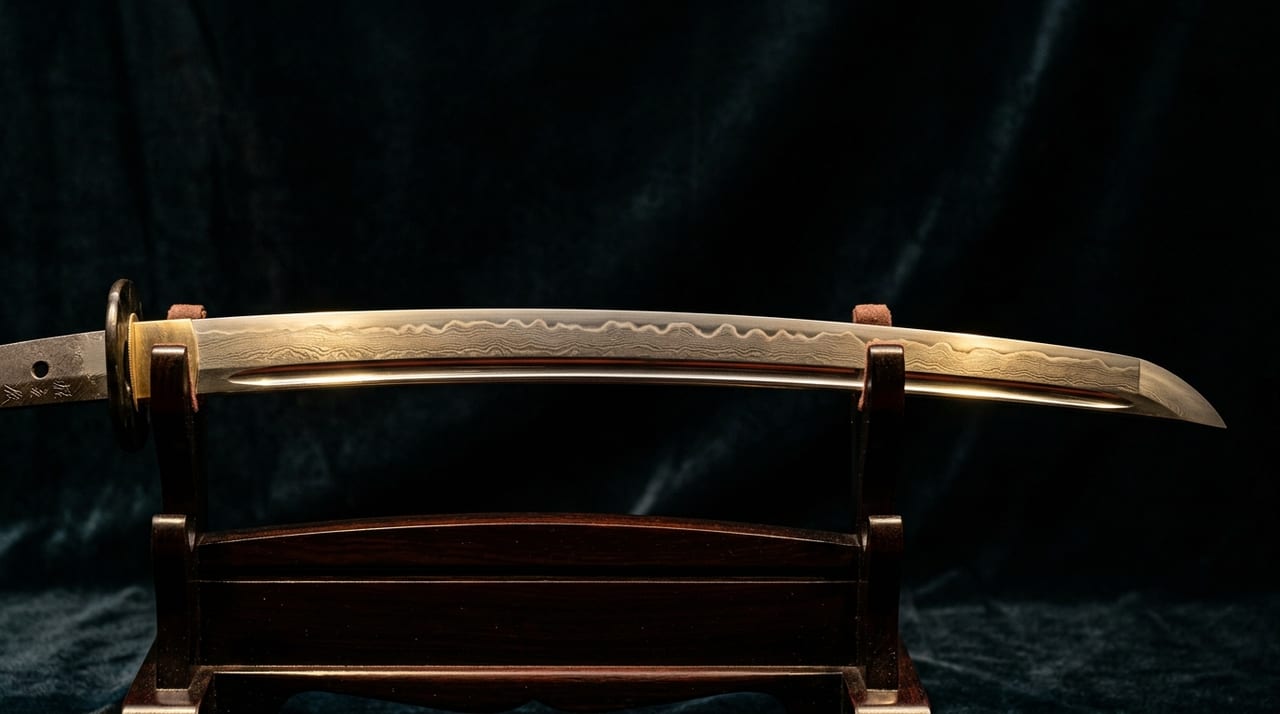 * Image is for illustrative purposes only.
Table of Contents
What Is Kitaewari — The Worst Defect Threatening the Blade
"Kitaewari" is the collective term for cracks, fissures, and delamination that occur inside or on the surface of a blade during the tanren (forging) process of Japanese swords. In English, it is expressed as "forge crack" or "delamination." Kitaewari is not merely a cosmetic defect; it can fundamentally compromise the structural integrity of the blade, and is therefore considered one of the most serious defects that a tōshō must guard against.
Kitaewari can be broadly classified into two types. The first is "surface cracking," which refers to fine cracks that appear on the surface of the blade during or after tanren. Minor cases may be removable through polishing, but deep ones may necessitate discarding the blade. The second is "internal delamination (interlayer cracking)," in which the layered steel built up through orikaeshi tanren (folding) separates between layers. This type is difficult to detect visually, but is the most dangerous defect, as it becomes apparent under use (bending stress, impact); it is often discovered by the togishi (polisher) during polishing work and is also one of the main issues pointed out as a defect in kanteisho (appraisal certificate) evaluations.
Chemical Causes — Uneven Carbon Distribution and Oxidation
The occurrence of kitaewari involves multiple intertwined chemical and physical factors. From a chemical perspective, when the distribution of carbon (C) in tamahagane is uneven, regions of high and low carbon content exist adjacent to each other locally. High-carbon steel has low toughness (tenacity) and high brittleness, making it prone to cracking under the repeated impacts of tanren.
The problem of oxidation is also important. When steel is exposed to air (oxygen) during tanren, iron oxide (scale) forms on the surface. If this scale is not properly removed, it is driven into the interior of the steel and remains as non-metallic inclusions. These inclusions act as stress concentration points from which cracks easily propagate. When the steel taken from the furnace is struck during tanren operations, "tekka" (iron sparks) scatter, and it is important to disperse the oxidation scale sufficiently at this point; tōkō employ an advanced technique of intentionally blowing off the scale with the first hammer strike.
Physical Causes — Failure in Temperature Management and Over-Forging
From a physical perspective, failure to manage tanren temperature is the main cause of cracking. If steel is forged at too high a temperature (overheating range: 1,300°C or above), "sugoyake" (overburning) occurs, causing the crystal grains to coarsen and grain boundaries to weaken. Steel that has been overburned has dramatically reduced toughness and cracks easily during folding or drawing out. Conversely, forging at too low a temperature results in "tsumetatataki" (cold hammering), in which steel with reduced plasticity cracks, causing "low-temperature cracking."
"Uchisugi" (over-forging) is also a cause of cracking. If orikaeshi tanren (folding) is repeated too many times (more than approximately 15–20 times as a guide), the carbon content decreases excessively and the internal microstructure of the steel may become overly refined, paradoxically increasing brittleness. The appropriate number of tanren cycles varies depending on the quality of the tamahagane and the intended use of the sword, but discerning this optimal number is included in the "kando of forging" (forging intuition) that tōkō independently accumulate, and is often carefully transmitted as kuden (oral instruction) to apprentices.
Differences from Similar Defects — Distinguishing Hagire and Fukure
Kitaewari is easily confused with other defects of similar appearance. "Hagire" (blade crack) is a crack that runs transversely across the hamon (temper line), and is generally considered to arise from impact or accidental causes during use after completion, differing in background from kitaewari, which originates in the tanren process itself. "Fukure" (blister) is a swelling or bubble-like defect that forms when air or foreign matter is trapped inside the steel and forge-welded (tansetsu) in during tanren; it is distinguished from kitaewari in that, as polishing progresses and the surface breaks open, the internal cavity is exposed. Since all of these are defects that significantly affect the evaluation of a blade, careful distinction is exercised in appraisal settings.
| Defect name | Main cause | Process most commonly detected |
|---|---|---|
| Kitaewari | Temperature management during tanren; uneven carbon distribution | During tanren through polishing |
| Hagire | Impact or accident during use after completion | Post-use inspection / polishing |
| Fukure | Air or foreign matter trapped during tansetsu (forge welding) | During polishing |
Practical Preventive Measures — From Material Selection to Process Management
Practical countermeasures for preventing kitaewari begin at the material selection stage. The appropriate carbon content for tamahagane is considered to be approximately 0.6–0.9% for kawagane (jacket steel) and 0.2–0.4% for shingane (core steel), and tōshō roughly gauge carbon content by striking the material and judging the sound, feel, and color of the fracture surface. Tamahagane with low homogeneity (uneven carbon distribution) carries a higher risk of kitaewari, so eliminating high-risk materials at the selection stage is the first preventive measure.
Regarding the processes of yaki-ire (quenching) and yaki-modoshi (tempering) as well, research as of 2026 has clarified that precision in temperature adjustment is extremely important for preventing cracks. Some modern tōshō combine scientific management using thermometers with the traditional "mekiki" (expert discernment), producing more reliable swords.
The key points for preventing kitaewari are as follows.
- Assess the carbon distribution of tamahagane in advance and avoid materials with low homogeneity
- Maintain temperature within the appropriate range during tanren, avoiding both overheating and overcooling
- Thoroughly remove oxidation scale with each striking session to prevent inclusions from mixing in
- Discern the appropriate number of orikaeshi tanren cycles according to the material and intended use, and avoid uchisugi (over-forging)
- Carefully inspect the blade after tanren and during polishing, detecting fine cracks early
What is important is that these are not independent processes; they function as a unified chain of management from material selection through tanren to yaki-ire. If a misjudgment is made at any one step, there is a risk that all the careful work up to that point will come to nothing, so tōshō must maintain a constant sense of tension throughout the entire process.
Points to Check When Purchasing or Appraising
When purchasing or appraising a sword, checking for the presence of kitaewari is indispensable. Expert togishi and appraisers hold the blade under light from various angles, carefully checking for irregularities in the jihada (grain pattern of the steel) and any linear shadows. In particular, the shinogi-ji and the areas near the edge are considered prone to cracking and are inspected with particular care. In appraisals by organizations such as NBTHK (Society for the Preservation of Japanese Art Swords), the structural soundness of the blade is also considered an important element of evaluation, and it is believed that confirmed structural defects may affect the appraisal outcome. Choosing a sword accompanied by a reliable kanteisho (appraisal certificate) is one effective means of avoiding such risks.
Furthermore, since there are defects such as internal delamination that are difficult to distinguish from outward appearance, it is advisable before purchase to have a specialist physically examine the piece and to carefully review the contents of any already-issued kanteisho.