Kirikane Goldwork and Sword Ornaments: How Buddhist Metalworking Techniques Influenced Sword Fitting Decoration
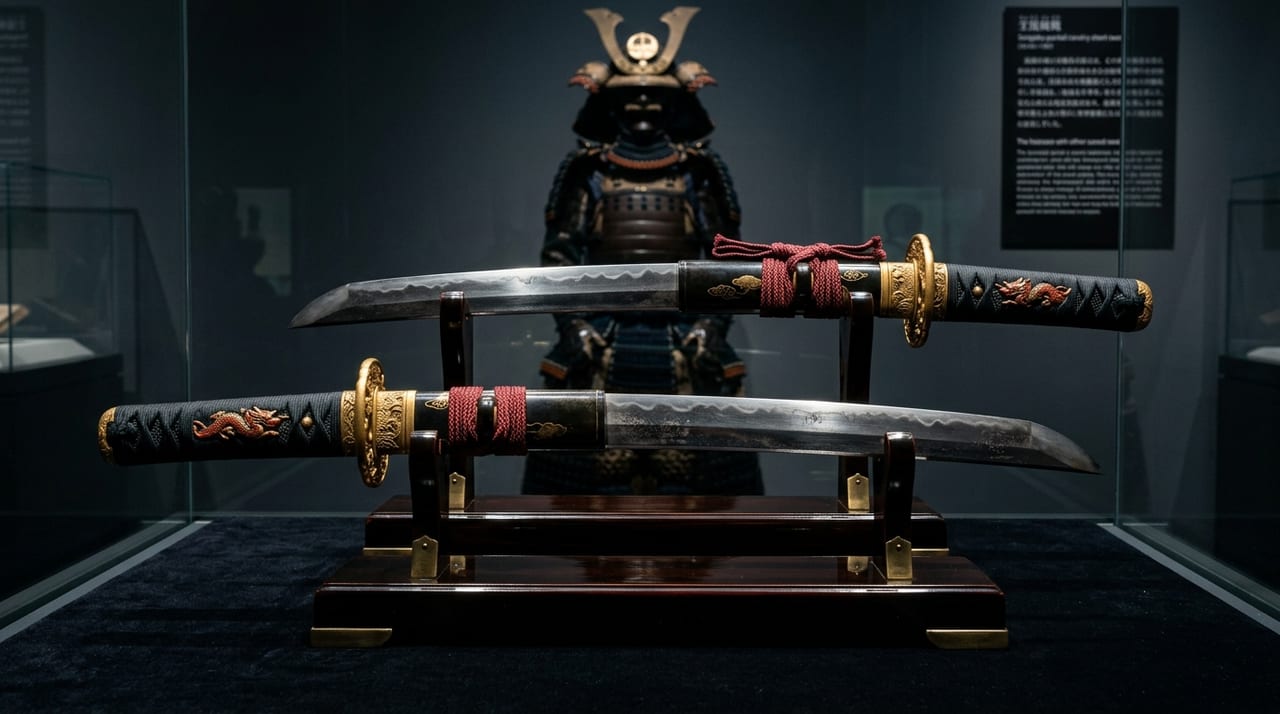 * Image is for illustrative purposes only.
Table of Contents
What is Kirikane — From Buddhist Art to Sword Fittings
Kirikane (截金) is a decorative technique in which extremely thin metal foil of gold, silver, platinum, and other materials are cut into fine pieces and affixed to the surface of a material as a pattern. Transmitted from China and India along with Buddhism during the Nara period, this technique was refined within the world of Buddhist art, including the halos of Buddhist statues, priest robes, and mother-of-pearl (raden) craftsmanship.
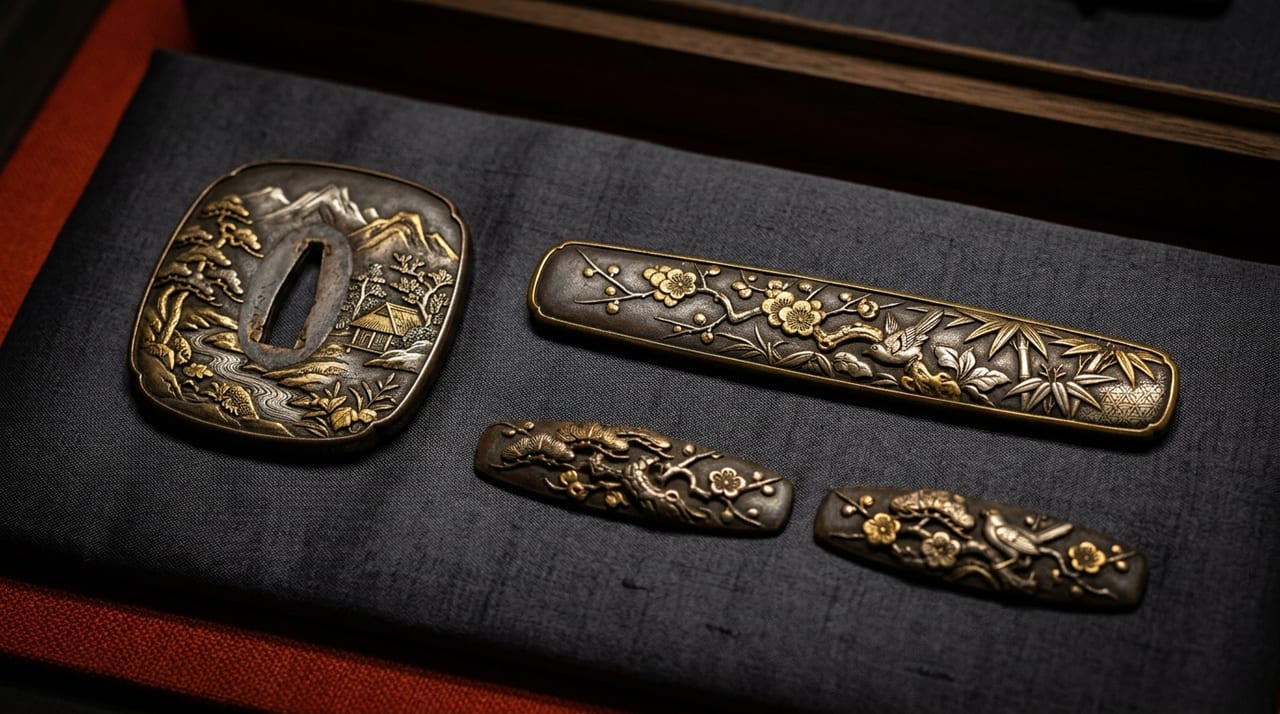
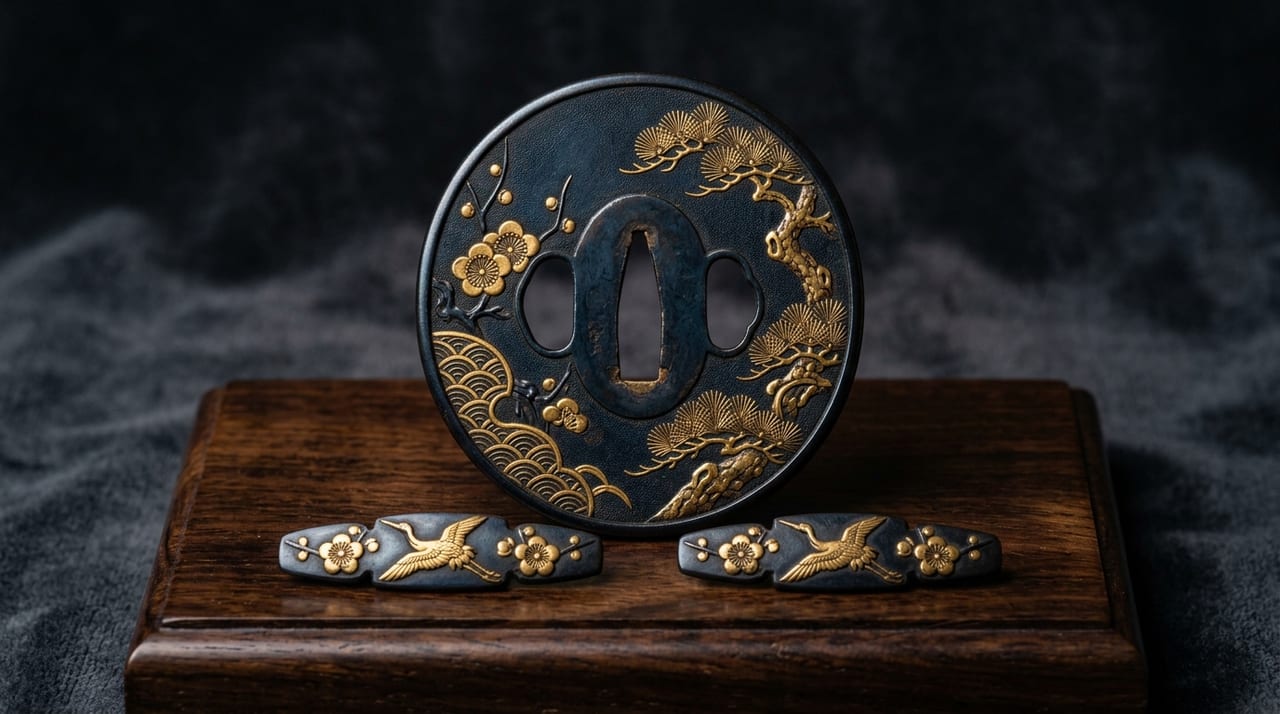
This technique was applied to the decoration of Japanese swords, particularly to sword fittings (tousougou)—including the tsuba, fuchigashira, menuki, kozuka, and kougai—primarily from the late Heian period through the Kamakura period. With the establishment of samurai society, swords transformed from practical items to ceremonial and artistic objects, and decorative techniques influenced by court nobility culture were incorporated into the world of sword fittings.
The Structure of Kirikane Technique — From Cutting Gold Foil to Affixing
The process of creating kirikane is a continuous series of precision work requiring precision and patience.
It begins with preparation of the gold foil. The metal foil used in kirikane is thinner than ordinary gold foil, and materials of high purity are selected. A technique also developed in which gold, silver, and platinum are combined to create color contrast in the pattern.
Next, the gold foil is cut out. Using thin bamboo spatulas or specialized blades, the foil is cut into various shapes including straight lines, curves, triangles, and diamonds. The precision of this cutting work determines the beauty of the finished piece.
Finally, affixing and securing are performed. The cut metal foil is adhered to the material surface using adhesive such as nikawa (animal glue), creating the pattern. Kirikane patterns range from geometric designs to those derived from nature, such as clouds, waves, and flowers and birds.
The Application of Kirikane in Sword Fittings — The Aesthetics of the Goto Family
The Goto family (Gotou-ke) is famous for actively incorporating kirikane techniques into sword fittings. The Goto family, founded by Goto Yuujou, served as official metalworkers (kinkoushi) for the shogun family from the mid-Muromachi period through the Edo period, establishing their distinctive "Goto style."
The works of the Goto family are characterized by delicate patterns featuring gold and silver kirikane and nunome zogan (cloth-pattern inlay) on a shakudou (red copper) ground. Auspicious motifs such as dragons, phoenixes, clouds, and pine-bamboo-plum were rendered in shining gold foil using kirikane on fuchigashira and menuki, embodying the highest level of aesthetic beauty in the ceremonial culture of samurai society.
Beyond the Goto family, metalworkers in Kyoto also applied kirikane techniques to sword fitting production. Since many craftsmen worked on both Buddhist implement production and sword fitting production, the kirikane technology of Buddhist art naturally flowed into the world of swords.
Kirikane and Other Metalworking Techniques — Differences from Inlay and Engraving
Sword fittings employ various metalworking techniques besides kirikane, including zogan (inlay), choukinu (engraving), and chuuzou (casting). While kirikane is a technique of "affixing" metal foil to a surface, zogan is a technique of carving grooves into a material's surface and fitting dissimilar metals into them.
Nunome zogan (cloth-pattern inlay) is a type of inlay in which a fine grid pattern resembling cloth is carved into the material surface, and gold or silver wire is press-fitted into it. In the works of the Goto family, kirikane and nunome zogan are used in combination, with the two techniques enhancing each other's effects.
Choukinu (engraving) is a technique of carving directly into the material surface, with diverse types including hair-line engraving, single-cut engraving, and full-round engraving. While kirikane is an "affixing" decoration, engraving is a "carving" decoration, and combining the two creates three-dimensional and intricate designs.
Comparison of Kirikane, Inlay, and Engraving Techniques — A Reference for Appreciation
The main points of the three metalworking techniques discussed thus far are organized below as a reference for appreciation and comparison.
| Technique | Method of Processing | Main Characteristics |
|---|---|---|
| Kirikane | Metal foil is cut out and affixed to the material surface | A form of "affixing" decoration. Patterns range from geometric to natural motifs |
| Nunome zogan | A grid-like groove is carved into the material surface, and gold or silver wire is press-fitted into it | A type of inlay. Often used in combination with kirikane |
| Choukinu | The material surface is directly carved (hair-line engraving, single-cut engraving, full-round engraving, etc.) | A form of "carving" decoration. Combined with kirikane and inlay to create three-dimensional designs |
Kirikane is a technique expressing pattern through "affixing," nunome zogan through "fitting," and choukinu through "carving"—different approaches, and as seen in the works of the Goto family, multiple techniques combined create the intricate designs unique to sword fittings.
Points to Note When Handling Sword Fittings with Kirikane Decoration — Preservation and Authentication Basics
Because kirikane is a decoration of thin metal foil secured with adhesive, it is prone to wear and loss over time compared to other metalworking techniques. When handling, avoid direct contact with bare hands and instead handle with a clean, dry cloth. When storing, choose a location with minimal humidity and temperature fluctuations, and placing items in a paulownia wood box can suppress deterioration of the metal foil. Direct sunlight and high humidity can affect the condition of the gold foil, so such locations should be avoided for everyday storage.
In determining the skill level of kirikane technique, the precision of the gold foil cutting lines and the uniformity of the affixed surface serve as one clue. Since kirikane is a technique built upon the accumulated handwork of skilled craftsmen, crude imitations may show wrinkles in the foil or adhesive overflow. When purchasing sword fittings, the presence of a certificate of authenticity issued by a specialized organization such as the NBTHK (Japanese Sword and Art Sword Preservation Society) becomes an important clue substantiating the quality of the technique and authenticity.
Kirikane Technology Passed Down to Modern Times — Cultural Asset Restoration and Contemporary Sword Fitting Production
The kirikane technique continues to be transmitted in modern times as an essential technology for the restoration and reconstruction of cultural assets. In Buddhist art restoration workshops in Nara and Kyoto, specialist craftsmen called kirikane-shi practice the cutting and affixing techniques of gold foil across generations.
In the world of sword fittings as well, contemporary artists incorporating kirikane techniques exist. At sword fitting exhibitions sponsored by the Agency for Cultural Affairs and the Japanese Sword and Art Sword Preservation Society, contemporary works using traditional kirikane techniques are exhibited, demonstrating the vitality of this technique that connects Buddhist art and samurai culture.
Kirikane is "the technique of depicting the world with tiny metal foil." The kirikane patterns applied to sword fittings both embody the status and aesthetic cultivation of the owner, and quietly speak to the continuity of Japanese art from Buddhist art to samurai culture. For those interested in sword fittings, please feel free to peruse and compare works online and contact us regarding any items of interest.